Izu Vaisman – författare
Visar alla böcker från författaren Izu Vaisman. Handla med fri frakt och snabb leverans.
11 produkter
First Course in Differential Geometry
Av Izu Vaisman
Häftad, 2019
1009 kr
Lägg i varukorg
This book proposes a new approach which is designed to serve as an introductory course in differential geometry for advanced undergraduate students. It is based on lectures given by the author at several universities, and discusses calculus, topology, and linear algebra.
First Course in Differential Geometry
Av Izu Vaisman
Inbunden, 1983
2126 kr
Lägg i varukorg
This book proposes a new approach which is designed to serve as an introductory course in differential geometry for advanced undergraduate students. It is based on lectures given by the author at several universities, and discusses calculus, topology, and linear algebra.
Foundations of Three-Dimensional Euclidean Geometry
Av Izu Vaisman
E-bok, 2020
4156 kr
Lägg i varukorg
This book presents to the reader a modern axiomatic construction of three-dimensional Euclidean geometry in a rigorous and accessible form. It is helpful for high school teachers who are interested in the modernization of the teaching of geometry.
Foundations of Three-Dimensional Euclidean Geometry
Av Izu Vaisman
E-bok, 2020
4156 kr
Lägg i varukorg
This book presents to the reader a modern axiomatic construction of three-dimensional Euclidean geometry in a rigorous and accessible form. It is helpful for high school teachers who are interested in the modernization of the teaching of geometry.
Symplectic Geometry and Secondary Characteristic Classes
Av Izu Vaisman
E-bok, 2013
1214 kr
Lägg i varukorg
The present work grew out of a study of the Maslov class (e. g. (37]), which is a fundamental invariant in asymptotic analysis of partial differential equations of quantum physics. One of the many in terpretations of this class was given by F. Kamber and Ph. Tondeur (43], and it indicates that the …
Symplectic Geometry and Secondary Characteristic Classes
Av Izu Vaisman
Häftad, 2013
932 kr
Lägg i varukorg
The present work grew out of a study of the Maslov class (e. g. (37]), which is a fundamental invariant in asymptotic analysis of partial differential equations of quantum physics. One of the many in terpretations of this class was given by F. Kamber and Ph. Tondeur (43], and it indicates that the …
Lectures on the Geometry of Poisson Manifolds
Av Izu Vaisman
Häftad, 2012
551 kr
Lägg i varukorg
Everybody having even the slightest interest in analytical mechanics remembers having met there the Poisson bracket of two functions of 2n variables (pi, qi) f g ~(8f8g 8 8 ) (0.1) {f,g} = L...~[ji - [ji~ ,;=1 p, q q p, and the fundamental role it plays in that field. In modern works, this bracket …
Lectures on the Geometry of Poisson Manifolds
Av Izu Vaisman
Inbunden, 1994
1204 kr
Lägg i varukorg
Everybody having even the slightest interest in analytical mechanics remembers having met there the Poisson bracket of two functions of 2n variables (pi, qi) f g ~(8f8g 8 8 ) (0.1) {f,g} = L...~[ji - [ji~ ,;=1 p, q q p, and the fundamental role it plays in that field. In modern works, this bracket …
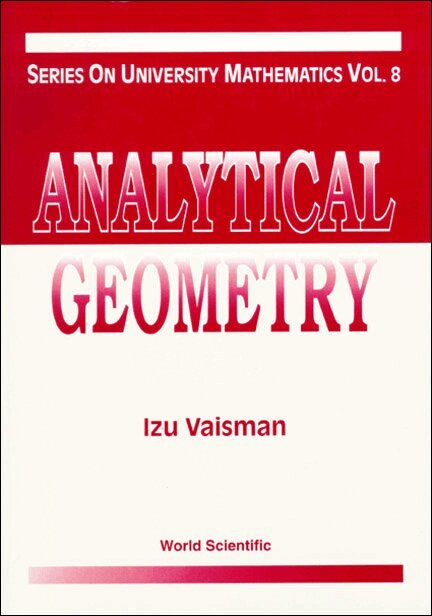
ANALYTICAL GEOMETRY
Av Izu Vaisman
Inbunden, 1997
1009 kr
Lägg i varukorg
This volume discusses the classical subjects of Euclidean, affine and projective geometry in two and three dimensions, including the classification of conics and quadrics, and geometric transformations. These subjects are important both for the mathematical grounding of the student and for …
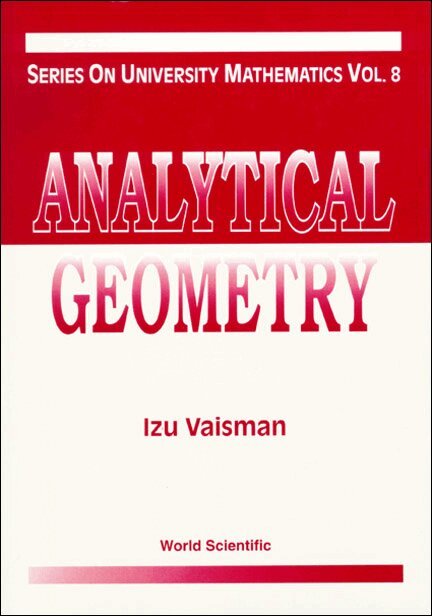
ANALYTICAL GEOMETRY
Av Izu Vaisman
Häftad, 1997
585 kr
Lägg i varukorg
This volume discusses the classical subjects of Euclidean, affine and projective geometry in two and three dimensions, including the classification of conics and quadrics, and geometric transformations. These subjects are important both for the mathematical grounding of the student and for …