J B Dent – författare
Visar alla böcker från författaren J B Dent. Handla med fri frakt och snabb leverans.
3 produkter
3 produkter
E-bok
PDF, Engelska, 2013756 kr
Läs direkt efter köp
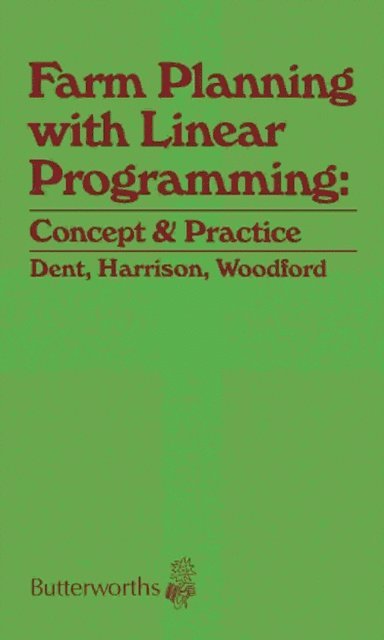
Farm Planning with Linear Programming: Concept and Practice focuses on concepts and methods in farm planning. The book first discusses the principles of farm planning, including elements of farm planning problems, summary, and review questions. The text highlights farm planning models. The nature of models; commonly used farm planning models; multiple constraint problems and program planning; problems in applying models; and comments are considered. The book also focuses on the linear programming network; opportunity cost and the simplex method; and analysis of the linear programming solution. The text also explains tableaux construction for short-run planning. Crop and pasture rotations; feed budgeting; buy, sell, and hire activities; and livestock reconciliation are discussed. The book also describes pastoral property applications. Breed comparison; economics of off-farm grazing and spatial diversification; and optimal calving date and lactation length on dairy farms are discussed. The text is a good source of information for agricultural researchers, farmers, and students wanting to study farm management.
E-bok
PDF, Engelska, 2012712 kr
Läs direkt efter köp
A fast-growing interest in the concepts and application of systems research has spawned a wide and general literature over the past decade. Most disciplinary areas have been touched, but commerce, engineering and military studies have, perhaps, been best served with outstanding texts. No provision has so far been made for a general book at introductory level of direct relevance to agricultural science, technology and management. General reviews are, of course, valuable to the agricultural-systems researcher but agricultural systems, with important biological components interacting with equally vital social and economic elements, embody particular characteristics which influence the approach to their study. This book is written in the belief that the concepts as well as the technology of the systems approach have a basic role in the rational advancement of the agricultural discipline and in the improvement of efficiency in agricultural research and practice. A basic and introductory text is an essential pre requisite to this role being realised. A reiteration of basic concepts is expressed in the introductory chapter while in the final chapter particular attention is given to the general problems of integrating systems concepts in research, extension and practice. The dialogue of these chapters is necessarily brief and in some respects speculative but it is supported by appropriate bibliography. The main body of the text is concerned with the methodology of systems research; the conception, construction, implementation, validation and exploitation of computer-based simulation models of agricultural systems.
Häftad, Engelska, 2012
550 kr
Skickas inom 10-15 vardagar
A fast-growing interest in the concepts and application of systems research has spawned a wide and general literature over the past decade. Most disciplinary areas have been touched, but commerce, engineering and military studies have, perhaps, been best served with outstanding texts. No provision has so far been made for a general book at introductory level of direct relevance to agricultural science, technology and management. General reviews are, of course, valuable to the agricultural-systems researcher but agricultural systems, with important biological components interacting with equally vital social and economic elements, embody particular characteristics which influence the approach to their study. This book is written in the belief that the concepts as well as the technology of the systems approach have a basic role in the rational advancement of the agricultural discipline and in the improvement of efficiency in agricultural research and practice. A basic and introductory text is an essential pre requisite to this role being realised. A reiteration of basic concepts is expressed in the introductory chapter while in the final chapter particular attention is given to the general problems of integrating systems concepts in research, extension and practice. The dialogue of these chapters is necessarily brief and in some respects speculative but it is supported by appropriate bibliography. The main body of the text is concerned with the methodology of systems research; the conception, construction, implementation, validation and exploitation of computer-based simulation models of agricultural systems.