J. Encarnacao - Böcker
Visar alla böcker från författaren J. Encarnacao. Handla med fri frakt och snabb leverans.
4 produkter
4 produkter
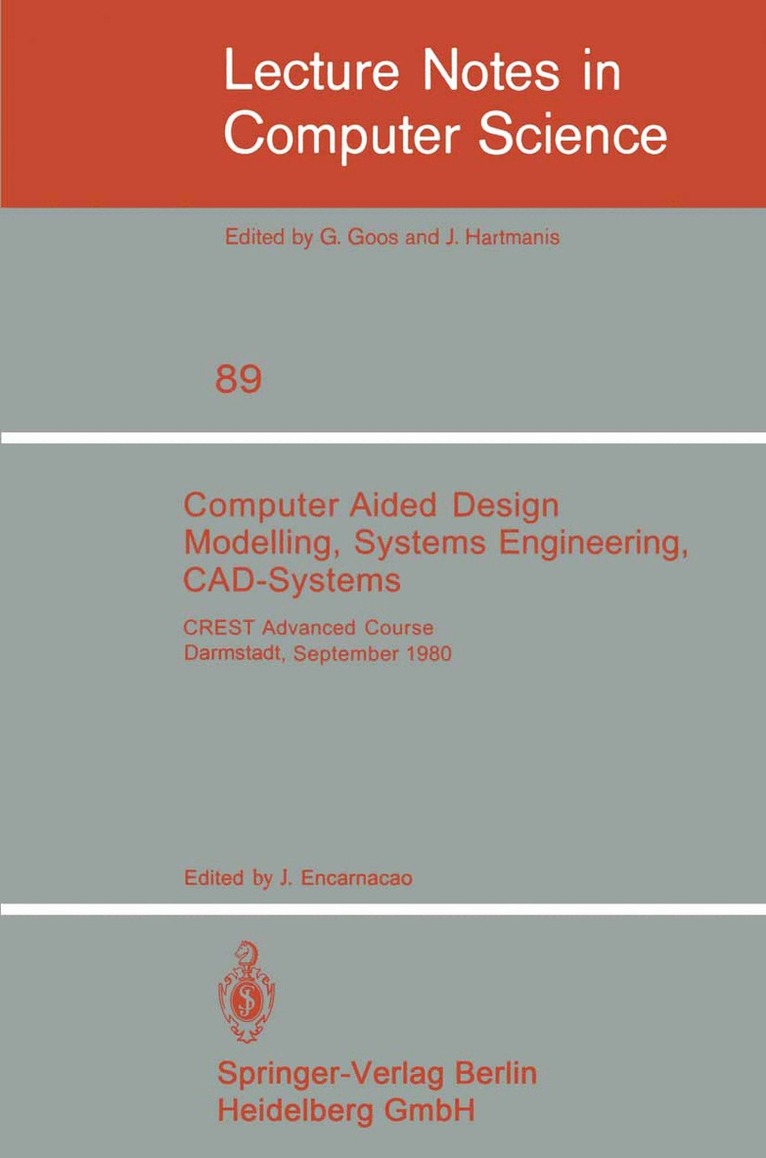
Computer Aided Design Modelling, Systems Engineering, CAD-Systems
CREST Advanced Course, Darmstadt, 8. - 19. September 1980
Häftad, Engelska, 1980
391 kr
Skickas inom 10-15 vardagar
571 kr
Skickas inom 10-15 vardagar
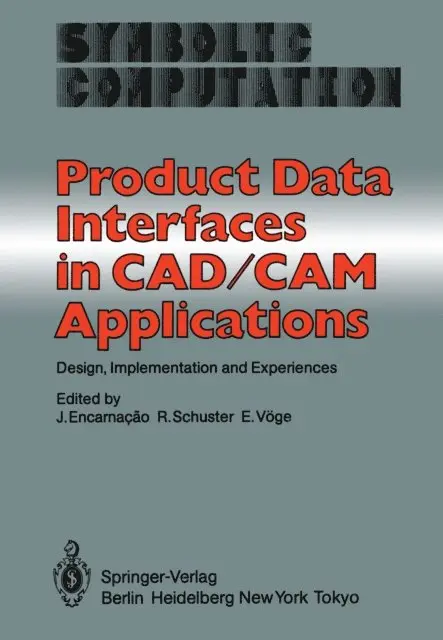
Product Data Interfaces in CAD/CAM Applications
Design, Implementation and Experiences
Häftad, Engelska, 2011
1 105 kr
Skickas inom 10-15 vardagar
Interest in product data exchange and interfaces in the CAD/CAM area is steadi ly growing. The rapidly increasing graphics applications in engineering and sci ence has led to a great variety of heterogeneous hardware and software products. This has become a major obstacle in the progress of systems integration. To improve this situation CAD/CAM users have called for specification and imple mentation of standardized product data interfaces. These needs resulted in the definition of preliminary standards in this area. Since 1975 activities have been concentrated on developing standards for three major areas: - computer graphics, - sculptured surfaces, and - data exchange for engineering drawings. The Graphical Kernel System (GKS) has been accepted as an international standard for graphics programming in 1984, Y14.26M (IGES) was adopted as an American Standard in 1981 and the VDA Surface Interface (VDAFS) has been accepted by the German National Standardization Institute (DIN NAM 96.4). Although considerable progress has been achieved, the complexity of the subject and the dynamics of the CAD/CAM-development still calls for more generality and compatibility of the interfaces. This has resulted in an inter national discussion on further improvements of the standards. The major goal of this book is to bring together the different views and experiences in industry and university in the area of Product Data Interfaces, thereby contributing to the ongoing work in improving the state of the art.
1 105 kr
Skickas inom 10-15 vardagar
4 lation and optimization. These are essential constituents of the iterative process, leading to a feasible and, one hopes, optimal design. 1.3 Content of the Book In Chapter 2 we present briefly the history of CAD. The main components of CAD systems are identified, and their principal functions described. Economi cal and interdisciplinary aspects are discussed. Chapter 3 starts with a systems analysis of the design process. The notion of a process is introduced as a fundamental tool to describe activities like design as a whole, computer-aided design, program executions, terminal sessions etc. The environment and the resources which the environment must supply for the successful execution of any process are discussed. The problem of modelling the design objects in an abstract schema and the interrelation between the schema and the planning of the individual step in the design are analysed. Chapter 4 concentrates on the interfaces among the components of a CAD system, including the human operator. The problem of mapping an abstract schema onto the capabilities of various programming, command, or data de scription languages is described in detail. Emphasis is laid upon the resource aspect and its influence on the design of CAD systems. The concept of a CAD software machine is introduced, and rules for designing such machines are given.