J. Ezquerro – författare
Visar alla böcker från författaren J. Ezquerro. Handla med fri frakt och snabb leverans.
6 produkter
6 produkter
Inbunden, Engelska, 1991
1 616 kr
Skickas inom 10-15 vardagar
Cognition, Semantics and Philosophy brings together theorists from philosophy, linguistics, psychology and artificial intelligence, in order to develop foundations, to present methodological issues and to point the ways to future theoretical research in cognitive science. The interdisciplinary approach of the book is apparent and it seeks to integrate the theoretical paradigms already constructed in the particular fields mentioned above. Its title indicates the central place of semantics as a bridge between cognition and philosophy. The introduction presents the basic content of the papers and points out some of the links between them.
Del 69 - Philosophical Studies Series
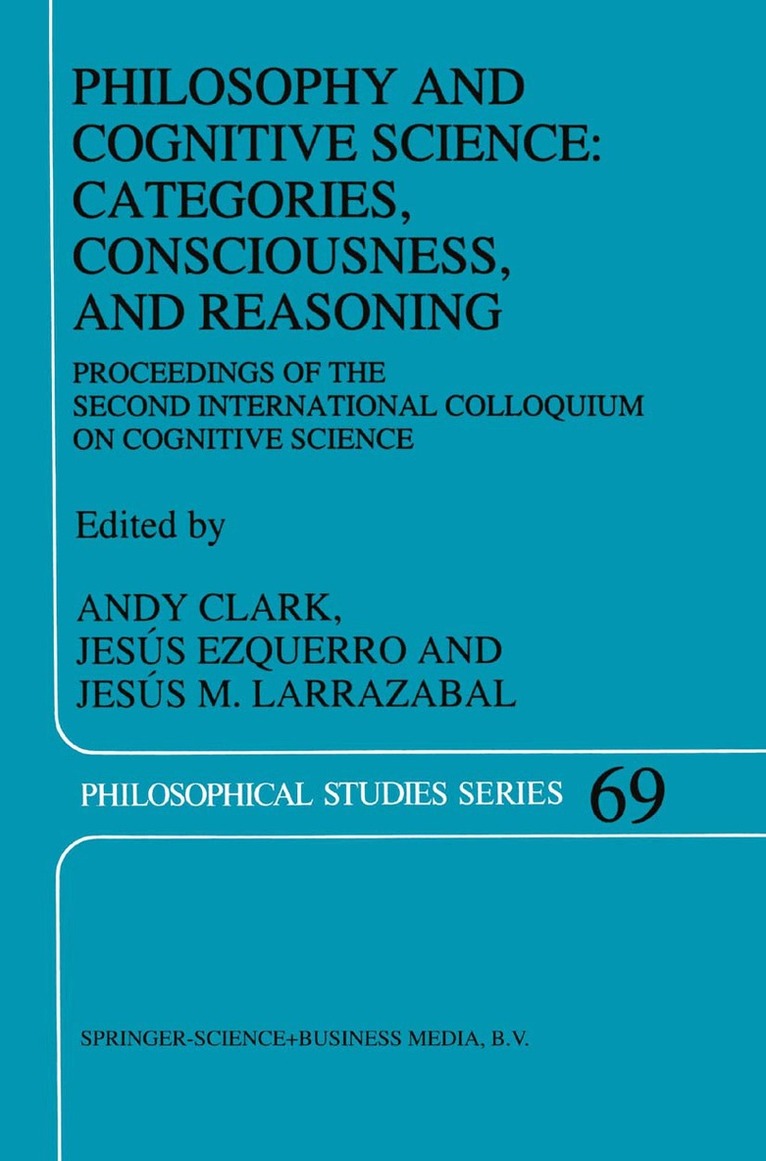
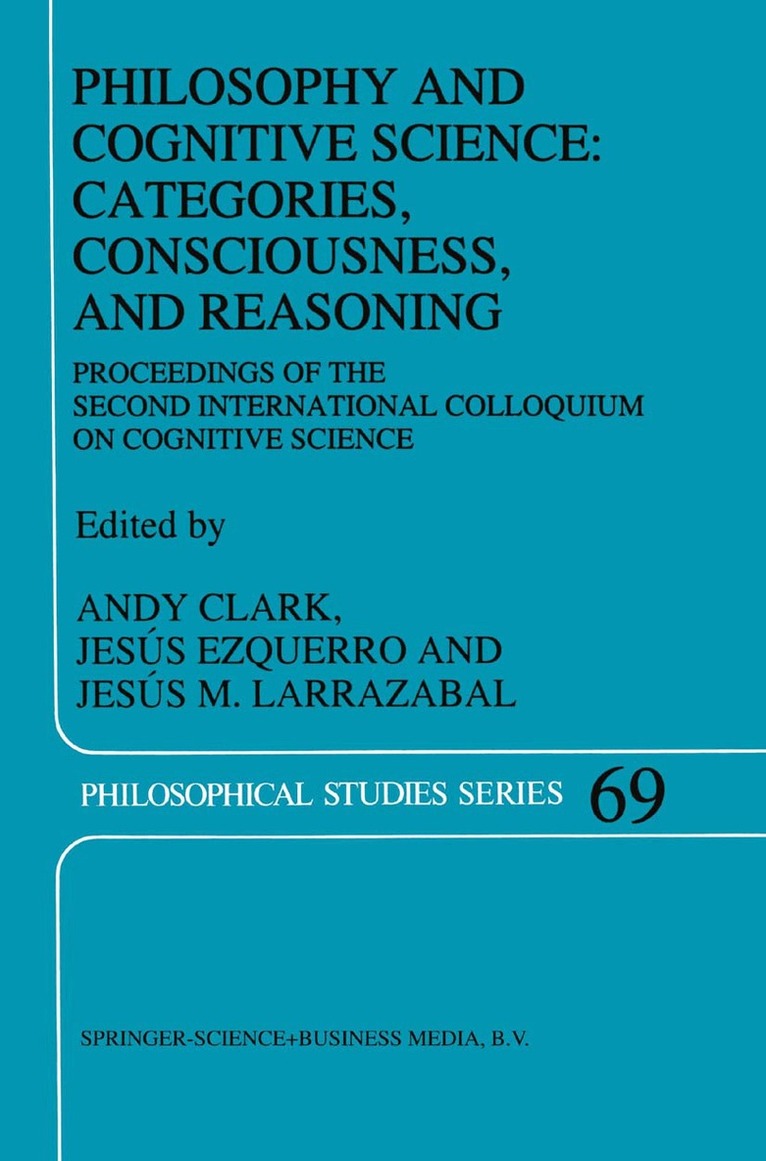
Philosophy and Cognitive Science: Categories, Consciousness, and Reasoning
Proceeding of the Second International Colloquium on Cognitive Science
Inbunden, Engelska, 1996
1 616 kr
Skickas inom 10-15 vardagar
PHILOSOPHY AND COGNITIVE SCIENCE: CATEGORIES, CONSCIOUSNESS, AND REASONING The individual man, since his separate existence is manifested only by ignorance and error, so far as he is anything apart from his fellows, and from what he and they are to be, is only a negation. Peirce, Some Consequences of Four Incapacities. 1868. For the second time the International Colloquium on Cognitive Science gathered at San Sebastian from May, 7-11, 1991 to discuss the following main topics: Knowledge of Categories Consciousness Reasoning and Interpretation Evolution, Biology, and Mind It is not an easy task to introduce in a few words the content of this volume. We have collected eleven invited papers presented at the Colloquium, which means the substantial part of it. Unfortunately, it has not been possible to include all the invited lectures of the meeting. Before sketching and showing the relevance of each paper, let us explain the reasons for having adopted the decision to organize each two years an international colloquium on Cognitive Science at Donostia (San Sebastian). First of all, Cognitive Science is a very active research area in the world, linking multidisciplinary efforts coming mostly from psychology, artificial intelligence, theoretical linguistics and neurobiology, and using more and more formal tools. We think that this new discipline lacks solid foundations, and in this sense philosophy, particularly knowledge theory, and logic must be called for.
Del 69 - Philosophical Studies Series
Philosophy and Cognitive Science: Categories, Consciousness, and Reasoning
Proceeding of the Second International Colloquium on Cognitive Science
Häftad, Engelska, 2010
1 616 kr
Skickas inom 10-15 vardagar
PHILOSOPHY AND COGNITIVE SCIENCE: CATEGORIES, CONSCIOUSNESS, AND REASONING The individual man, since his separate existence is manifested only by ignorance and error, so far as he is anything apart from his fellows, and from what he and they are to be, is only a negation. Peirce, Some Consequences of Four Incapacities. 1868. For the second time the International Colloquium on Cognitive Science gathered at San Sebastian from May, 7-11, 1991 to discuss the following main topics: Knowledge of Categories Consciousness Reasoning and Interpretation Evolution, Biology, and Mind It is not an easy task to introduce in a few words the content of this volume. We have collected eleven invited papers presented at the Colloquium, which means the substantial part of it. Unfortunately, it has not been possible to include all the invited lectures of the meeting. Before sketching and showing the relevance of each paper, let us explain the reasons for having adopted the decision to organize each two years an international colloquium on Cognitive Science at Donostia (San Sebastian). First of all, Cognitive Science is a very active research area in the world, linking multidisciplinary efforts coming mostly from psychology, artificial intelligence, theoretical linguistics and neurobiology, and using more and more formal tools. We think that this new discipline lacks solid foundations, and in this sense philosophy, particularly knowledge theory, and logic must be called for.
Del 52 - Philosophical Studies Series
Cognition, Semantics and Philosophy
Proceedings of the First International Colloqium on Cognitive Science
Häftad, Engelska, 2012
1 616 kr
Skickas inom 10-15 vardagar
THE PLACE OF PHILOSOPHY IN COGNITIVE SCIENCE During the last few years, many books have been published and many meetings have been held on Cognitive Science. A cursory review of their contents shows such a diversity of topics and approaches that one might well infer that there are no genuine criteria for classifying a paper or a lecture as a contribution to Cognitive Science. It is as though the only criterion is to have appeared in a book or in the programme of a meeting or title we can find the expression " . . . Cognitive Science" in whose name or something like that. Perhaps this situation is due to the (relative) youth of the field, which is seeking its own identity, still involved in a process of formation and consolidation within the scientific community; but there are actually deep disagreements about how a science of the mind should be worked out, including how to understand its own subject, that is, "the mind. "While for some the term makes reference to a set of phenomena impossible to grasp by any scientific approach, for others "the mind" would be a sort of myth, and the mental terms await elimination by other more handy and empirically tractable terms.
E-bok
PDF, Engelska, 20122 049 kr
Läs direkt efter köp
THE PLACE OF PHILOSOPHY IN COGNITIVE SCIENCE During the last few years, many books have been published and many meetings have been held on Cognitive Science. A cursory review of their contents shows such a diversity of topics and approaches that one might well infer that there are no genuine criteria for classifying a paper or a lecture as a contribution to Cognitive Science. It is as though the only criterion is to have appeared in a book or in the programme of a meeting or title we can find the expression " . . . Cognitive Science" in whose name or something like that. Perhaps this situation is due to the (relative) youth of the field, which is seeking its own identity, still involved in a process of formation and consolidation within the scientific community; but there are actually deep disagreements about how a science of the mind should be worked out, including how to understand its own subject, that is, "the mind. "While for some the term makes reference to a set of phenomena impossible to grasp by any scientific approach, for others "the mind" would be a sort of myth, and the mental terms await elimination by other more handy and empirically tractable terms.
E-bok
PDF, Engelska, 20131 995 kr
Läs direkt efter köp
PHILOSOPHY AND COGNITIVE SCIENCE: CATEGORIES, CONSCIOUSNESS, AND REASONING The individual man, since his separate existence is manifested only by ignorance and error, so far as he is anything apart from his fellows, and from what he and they are to be, is only a negation. Peirce, Some Consequences of Four Incapacities. 1868. For the second time the International Colloquium on Cognitive Science gathered at San Sebastian from May, 7-11, 1991 to discuss the following main topics: Knowledge of Categories Consciousness Reasoning and Interpretation Evolution, Biology, and Mind It is not an easy task to introduce in a few words the content of this volume. We have collected eleven invited papers presented at the Colloquium, which means the substantial part of it. Unfortunately, it has not been possible to include all the invited lectures of the meeting. Before sketching and showing the relevance of each paper, let us explain the reasons for having adopted the decision to organize each two years an international colloquium on Cognitive Science at Donostia (San Sebastian). First of all, Cognitive Science is a very active research area in the world, linking multidisciplinary efforts coming mostly from psychology, artificial intelligence, theoretical linguistics and neurobiology, and using more and more formal tools. We think that this new discipline lacks solid foundations, and in this sense philosophy, particularly knowledge theory, and logic must be called for.