J. Lorenz – författare
Visar alla böcker från författaren J. Lorenz. Handla med fri frakt och snabb leverans.
3 produkter
3 produkter
Inbunden, Engelska, 1999
866 kr
Skickas inom 10-15 vardagar
The articles collected in this volume represent the contributions presented at the IMA workshop on "Dynamics of Algorithms" which took place in November 1997. The workshop was an integral part of the 1997 -98 IMA program on "Emerging Applications of Dynamical Systems." The interaction between algorithms and dynamical systems is mutually beneficial since dynamical methods can be used to study algorithms that are applied repeatedly. Convergence, asymptotic rates are indeed dynamical properties. On the other hand, the study of dynamical systems benefits enormously from having efficient algorithms to compute dynamical objects.
E-bok
PDF, Engelska, 2012687 kr
Läs direkt efter köp
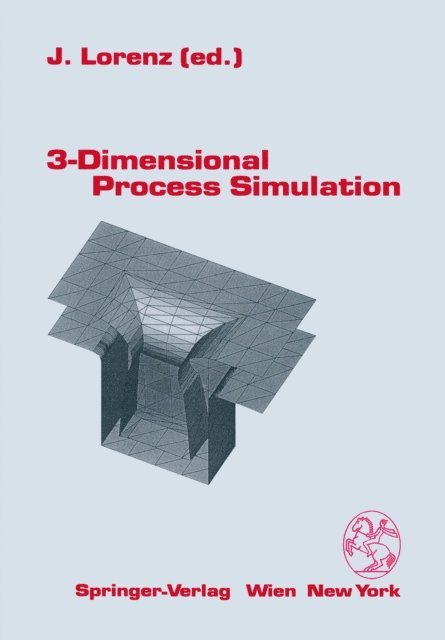
Whereas two-dimensional semiconductor process simulation has achieved a certain degree of maturity, three-dimensional process simulation is a newly emerging field in which most efforts are dedicated to necessary basic developments. Research in this area is promoted by the growing demand to obtain reliable information on device geometries and dopant distributions needed for three-dimensional device simulation, and challenged by the great algorithmic problems caused by moving interfaces and by the requirement to limit computation times and memory requirements. A workshop (Erlangen, September 5, 1995) provided a forum to discuss the industrial needs, technical problems, and solutions being developed in the field of three-dimensional semiconductor process simulation. Invited presentations from leading semiconductor companies and research Centers of Excellence from Japan, the USA, and Europe outlined novel numerical algorithms, physical models, and applications in this rapidly emerging field.
Häftad, Engelska, 2011
544 kr
Skickas inom 10-15 vardagar
Whereas two-dimensional semiconductor process simulation has achieved a certain degree of maturity, three-dimensional process simulation is a newly emerging field in which most efforts are dedicated to necessary basic developments. Research in this area is promoted by the growing demand to obtain reliable information on device geometries and dopant distributions needed for three-dimensional device simulation, and challenged by the great algorithmic problems caused by moving interfaces and by the requirement to limit computation times and memory requirements. A workshop (Erlangen, September 5, 1995) provided a forum to discuss the industrial needs, technical problems, and solutions being developed in the field of three-dimensional semiconductor process simulation. Invited presentations from leading semiconductor companies and research Centers of Excellence from Japan, the USA, and Europe outlined novel numerical algorithms, physical models, and applications in this rapidly emerging field.