J. Urbanowicz – författare
Visar alla böcker från författaren J. Urbanowicz. Handla med fri frakt och snabb leverans.
3 produkter
3 produkter
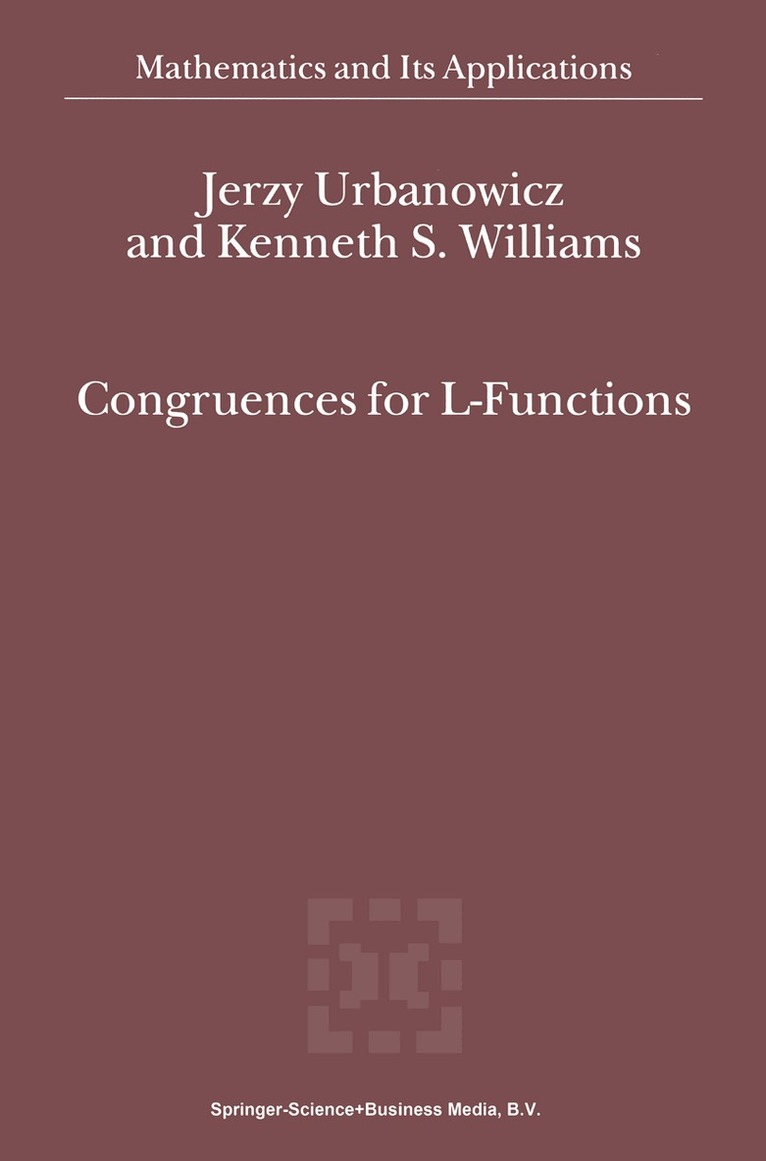
Inbunden, Engelska, 2000
547 kr
Skickas inom 10-15 vardagar
In [Hardy and Williams, 1986] the authors exploited a very simple idea to obtain a linear congruence involving class numbers of imaginary quadratic fields modulo a certain power of 2. Their congruence provided a unified setting for many congruences proved previously by other authors using various means. The Hardy-Williams idea was as follows. Let d be the discriminant of a quadratic field. Suppose that d is odd and let d = PIP2· . . Pn be its unique decomposition into prime discriminants. Then, for any positive integer k coprime with d, the congruence holds trivially as each Legendre-Jacobi-Kronecker symbol (~) has the value + 1 or -1. Expanding this product gives ~ eld e:=l (mod4) where e runs through the positive and negative divisors of d and v (e) denotes the number of distinct prime factors of e. Summing this congruence for o < k
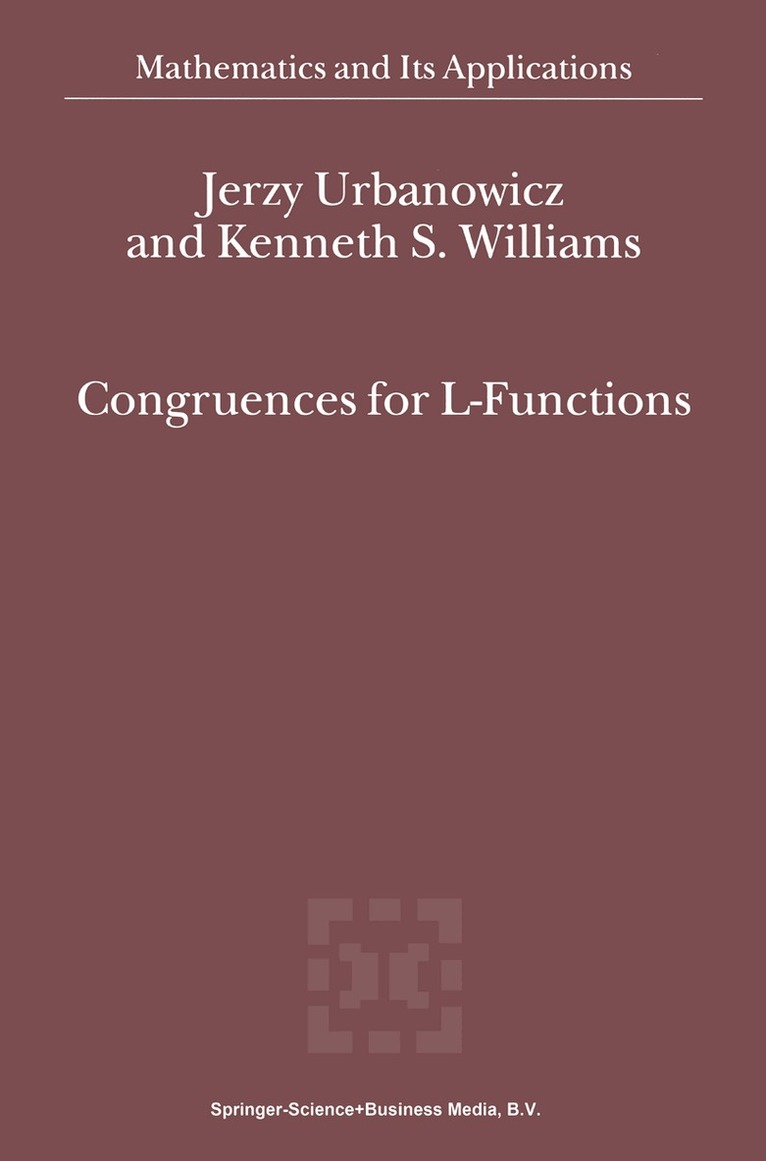
Häftad, Engelska, 2010
549 kr
Skickas inom 10-15 vardagar
In [Hardy and Williams, 1986] the authors exploited a very simple idea to obtain a linear congruence involving class numbers of imaginary quadratic fields modulo a certain power of 2. Their congruence provided a unified setting for many congruences proved previously by other authors using various means. The Hardy-Williams idea was as follows. Let d be the discriminant of a quadratic field. Suppose that d is odd and let d = PIP2· . . Pn be its unique decomposition into prime discriminants. Then, for any positive integer k coprime with d, the congruence holds trivially as each Legendre-Jacobi-Kronecker symbol (~) has the value + 1 or -1. Expanding this product gives ~ eld e:=l (mod4) where e runs through the positive and negative divisors of d and v (e) denotes the number of distinct prime factors of e. Summing this congruence for o < k
E-bok
PDF, Engelska, 2013687 kr
Läs direkt efter köp
In [Hardy and Williams, 1986] the authors exploited a very simple idea to obtain a linear congruence involving class numbers of imaginary quadratic fields modulo a certain power of 2. Their congruence provided a unified setting for many congruences proved previously by other authors using various means. The Hardy-Williams idea was as follows. Let d be the discriminant of a quadratic field. Suppose that d is odd and let d = PIP2· . . Pn be its unique decomposition into prime discriminants. Then, for any positive integer k coprime with d, the congruence holds trivially as each Legendre-Jacobi-Kronecker symbol (~) has the value + 1 or -1. Expanding this product gives ~ eld e:=l (mod4) where e runs through the positive and negative divisors of d and v (e) denotes the number of distinct prime factors of e. Summing this congruence for o < k