Jackson Nickerson - Böcker
Visar alla böcker från författaren Jackson Nickerson. Handla med fri frakt och snabb leverans.
4 produkter
4 produkter
Leading Change in a Web 2.1 World
How ChangeCasting Builds Trust, Creates Understanding, and Accelerates Organizational Change
Häftad, Engelska, 2013
282 kr
Skickas inom 10-15 vardagar
Recent advances in Web 2.0 technology enable new leadership processes and guidelines that can create great value for organizations. In this important new bookthe first title in the new Brookings series on Innovations in Leadershipmanagement expert Jackson Nickerson proposes a combination of processes and guidelines utilizing Web 2.0 technology, which he refers to as Web 2.1, that will not only lead and direct change in an organization but actually accelerate it. He calls this set of processes and guidelines ""ChangeCasting,"" and it should be an important part of any organization's leadership toolkit.Leading Change in a Web 2.1 World provides fresh insights into why people and organizations are so difficult to engage in change. It explains how web-based video communications, when used in accordance with ChangeCasting principles, can be a keyway to building trust and creating understanding in an organization, thereby unlocking and accelerating organizational change.Nickerson introduces us to two Fortune 1000 firms facing dire economic and competitive circumstances. Both CEOs attempted extensive organizational change using web-based video communications, but one used ChangeCasting while the other did notNickerson details how ChangeCasting produced positive financial results for the former. He also discusses how ChangeCasting principles were used so successfully by the Barack Obama presidential campaign in 2008.The insights presented here will be invaluable to business executives, public officials, students of management and organizations, and anyone who needs to take organizational change from the drawing board to successful implementation and replication.
Tackling Wicked Government Problems
A Practical Guide for Developing Enterprise Leaders
Häftad, Engelska, 2014
354 kr
Skickas inom 10-15 vardagar
How can government leaders build, sustain, and leverage the cross-organizational collaborative networks needed to tackle the complex interagency and intergovernmental challenges they increasingly face? Tackling Wicked Government Problems: A Practical Guide for Developing Enterprise Leaders draws on the experiences of high-level government leaders to describe and comprehensively articulate the complicated, ill-structured difficulties they faceoften referred to as ""wicked problems""in leading across organizational boundaries and offers the best strategies for addressing them.Tackling Wicked Government Problems explores how enterprise leaders use networks of trusted, collaborative relationships to respond and lead solutions to problems that span agencies. It also offers several approaches for translating social network theory into practical approaches for these leaders to build and leverage boundary-spanning collaborative networks and achieve real mission results.Finally, past and present government executives offer strategies for systematically developing enterprise leaders. Taken together, these essays provide a way forward for a new cadre of officials better equipped to tackle government's twenty-first-century wicked challenges.
Leading Change from the Middle
A Practical Guide to Building Extraordinary Capabilities
Häftad, Engelska, 2014
434 kr
Skickas inom 10-15 vardagar
Bookshelves abound with theoretical analyses, how-to guides, and personal success stories by famous corporate leaders, public officials, even athletic coaches, expounding on how to lead from the top. But what about those in the middle who are increasingly tasked with trying to reshape, reorient, or recreate the capabilities of an organization?Leading Change from the Middle takes you on the journeys traveled by Kurt Mayer, an information technology executive in the Department of Defense trying to build a new IT system in record time with limited resources, and Stephen Wang, a mid-level leader in city government trying to build a capability for supporting commercial agriculture. Kurt and Stephen have to navigate complex organizational and stakeholder landscapes in which they often have few decision rights and few resourcesa common scenario for mid-level leaders. One succeeds; one does not.While following Kurt and Stephen, the book introduces a new approach for increasing the likelihood of successfully leading change. This new approach breaks down into three core strategies: First, identify all relevant stakeholders and partition them into four categories: superordinates, subordinates, customers, and complementors/blockers (those who control needed resources but over whom the leaders have no authority).Second, for each stakeholder category, identify Communications, Strategies, and Tactics (referred to as CoSTS).Third, don't stimulate negative emotions that make people DEAFDisrespect, Envy, Anger, and Fearto efforts to produce change. As the book follows the journeys of Kurt and Stephen, it walks through the details of each strategy.In presenting this material in a concise, accessible, and applicable format that translates theory to practice, Nickerson provides an important service for leaders trying to build extraordinary capabilities for their organizationsfrom the middle.
1 388 kr
Skickas inom 7-10 vardagar
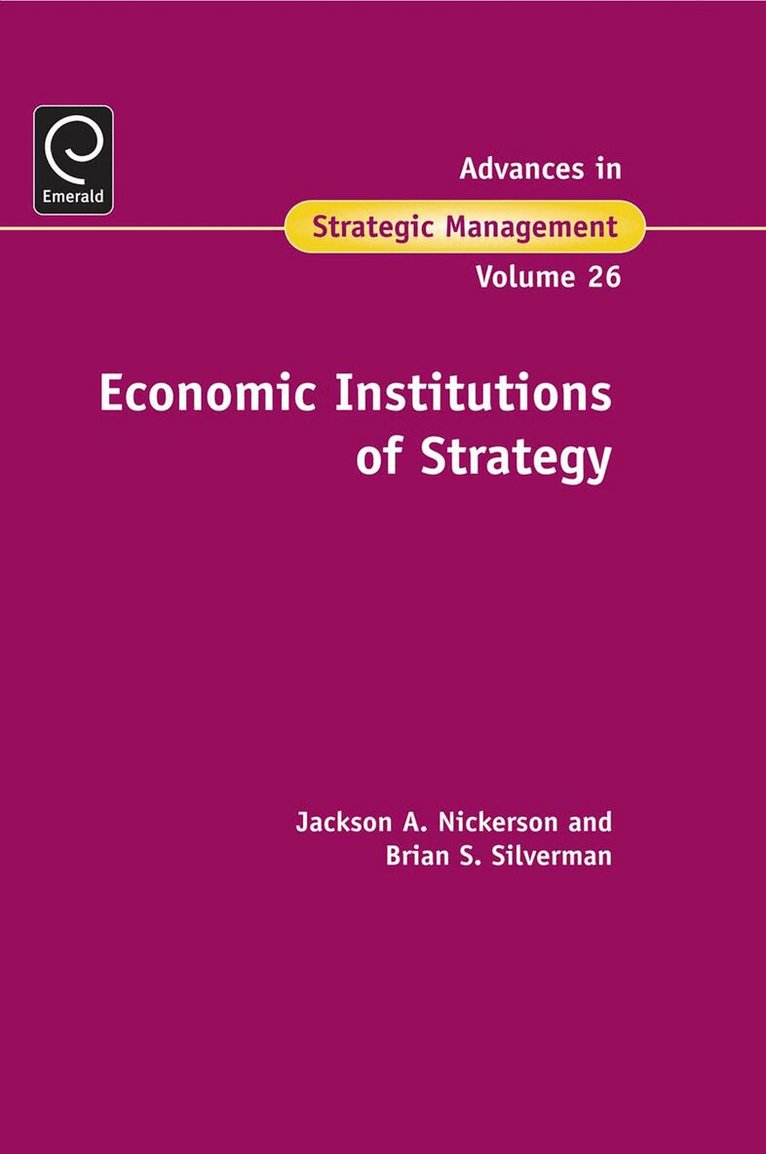
Since the publication of Oliver Williamson's "Economic Institutions of Capitalism" in 1985, new institutional economics approaches have increasingly been used to understand strategic challenges. "Economic Institutions of Strategy" (EIS) offers an interconnected set of papers that reviews and extends the economic institutional approach to business and corporate strategy bringing together the disparate strands of new institutional economics-based strategy research in a single comprehensive source. The contributors to this volume focus on new institutional economics' insights regarding diversification, alliances, franchising, geographic location, innovation, and other strategic choices. Each contributor uses either a single influential article - with excerpts reprinted - or a survey of the literature to ask and answer three questions: What is the current state of the art in new institutional economics' contribution to fundamental strategic questions? Where has this approach succeeded most, and what gaps remain?