Jacob Klapwijk – författare
Visar alla böcker från författaren Jacob Klapwijk. Handla med fri frakt och snabb leverans.
7 produkter
7 produkter
Inbunden, Engelska, 2008
1 016 kr
Skickas inom 7-10 vardagar
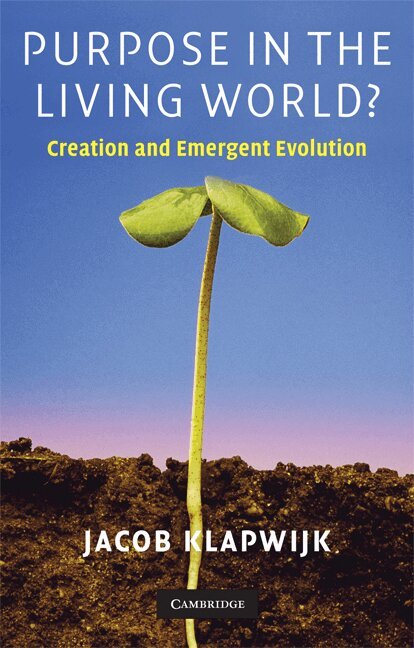
Are evolution and creation irreconcilably opposed? Is 'intelligent design' theory an unhappy compromise? Is there another way of approaching the present-day divide between religious and so-called secular views of the origins of life? Jacob Klapwijk offers a philosophical analysis of the relation of evolutionary biology to religion, and addresses the question of whether the evolution of life is exclusively a matter of chance or is better understood as including the notion of purpose. Writing from a Christian (Augustinian) point of view, he criticizes creationism and intelligent design theory as well as opposing reductive naturalism. He offers an alternative to both and an attempt to bridge the gap between them, via the idea of 'emergent evolution'. In this theory the process of evolution has an emergent or innovative character resulting in a living world of ingenious, multifaceted complexity.
Häftad, Engelska, 2008
431 kr
Skickas inom 7-10 vardagar
Are evolution and creation irreconcilably opposed? Is 'intelligent design' theory an unhappy compromise? Is there another way of approaching the present-day divide between religious and so-called secular views of the origins of life? Jacob Klapwijk offers a philosophical analysis of the relation of evolutionary biology to religion, and addresses the question of whether the evolution of life is exclusively a matter of chance or is better understood as including the notion of purpose. Writing from a Christian (Augustinian) point of view, he criticizes creationism and intelligent design theory as well as opposing reductive naturalism. He offers an alternative to both and an attempt to bridge the gap between them, via the idea of 'emergent evolution'. In this theory the process of evolution has an emergent or innovative character resulting in a living world of ingenious, multifaceted complexity.
Inbunden, Engelska, 2010
364 kr
Skickas inom 5-8 vardagar
E-bok
Engelska, 2010286 kr
Läs direkt efter köp
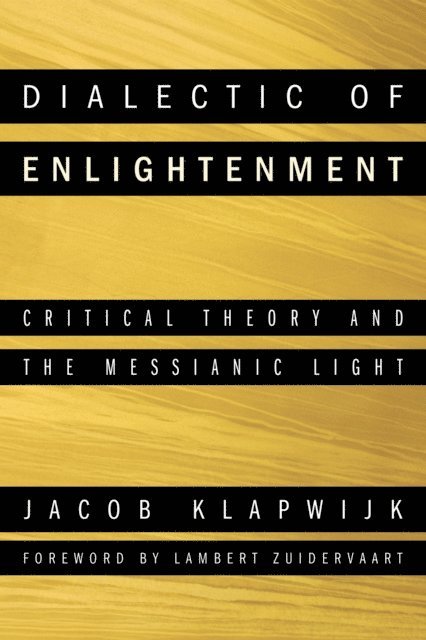
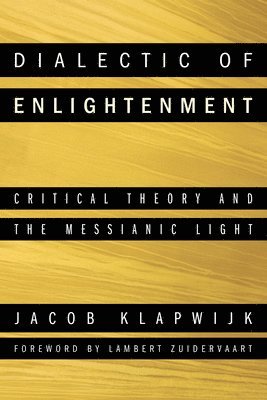
Dialectic of Enlightenment is a thought-provoking introduction to the Frankfurt School of Critical Theory. Max Horkheimer and Theodor Adorno first identified the dialectic of enlightenment when fascism was on the rampage in Europe. They warned that enlightened reason and societal freedom threaten to revert into blindness and oppression. Herbert Marcuse and the young Jurgen Habermas elaborated their Critical Theory, declaring that post-war society has not escaped this dilemma, blinded as it is by ideology, pseudo-democracy, and mass manipulation.Critical Theory aims to unmask modern reason and liberate society. But a fundamental question keeps coming back: how can this critique of modernity remain viable within a repressive societal system? Is reason in the modern world indeed doomed to self-destruct? Does rationality inevitably lead to domination and oppression? Jacob Klapwijk argues that the dialectic of enlightenment proves to be a faith, a mythical faith encouraging resignation and despair. Instead we need a wholesome reason, one inspired by a messianic faith.Dialectic of Enlightenment is an important book for students of philosophy, theology, and the social sciences. It invites them to a renewed criticism of the mythological traits and self-destructive tendencies of modern reason. It also offers a perspective of hope to all who share the author''s concern about the direction of today''s globalizing world.
Häftad, Engelska, 2010
195 kr
Skickas inom 5-8 vardagar
Inbunden, Engelska, 1992
648 kr
Tillfälligt slut
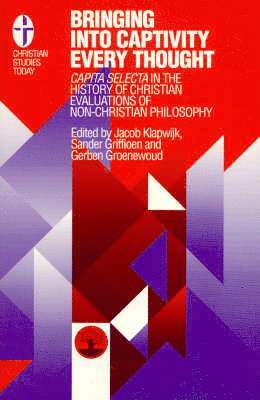
What Clement of Alexandria, Calvin of Geneva and Gutierrez of Peru, and all the other thinkers discussed in this book have in common is at least this: they all bear witness to their struggle with the relation between Christian faith and non-Christian thought. This relation is the theme of the collection of essays presented here by way of case studies. The struggle of the early church with the philosophy of the late antiquity was one of life and death. Faced with a despising Greco-Roman elite, Christians were forced to take a stand with respect to the Greek mind very existentially. As Christianity gained influence in the highly developed intellectual culture of the Roman Empire, the church wavered between acceptance and rejection of that culture. Such hesitance between antithesis and synthesis also marked the church in the Middle Ages. The tensions left a wide track of power struggles. How did Christians throughout the ages, actually find their way through the tension-fraught terrain of faith and culture? The issue far surpasses mere academic or historical interest: we ourselves are involved, and we are unable not to choose. This book is one of the results of the research and discussions of an interdisciplinary team at the Free University of Amsterdam. Co-published with the Institute for Christian Studies.
Häftad, Engelska, 1992
458 kr
Tillfälligt slut
What Clement of Alexandria, Calvin of Geneva and Gutierrez of Peru, and all the other thinkers discussed in this book have in common is at least this: they all bear witness to their struggle with the relation between Christian faith and non-Christian thought. This relation is the theme of the collection of essays presented here by way of case studies. The struggle of the early church with the philosophy of the late antiquity was one of life and death. Faced with a despising Greco-Roman elite, Christians were forced to take a stand with respect to the Greek mind very existentially. As Christianity gained influence in the highly developed intellectual culture of the Roman Empire, the church wavered between acceptance and rejection of that culture. Such hesitance between antithesis and synthesis also marked the church in the Middle Ages. The tensions left a wide track of power struggles. How did Christians throughout the ages, actually find their way through the tension-fraught terrain of faith and culture? The issue far surpasses mere academic or historical interest: we ourselves are involved, and we are unable not to choose. This book is one of the results of the research and discussions of an interdisciplinary team at the Free University of Amsterdam. Co-published with the Institute for Christian Studies.