Jacopo Iannacci – författare
1 526 kr
Skickas inom 5-8 vardagar
1 847 kr
Skickas inom 5-8 vardagar
397 kr
Skickas inom 5-8 vardagar
1 136 kr
Läs direkt efter köp
For a decade, with the uptake of 4G, we have become accustomed to the relentless increase in data and services on the move. The deployment of 5G is advancing crucial key performance indicators (KPIs), along with quality of service (QoS). Setting the horizon to 2030 and later, 6G will take the KPIs to numbers 100–1000 times better than 5G. Yet, the actual disruption of 6G and future networks (FN) will take place following other unprecedented paths.
Artificial intelligence (AI) will be exploited in a threadlike fashion, at any level of the network physical infrastructure. This will introduce, to date unknown features, like self-sustaining, self-evolution and high-resilience of small portions of the infrastructure, pioneering the concept of a network of networks. Each segment of the infrastructure will bear a high degree of independence, while working at the same time as a whole, in full orchestration with the rest of the network.
Given such a scenario, this book claims that the established and currently in use paradigms for the design and development of hardware–software (HW–SW) systems, are not appropriate to address the challenges of 6G and, further ahead, of FN. In response, unprecedented design approaches are suggested, relying on a fresh reinterpretation of the standard concept of HW, with specific attention to the network edge and edge intelligence (EI).
This work develops some conceptual tools that may help address the technical challenges resulting from the intricate scenario sketched above. Within the mentioned HW reconceptualization, a pivotal role is forecasted for microtechnologies and nanotechnologies, intended with a broad meaning, which embraces, among others, devices, systems (MEMS/NEMS) and materials.
1 136 kr
Läs direkt efter köp
For a decade, with the uptake of 4G, we have become accustomed to the relentless increase in data and services on the move. The deployment of 5G is advancing crucial key performance indicators (KPIs), along with quality of service (QoS). Setting the horizon to 2030 and later, 6G will take the KPIs to numbers 100–1000 times better than 5G. Yet, the actual disruption of 6G and future networks (FN) will take place following other unprecedented paths.
Artificial intelligence (AI) will be exploited in a threadlike fashion, at any level of the network physical infrastructure. This will introduce, to date unknown features, like self-sustaining, self-evolution and high-resilience of small portions of the infrastructure, pioneering the concept of a network of networks. Each segment of the infrastructure will bear a high degree of independence, while working at the same time as a whole, in full orchestration with the rest of the network.
Given such a scenario, this book claims that the established and currently in use paradigms for the design and development of hardware–software (HW–SW) systems, are not appropriate to address the challenges of 6G and, further ahead, of FN. In response, unprecedented design approaches are suggested, relying on a fresh reinterpretation of the standard concept of HW, with specific attention to the network edge and edge intelligence (EI).
This work develops some conceptual tools that may help address the technical challenges resulting from the intricate scenario sketched above. Within the mentioned HW reconceptualization, a pivotal role is forecasted for microtechnologies and nanotechnologies, intended with a broad meaning, which embraces, among others, devices, systems (MEMS/NEMS) and materials.
1 330 kr
Läs direkt efter köp
1 160 kr
Läs direkt efter köp
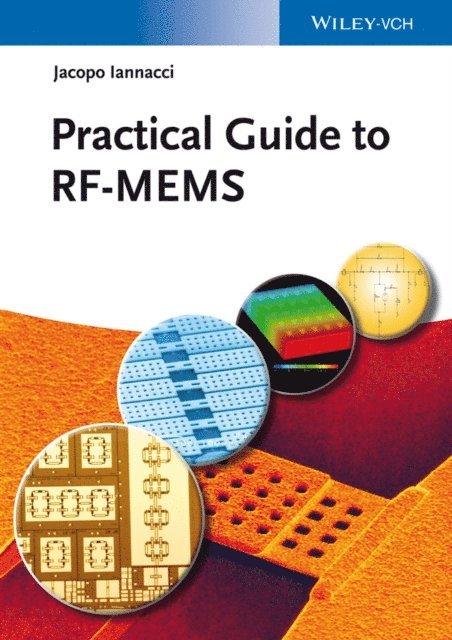
Closes the gap between hardcore-theoretical and purely experimental RF-MEMS books.
The book covers, from a practical viewpoint, the most critical steps that have to be taken in order to develop novel RF-MEMS device concepts. Prototypical RF-MEMS devices, both including lumped components and complex networks, are presented at the beginning of the book as reference examples, and these are then discussed from different perspectives with regard to design, simulation, packaging, testing, and post-fabrication modeling. Theoretical concepts are introduced when necessary to complement the practical hints given for all RF-MEMS development stages.
Provides researchers and engineers with invaluable practical hints on how to develop novel RF-MEMS device concepts Covers all critical steps, dealing with design, simulation, optimization, characterization and fabrication of MEMS for radio-frequency applications Addresses frequently disregarded issues, explicitly treating the hard to predict interplay between the three-dimensional device structure and its electromagnetic functionality Bridges theory and experiment, fundamental concepts are introduced with the application in mind, and simulation results are validated against experimental resultsAppeals to the practice-oriented R&D reader: design and simulation examples are based on widely known software packages such as ANSYS and the hardware description language Verilog.
1 170 kr
Läs direkt efter köp
Closes the gap between hardcore-theoretical and purely experimental RF-MEMS books.
The book covers, from a practical viewpoint, the most critical steps that have to be taken in order to develop novel RF-MEMS device concepts. Prototypical RF-MEMS devices, both including lumped components and complex networks, are presented at the beginning of the book as reference examples, and these are then discussed from different perspectives with regard to design, simulation, packaging, testing, and post-fabrication modeling. Theoretical concepts are introduced when necessary to complement the practical hints given for all RF-MEMS development stages.
Provides researchers and engineers with invaluable practical hints on how to develop novel RF-MEMS device concepts Covers all critical steps, dealing with design, simulation, optimization, characterization and fabrication of MEMS for radio-frequency applications Addresses frequently disregarded issues, explicitly treating the hard to predict interplay between the three-dimensional device structure and its electromagnetic functionality Bridges theory and experiment, fundamental concepts are introduced with the application in mind, and simulation results are validated against experimental resultsAppeals to the practice-oriented R&D reader: design and simulation examples are based on widely known software packages such as ANSYS and the hardware description language Verilog.
1 141 kr
Skickas inom 10-15 vardagar
1 330 kr
Läs direkt efter köp
1 252 kr
Skickas inom 10-15 vardagar
1 460 kr
Läs direkt efter köp
1 460 kr
Läs direkt efter köp
975 kr
Skickas inom 10-15 vardagar
3 203 kr
Kommande
Micro and Nanoelectronics Devices, Circuits and Systems
Select Proceedings of MNDCS 2024
3 204 kr
Skickas inom 10-15 vardagar
3 809 kr
Läs direkt efter köp