Jairos Kangira – författare
Visar alla böcker från författaren Jairos Kangira. Handla med fri frakt och snabb leverans.
5 produkter
5 produkter
Häftad, Engelska, 2019
534 kr
Skickas inom 5-8 vardagar
E-bok
PDF, Engelska, 2019611 kr
Läs direkt efter köp
Colonial scholars have taken immense pleasure in portraying Africans as possessed by spirits but as lacking possession and ownership of their resources, including land. Erroneously deemed to be thoroughly spiritually possessed but lacking senses of material possession and ownership of resources, Africans have been consistently dispossessed and displaced from the era of enslavement, through colonialism, to the neocolonial era. Delving into the historiography of dispossession and displacement on the continent of Africa, and in particular in Zimbabwe, this book also tackles contemporary forms of dispossession and displacement manifesting in the ongoing transnational corporations land grabs in Africa, wherein African peasants continue to be dispossessed and displaced. Focusing on the topical issues around dispossession and repossession of land, and the attendant displacements in contemporary Zimbabwe, the book theorises displacements from a decolonial Pan-Africanist perspective and it also unpacks various forms of displacements , corporeal, noncorporeal, cognitive, spiritual, genealogical and linguistic displacements, among others. The book is an excellent read for scholars from a variety of disciplines such as Geography, Sociology, Social Anthropology, History, Linguistics, Development Studies, Science and technology Studies, Jurisprudence and Social Theory, Law and Philosophy. The book also offers intellectual grit for policy makers and implementers, civil society organisations including activists as well as thinkers interested in decolonisation and transformation.
E-bok
PDF, Engelska, 2021935 kr
Läs direkt efter köp
Might it be possible that the world is being migrated into an era where the imperial periphery will be increasingly governed through Artificial Intelligence (AI) and robotics designed to replace human beings? Celebrated as efficient, strong, unfailing, tireless, precise and beyond corruption, AI and robots are set to replace African leaders who are imperially deemed to be and consistently condemned as corrupt, failed, weak and inefficient. But, if these AI and robots are neo-imperial tools and machinations, the million-dollar question is whether empire is not returning to recolonise the [supposedly inefficient] Africans via the new technologies and machinism? Where Africans once celebrated their liberation war movements, empire has emplaced what it calls liberation technologies designed to supposedly liberate African youths from their own states and governments led by liberation movements. Where Africans once celebrated their liberation war movements, empire has placed its own NGOs/CSOs spewing liberal ideologies designed to ostensibly liberate African youths from their own supposedly failed and corrupt states and government leaders. With African youths/citizens allying not with their liberation movements but with the liberation technologies and liberal NGOs/CSOs, it is not surprising why African citizens oppose their states-led Fast-Track Land Redistribution Programmes while ironically they happily celebrate Fast-Tracked COVID-19 Vaccines. Positing the notion of #HumansMustFall movements, this book underscores ways in which empire is in a process of eternal return to 21st century Africa. The book is crucial for scholars and activists in political science, government studies, sociology, anthropology, cultural studies, history, languages and communication studies, security studies, military studies and development studies.
Häftad, Engelska, 2017
502 kr
Skickas inom 5-8 vardagar
E-bok
PDF, Engelska, 2017564 kr
Läs direkt efter köp
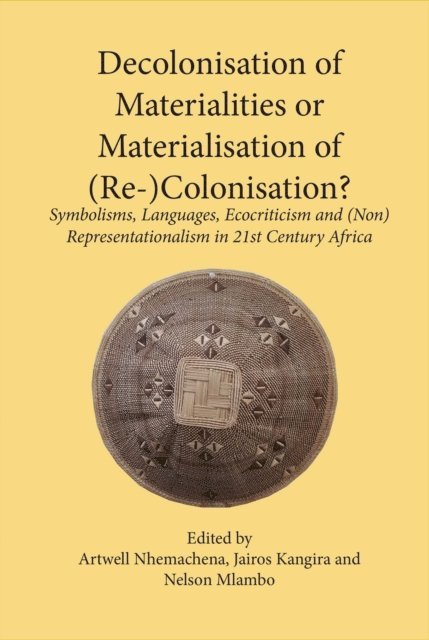
Contemporary scholarly discourses about decolonising materialities are taking two noticeable trajectories, the first trajectory privileges establishing “connections”, “relationships” and “associations” between human beings and nature. The second trajectory privileges restoration, restitution, reparations for colonial dispossessions, lootings and disinheritance. While the first trajectory presupposes that colonialism was merely about “separation”, “alienation”, and “disconnections” between human beings and nature, the second trajectory stresses the colonialists’ dispossession, disinheritance and privations of Africans. Drawing on contemporary discourses about materialities in relation to semiotics, (non-)representationalism, rhetoric, ecocriticism, territorialisation, deterritorialisation and reterritorialisation, translation, animism, science and technology studies, this book teases out the intellectually rutted terrain of African materialities. It argues that in a world of increasing impoverishment, the significance of materialities cannot be overemphasised: more so for the continent of Africa where impoverishment “materialises” in the midst of resource opulence. The book is a pacesetter in no holds barred interrogation of African materialities.