
Jakub Wysmułek – författare
Visar alla böcker från författaren . Handla med fri frakt och snabb leverans.
2 produkter
2 produkter
Inbunden, Engelska, 2026
2 627 kr
Kommande
Early modern Lviv was a city of many names, languages, rites, and laws. Catholics, Armenians, Ruthenians, and Jews lived close to one another, shared streets and courtyards, traded, litigated, borrowed, competed, and quarrelled. Yet this was neither a harmonious crossroads nor a city of sealed enclaves. It was a hierarchical multiethnic system whose groups were made and remade through law, memory, institutions, space, money, privilege, prejudice, and cooperation. Combining archival research, urban history, and social theory, this book asks how ethnic groups were created in a premodern city. It shows that Lviv’s communities were not primordial entities or simple products of religious difference. They became durable collective actors through courts, councils of elders, confraternities, parishes, synagogues, schools, hospitals, and systems of representation. Their boundaries were narrated through origin stories, enforced through law and custom, materialised in houses and quarters, and continually tested by migration, external threats, economic rivalry, limited urban space, and everyday proximity. Like the carpets once brought to Lviv by Armenian merchants, the city’s social fabric was woven from threads of different colour and thickness. The main strands remained visible, but they crossed, knotted, and changed their pattern over time. By untangling this weave, the book challenges both the myth of premodern multicultural harmony and the opposite image of ceaseless ethnic conflict. It offers instead a dynamic history of how ethnic groups are made, governed, contested, and reproduced.
Del 23 - Later Medieval Europe
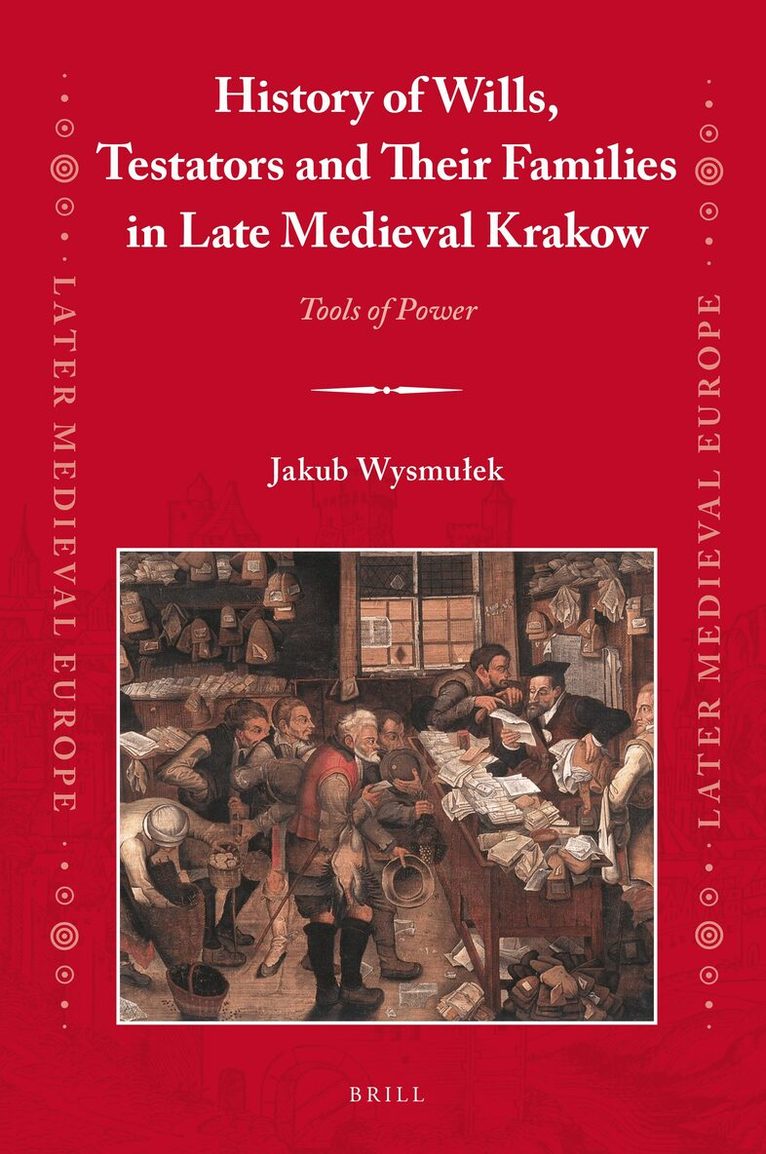
History of Wills, Testators and Their Families in Late Medieval Krakow
Tools of Power
Inbunden, Engelska, 2021
2 355 kr
Skickas inom 5-8 vardagar
This volume offers the first comprehensive analysis of wills in late medieval Krakow. It presents the origins of testamentary acts in the Kingdom of Poland and its centre, Krakow, and their subsequent transformation from so called ‘canonical wills’ to ‘communal wills’. Wysmułek discusses the socio-cultural role of wills and sets them in their contemporary legal, social, and economic context. In doing so, he uncovers their influence on property ownership and family relations in the city, as well as on the religious practices of the burghers. Ultimately, this work seeks to change the perception of wills by treating the testamentary act itself as an important agent of historical social change – a ‘tool of power’.