James A. Bemis – författare
Visar alla böcker från författaren James A. Bemis. Handla med fri frakt och snabb leverans.
2 produkter
2 produkter
Del 15 - Developments in Nephrology
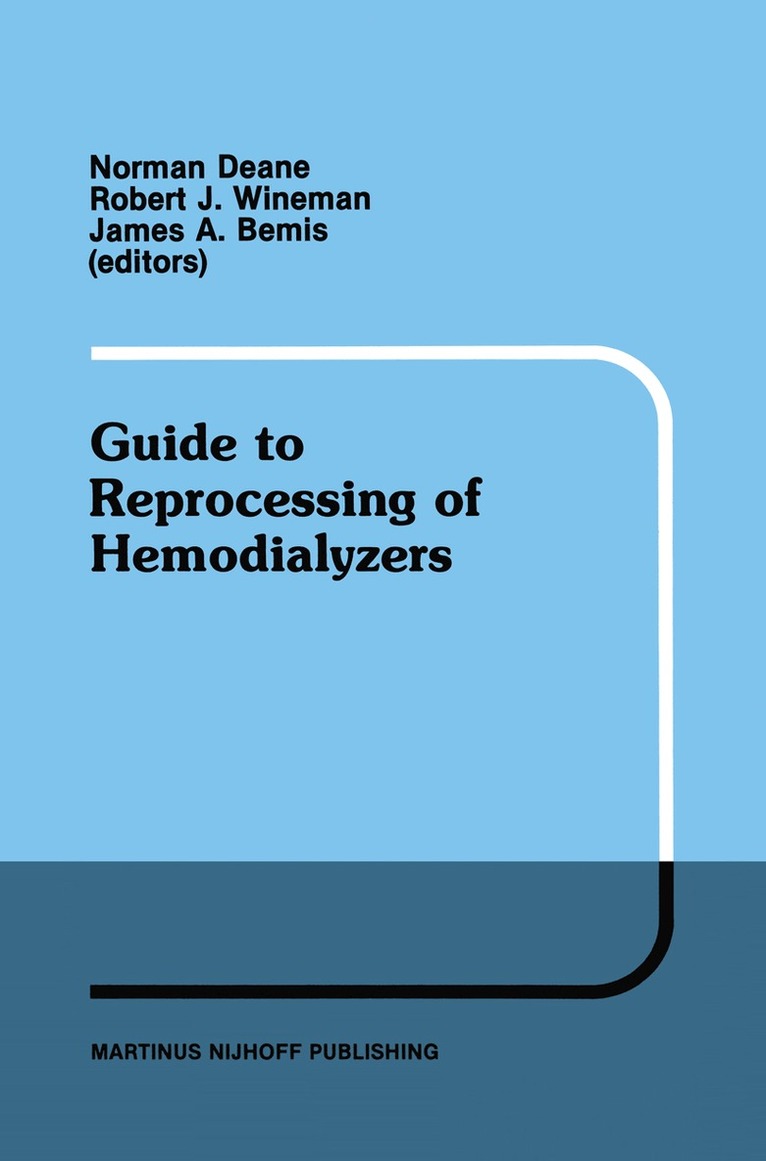
Guide to Reprocessing of Hemodialyzers
Häftad, Engelska, 2011
565 kr
Skickas inom 10-15 vardagar
The purpose of this book is to provide information for the nephrologist to gain a perspective on the medical, scientific, and technical aspects of reprocess ing of hemodialyzers. The book is also designed to serve the needs of the associated medical, nursing, and technical staffs of dialysis facilities for data on reuse of hemodialyzers. As an information source, the book will prove to be useful for those who may be considering reprocessing of dialyzers, as well as persons who are currently involved in this aspect of the practice of nephrology. We have focused on the clinical and technological aspects of hemodialyzer reprocessing and have not dealt with socioeconomic considerations. We do wish to share with physicians performing hemodialysis several observations we have made as a result of assembling this volume. We believe that hemodialyzer reuse has had a beneficial impact on the quality of care for hemodialysis patients in consideration of the following factors. There is an increased awareness of membrane biocompatibility issues that has been brought to the forefront with the application of reuse. Utilization ofhemodialyzer reprocess ing has enabled nephrologists . to compare the effect of various measures on biocompatibility when the patient is exposed to either a new or a reprocessed device. Previously, few readily available comparisons existed. In the practice of dialysis, water quality has always been of considerable importance. With the advent of widespread hemodialyzer reprocessing, the issues of water bacteriology and water quality have become more prominent.
E-bok
PDF, Engelska, 2012708 kr
Läs direkt efter köp
The purpose of this book is to provide information for the nephrologist to gain a perspective on the medical, scientific, and technical aspects of reprocess ing of hemodialyzers. The book is also designed to serve the needs of the associated medical, nursing, and technical staffs of dialysis facilities for data on reuse of hemodialyzers. As an information source, the book will prove to be useful for those who may be considering reprocessing of dialyzers, as well as persons who are currently involved in this aspect of the practice of nephrology. We have focused on the clinical and technological aspects of hemodialyzer reprocessing and have not dealt with socioeconomic considerations. We do wish to share with physicians performing hemodialysis several observations we have made as a result of assembling this volume. We believe that hemodialyzer reuse has had a beneficial impact on the quality of care for hemodialysis patients in consideration of the following factors. There is an increased awareness of membrane biocompatibility issues that has been brought to the forefront with the application of reuse. Utilization ofhemodialyzer reprocess ing has enabled nephrologists . to compare the effect of various measures on biocompatibility when the patient is exposed to either a new or a reprocessed device. Previously, few readily available comparisons existed. In the practice of dialysis, water quality has always been of considerable importance. With the advent of widespread hemodialyzer reprocessing, the issues of water bacteriology and water quality have become more prominent.