James Carlson - Böcker
Visar alla böcker från författaren James Carlson. Handla med fri frakt och snabb leverans.
7 produkter
7 produkter
896 kr
Skickas inom 10-15 vardagar
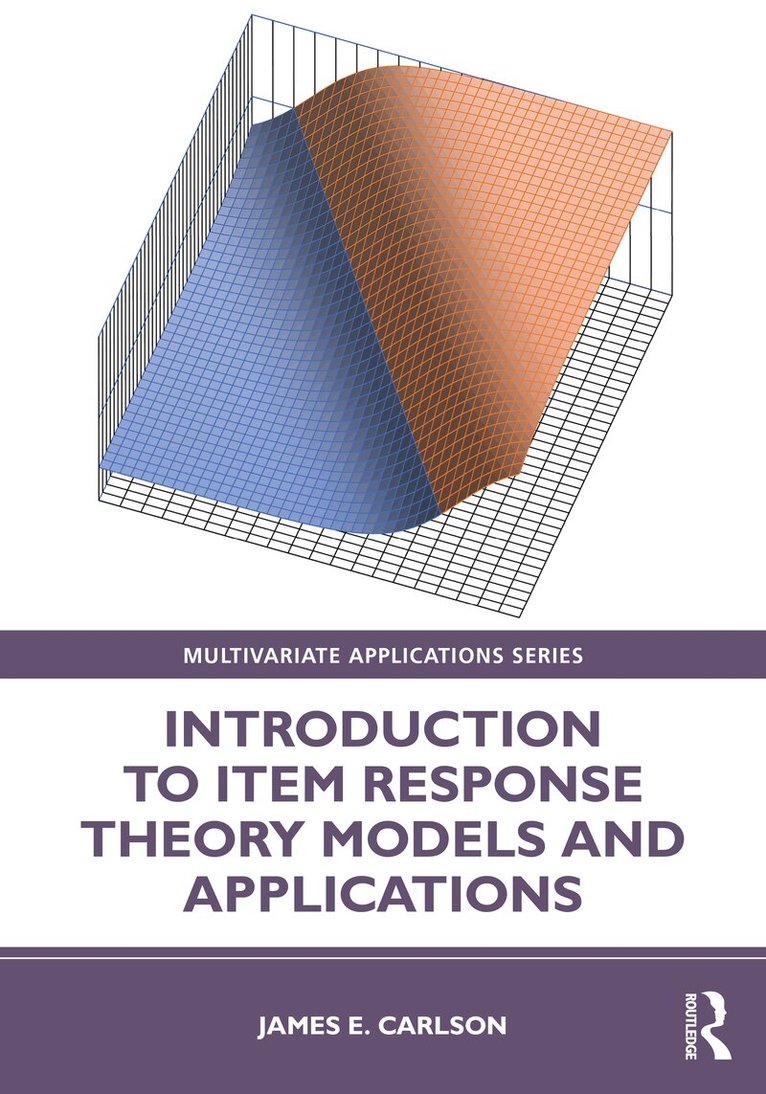
This is a highly accessible, comprehensive introduction to item response theory (IRT) models and their use in various aspects of assessment/testing. The book employs a mixture of graphics and simulated data sets to ease the reader into the material and covers the basics required to obtain a solid grounding in IRT.Written in an easily accessible way that assumes little mathematical knowledge, Carlson presents detailed descriptions of several commonly used IRT models, including those for items scored on a two-point (dichotomous) scale such as correct/incorrect, and those scored on multiple-point (polytomous) scales, such as degrees of correctness. One chapter describes a model in-depth and is followed by a chapter of instructions and illustrations showing how to apply the models to the reader’s own work.This book is an essential text for instructors and higher level undergraduate and postgraduate students of statistics, psychometrics, and measurement theory across the behavioral and social sciences, as well as testing professionals.
2 044 kr
Skickas inom 10-15 vardagar
This is a highly accessible, comprehensive introduction to item response theory (IRT) models and their use in various aspects of assessment/testing. The book employs a mixture of graphics and simulated data sets to ease the reader into the material and covers the basics required to obtain a solid grounding in IRT.Written in an easily accessible way that assumes little mathematical knowledge, Carlson presents detailed descriptions of several commonly used IRT models, including those for items scored on a two-point (dichotomous) scale such as correct/incorrect, and those scored on multiple-point (polytomous) scales, such as degrees of correctness. One chapter describes a model in-depth and is followed by a chapter of instructions and illustrations showing how to apply the models to the reader’s own work.This book is an essential text for instructors and higher level undergraduate and postgraduate students of statistics, psychometrics, and measurement theory across the behavioral and social sciences, as well as testing professionals.
1 192 kr
Skickas inom 7-10 vardagar
This up-to-date introduction to Griffiths' theory of period maps and period domains focusses on algebraic, group-theoretic and differential geometric aspects. Starting with an explanation of Griffiths' basic theory, the authors go on to introduce spectral sequences and Koszul complexes that are used to derive results about cycles on higher-dimensional algebraic varieties such as the Noether-Lefschetz theorem and Nori's theorem. They explain differential geometric methods, leading up to proofs of Arakelov-type theorems, the theorem of the fixed part and the rigidity theorem. They also use Higgs bundles and harmonic maps to prove the striking result that not all compact quotients of period domains are Kähler. This thoroughly revised second edition includes a new third part covering important recent developments, in which the group-theoretic approach to Hodge structures is explained, leading to Mumford-Tate groups and their associated domains, the Mumford-Tate varieties and generalizations of Shimura varieties.
687 kr
Skickas inom 7-10 vardagar
This up-to-date introduction to Griffiths' theory of period maps and period domains focusses on algebraic, group-theoretic and differential geometric aspects. Starting with an explanation of Griffiths' basic theory, the authors go on to introduce spectral sequences and Koszul complexes that are used to derive results about cycles on higher-dimensional algebraic varieties such as the Noether-Lefschetz theorem and Nori's theorem. They explain differential geometric methods, leading up to proofs of Arakelov-type theorems, the theorem of the fixed part and the rigidity theorem. They also use Higgs bundles and harmonic maps to prove the striking result that not all compact quotients of period domains are Kähler. This thoroughly revised second edition includes a new third part covering important recent developments, in which the group-theoretic approach to Hodge structures is explained, leading to Mumford-Tate groups and their associated domains, the Mumford-Tate varieties and generalizations of Shimura varieties.
551 kr
Skickas inom 3-6 vardagar
428 kr
Skickas inom 11-20 vardagar
On August 8, 1900, at the second International Congress of Mathematicians in Paris, David Hilbert delivered his famous lecture in which he described twenty-three problems that were to play an influential role in mathematical research. A century later, on May 24, 2000, at a meeting at the College de France, the Clay Mathematics Institute (CMI) announced the creation of a US$7 million prize fund for the solution of seven important classic problems which have resisted solution. The prize fund is divided equally among the seven problems. There is no time limit for their solution.The Millennium Prize Problems were selected by the founding Scientific Advisory Board of CMI--Alain Connes, Arthur Jaffe, Andrew Wiles, and Edward Witten--after consulting with other leading mathematicians. Their aim was somewhat different than that of Hilbert: not to define new challenges, but to record some of the most difficult issues with which mathematicians were struggling at the turn of the second millennium; to recognize achievement in mathematics of historical dimension; to elevate in the consciousness of the general public the fact that in mathematics, the frontier is still open and abounds in important unsolved problems; and to emphasize the importance of working towards a solution of the deepest, most difficult problems.The present volume sets forth the official description of each of the seven problems and the rules governing the prizes. It also contains an essay by Jeremy Gray on the history of prize problems in mathematics.A co-publication of the AMS and the Clay Mathematics Institute (Cambridge, MA).
3 219 kr
Skickas inom 3-6 vardagar