James Demmel – författare
Visar alla böcker från författaren James Demmel. Handla med fri frakt och snabb leverans.
2 produkter
2 produkter
Häftad, Engelska, 1994
638 kr
Skickas inom 5-8 vardagar
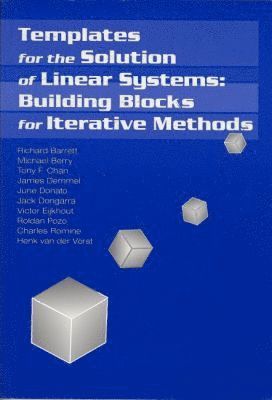
In this book, which focuses on the use of iterative methods for solving large sparse systems of linear equations, templates are introduced to meet the needs of both the traditional user and the high performance specialist. Templates, a description of a general algorithm rather than the executable object or source code more commonly found in a conventional software library, offer whatever degree of customization the user may desire.Templates have three distinct advantages: they are general and reusable, they are not language specific, and they exploit the expertise of both the numerical analyst, who creates a template reflecting in depth knowledge of a specific numerical technique, and the computational scientist, who then provides ""value added"" capability to the general template description, customizing it for specific needs.For each template that is presented, the authors provide a mathematical description of the flow of the algorithm, discussion of convergence and stopping criteria to use in the iteration, suggestions for applying a method to special matrix types, advice for tuning the template, tips on parallel implementations, and hints as to when and why a method is useful.
Häftad, Engelska, 2006
1 186 kr
Skickas inom 5-8 vardagar
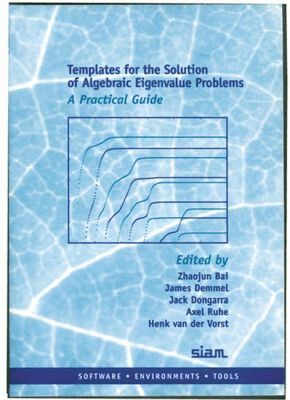
Large-scale problems of engineering and scientific computing often require solutions of eigenvalue and related problems. This book gives a unified overview of theory, algorithms, and practical software for eigenvalue problems. It organizes this large body of material to make it accessible for the first time to the many nonexpert users who need to choose the best state-of-the-art algorithms and software for their problems. Using an informal decision tree, just enough theory is introduced to identify the relevant mathematical structure that determines the best algorithm for each problem.The algorithms and software at the ""leaves"" of the decision tree range from the classical QR algorithm, which is most suitable for small dense matrices, to iterative algorithms for very large generalized eigenvalue problems. Algorithms are presented in a unified style as templates, with different levels of detail suitable for readers ranging from beginning students to experts. The authors' comprehensive treatment includes a treasure of further bibliographic information.