James Logue – författare
Visar alla böcker från författaren James Logue. Handla med fri frakt och snabb leverans.
4 produkter
4 produkter
Inbunden, Engelska, 1995
1 193 kr
Skickas inom 3-6 vardagar
This book presents a novel theory of probability and judgements of probability: strong coherentist subjectivism. Logue combines three claims in his exposition of this theory. The first states that probabilities may be treated as the degrees of partial belief of (ideally rational) agents, best established by the examination of behaviour. Thus, probability is personalist. The second claim contends that only such degrees of belief can be construed as probabilities: on this strongly subjectivist view the notion objective chance is, if not conceptually impossible, at any rate redundant. The third, coherentist, claim maintains that minimal coherence of probability-beliefs is all that is necessary for those beliefs to be rational; that is, on this view, weak coherence of a set of beliefs is both a necessary and sufficient condition for the rationality of those beliefs.This theory suggests a quasi-realist perspective, in which probabilities are viewed as projections of subjective evaluations. Provided that these evaluations conform to the standards of coherence, they come legitimately to be expressed in apparently realist of objectivist language. This projectivist outlook provides a convincing rationale for the theory, helps to free it from psychologism and excessive 'Bayesian' zeal, and provides it with smoother solutions to longstanding problems in the area of probability.
Del 227 - Boston Studies in the Philosophy and History of Science
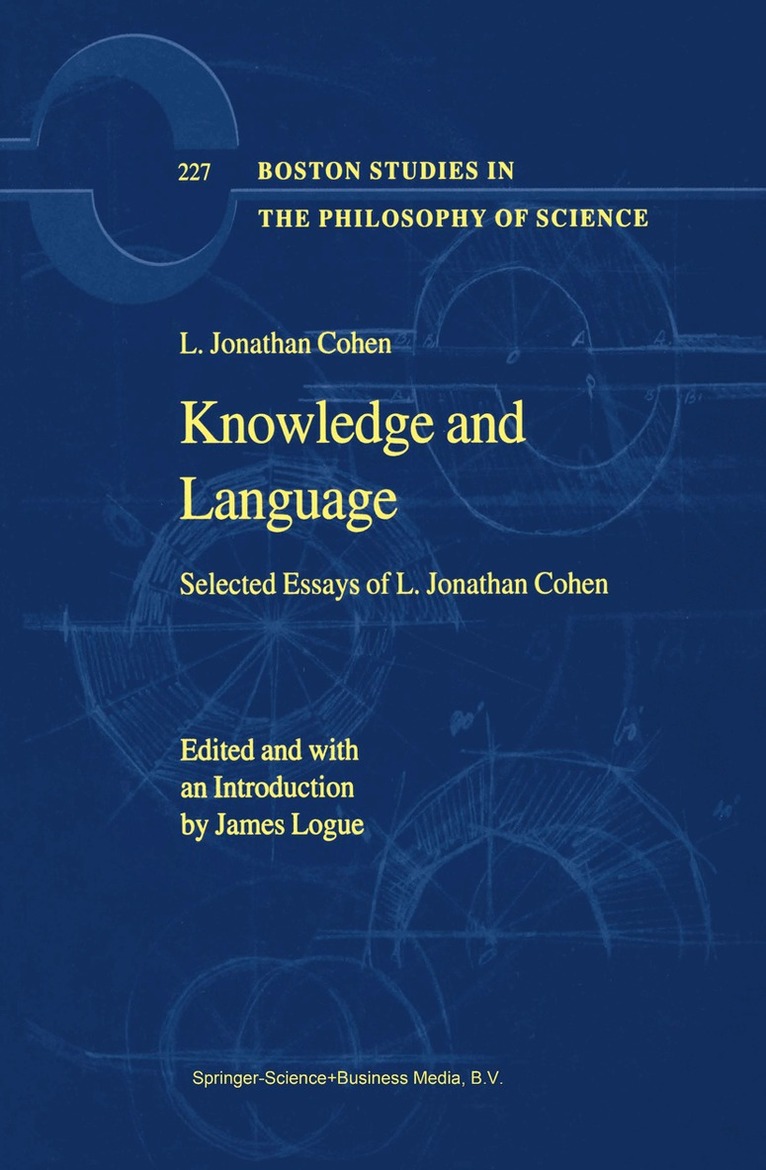
Knowledge and Language
Selected Essays of L. Jonathan Cohen
Inbunden, Engelska, 2002
1 634 kr
Skickas inom 10-15 vardagar
I am very grateful to Kluwer Academic Publishers for the opportunity to republish these articles about knowledge and language. The Introduction to the volume has been written by James Logue, and I need to pay a very sincerely intended tribute to the care and professionalism which he has devoted to every feature of its production. My thanks are also due to Matthew MeG rattan for his technical as sistance in scanning the articles onto disk and formatting them. 1. Jonathan Cohen vii Publisher's Note Thanks are due to the following publishers for permission to reproduce the articles in this volume. On the project of a universal character. Oxford University Press. Paper 1 On a concept of a degree of grammaticalness. Logique et Analyse. Paper 2 Paper 3 The semantics of metaphor. Cambridge University Press. Paper 4 Can the logic of indirect discourse be formalised? The Association for Symbolic Logic. Paper 5 Some remarks on Grice's views about the logical particles of natural language. Kluwer Academic Publishers. Paper 6 Can the conversationalist hypothesis be defended? Kluwer Academic Publishers. Paper 7 How is conceptual innovation possible? Kluwer Academic Publishers. Should natural language definitions be insulated from, or interactive Paper 8 with, one another in sentence composition? Kluwer Academic Publish ers. Paper 9 A problem about truth-functional semantics. Basil Blackwell Publisher Ltd. Paper 10 The individuation of proper names. Oxford University Press. Paper 11 Some comments on third world epistemology. Oxford University Press. Paper 12 Guessing. The Aristotelian Society.
Del 227 - Boston Studies in the Philosophy and History of Science
Knowledge and Language
Selected Essays of L. Jonathan Cohen
Häftad, Engelska, 2010
1 634 kr
Skickas inom 10-15 vardagar
This collection of twenty papers deals with a wide range of issues in philosophy of language, epistemology, history of philosophy, philosophy of psychology, jurisprudence and philosophy of science. It should be of interest to, and prove a stimulus for new work by, researchers and practitioners working in any of these fields. Tracing a route backwards through the papers as presented here, the final group is largely concerned with how empirical knowledge may be acquired through evidence in states of uncertainty; the middle group explores how such evidence often requires or results in conceptual innovation and is given to us in language the meaning of which may be difficult to determine; the first group explores how a theory of meaning can be constructed for natural and artificial languages. The papers exhibit a distinctive analytical perspective and a great deal of thematic continuity, underpinned by commitment to the richness both of language and of enquiry and opposition to simplistic or dogmatic formalisations and analyses.
E-bok
PDF, Engelska, 20131 977 kr
Läs direkt efter köp
I am very grateful to Kluwer Academic Publishers for the opportunity to republish these articles about knowledge and language. The Introduction to the volume has been written by James Logue, and I need to pay a very sincerely intended tribute to the care and professionalism which he has devoted to every feature of its production. My thanks are also due to Matthew MeG rattan for his technical as sistance in scanning the articles onto disk and formatting them. 1. Jonathan Cohen vii Publisher''s Note Thanks are due to the following publishers for permission to reproduce the articles in this volume. On the project of a universal character. Oxford University Press. Paper 1 On a concept of a degree of grammaticalness. Logique et Analyse. Paper 2 Paper 3 The semantics of metaphor. Cambridge University Press. Paper 4 Can the logic of indirect discourse be formalised? The Association for Symbolic Logic. Paper 5 Some remarks on Grice''s views about the logical particles of natural language. Kluwer Academic Publishers. Paper 6 Can the conversationalist hypothesis be defended? Kluwer Academic Publishers. Paper 7 How is conceptual innovation possible? Kluwer Academic Publishers. Should natural language definitions be insulated from, or interactive Paper 8 with, one another in sentence composition? Kluwer Academic Publish ers. Paper 9 A problem about truth-functional semantics. Basil Blackwell Publisher Ltd. Paper 10 The individuation of proper names. Oxford University Press. Paper 11 Some comments on third world epistemology. Oxford University Press. Paper 12 Guessing. The Aristotelian Society.