James M. Lindgren – författare
Visar alla böcker från författaren James M. Lindgren. Handla med fri frakt och snabb leverans.
3 produkter
3 produkter
E-bok
PDF, Engelska, 19951 681 kr
Läs direkt efter köp
By the first years of the twentieth century the memory of old-time New England was in danger. What had once been a land of small towns populated by tradition-minded Yankees was now becoming almost unrecognizable with a floodtide of immigrants and the constant change of a modernizing society. At the same time, cities such as Boston, Portsmouth, and Salem were bursting at the seams with factories, high-rises, and uncontrollable growth. During a period when the Colonial Revival and progressive movements held sway, Yankees asserted their influence through campaigns to redefine the meaning of their Anglo-American forebears. As part of the reaction, the modern preservation movement was founded by William Sumner Appleton, Jr., a privileged, old-blooded Bostonian. Resisting not simply this avalanche of change but the amateurish romanticism of fellow antiquaries, Appleton founded the Society for the Preservation of New England Antiquities in 1910. While examining SPNEA in the context of progressivism, Preserving Historic New England focuses on its redefinition of preservation to fit the methodology of science, the economy of capitalism, and the aestheticism of architecture. In so doing, preservation not only became a profession defined by those male worlds, but remade Yankee memory to accord with the modern corporate order.
Inbunden, Engelska, 2014
561 kr
Skickas inom 10-15 vardagar
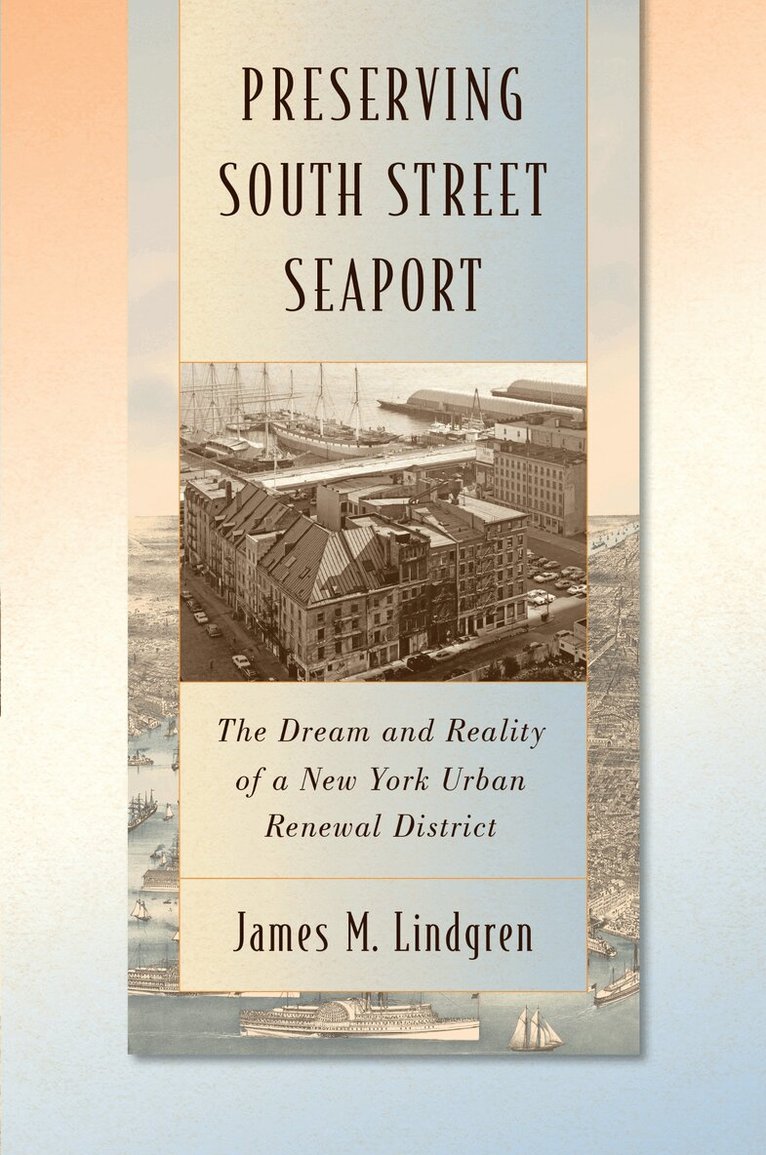
Preserving South Street Seaport tells the fascinating story, from the 1960s to the present, of the South Street Seaport District of Lower Manhattan. Home to the original Fulton Fish Market and then the South Street Seaport Museum, it is one of the last neighborhoods of late 18th- and early 19th-century New York City not to be destroyed by urban development. In 1988, South Street Seaport became the city's #1 destination for visitors. Featuring over 40 archival and contemporary black-and-white photographs, this is the first history of a remarkable historic district and maritime museum. Lindgren skillfully tells the complex story of this unique cobblestoned neighborhood. Comprised of deteriorating, 4-5 story buildings in what was known as the Fulton Fish Market, the neighborhood was earmarked for the erection of the World Trade Center until New Jersey forced its placement one mile westward. After Penn Station's demolition had angered many New York citizens, preservationists mobilized in 1966 to save this last piece of Manhattan's old port and recreate its fabled 19th-century "Street of Ships." The South Street Seaport and the World Trade Center became the yin and yang of Lower Manhattan's rebirth. In an unprecedented move, City Hall designated the museum as developer of the twelve-block urban renewal district. However, the Seaport Museum,whose membership became the largest of any history museum in the city, was never adequately funded, and it suffered with the real estate collapse of 1972. The city, bankers, and state bought the museum's fifty buildings and leased them back at terms that crippled the museum financially. That led to the controversial construction of the Rouse Company's New Fulton Market (1983) and Pier 17 mall (1985). Lindgren chronicles these years of struggle, as the defenders of the people-oriented museum and historic district tried to save the original streets and buildings and the largest fleet of historic ships in the country from the schemes of developers, bankers, politicians, and even museum administrators. Though the Seaport Museum's finances were always tenuous, the neighborhood and the museum were improving until the tragedy of 9/11. But the prolonged recovery brought on dysfunctional museum managers and indifference, if not hostility, from City Hall. Superstorm Sandy then dealt a crushing blow. Today, the future of this pioneering museum, designated by Congress as America's National Maritime Museum, is in doubt, as its waterfront district is eyed by powerful commercial developers. While Preserving South Street Seaport reveals the pitfalls of privatizing urban renewal, developing museum-corporate partnerships, and introducing a professional regimen over a people's movement, it also tells the story of how a seedy, decrepit piece of waterfront became a wonderful venue for all New Yorkers and visitors from around the world to enjoy. This book will appeal to a wide audience of readers in the history and practice of museums, historic preservation, urban history and urban development, and contemporary New York City.This book is supported by a grant from Furthermore: a program of the J.M. Kaplan Fund.
Häftad, Engelska, 2019
385 kr
Skickas inom 5-8 vardagar
The United States has long been dependent on the seas, but Americans know little about their maritime history. While Britain and other countries have established national museums to nurture their seagoing traditions, America has left that responsibility to private institutions. In this first-of-its-kind history, James M. Lindgren focuses on a half-dozen of these great museums, ranging from Salem's East India Marine Society, founded in 1799, to San Francisco's Maritime Museum and New York's South Street Seaport Museum, which were established in recent decades.Begun by activists with unique agendas -- whether overseas empire, economic redevelopment, or cultural preservation -- these museums have displayed the nation's complex interrelationship with the sea. Yet they all faced chronic shortfalls, as policymakers, corporations, and everyday citizens failed to appreciate the oceans' formative environment. Preserving Maritime America shows how these institutions shifted course to remain solvent and relevant and demonstrates how their stories tell of the nation's rise and decline as a commercial maritime power.