James Ockey – författare
Visar alla böcker från författaren James Ockey. Handla med fri frakt och snabb leverans.
8 produkter
8 produkter
Inbunden, Engelska, 2004
524 kr
Skickas inom 5-8 vardagar
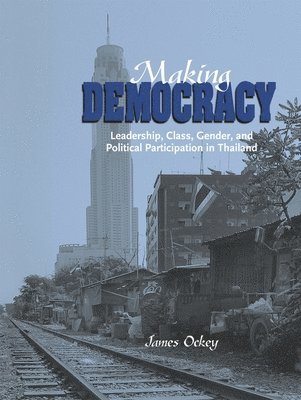
Democracy in Thailand is the result of a complex interplay of traditional and foreign attitudes. Although democratic institutions have been imported, participation in politics is deeply rooted in Thai village society. A contrasting strand of authoritarianism is present not only in the traditional culture of the royal court but also in the centralized bureaucracies and powerful armed services borrowed from the West. Both attitudes have helped to shape Thai democracy's specific character. This topical volume explores the importance of culture and the roles played by leadership, class, and gender in the making of Thai democracy. James Ockey describes changing patterns of leadership at all levels of society, from the cabinet to the urban middle class to the countryside, and suggests that such changes are appropriate to democratic government - despite the continuing manipulation of authoritarian patterns. He examines the institutions of democratic government, especially the political parties that link voters to the parliament. Political factions and the provincial notables that lead them are given careful attention. The failure to fully integrate the lower classes into the democratic system, Ockey argues, has been the underlying cause of many of the flaws of Thai democracy. Female political leadership, another imported notion, is better represented in urban rather than rural areas. Yet gender relations in villages were more equitable than at court, Ockey suggests, and these attitudes have persisted to this day. Successful women politicians from a variety of backgrounds have begun to overcome stereotypes associated with female. With its wide-ranging analysis of Thai politics over the last three decades, Making Democracy is an important resource for both students and specialists.
Häftad, Engelska, 2019
1 091 kr
Skickas inom 10-15 vardagar
This book explores theories of conflict and peacebuilding and applies them to case studies from the Asia Pacific region, seeking to shift attention to the inherency of conflict, the constant danger of re-emergence, and the need to establish mechanisms to resolve it. The authors argue that the central focus of peacebuilding should not be state-building per se, but rather the creation of effective mechanisms for peaceful resolution of both past and newly emerging conflicts. To do so, it is important to consider the entire process of creating peace, to contemplate the linkages between conflict, resolution, and post-conflict peacebuilding, rather than focus only on the period of institution-building.
Inbunden, Engelska, 2018
1 091 kr
Skickas inom 10-15 vardagar
This book explores theories of conflict and peacebuilding and applies them to case studies from the Asia Pacific region, seeking to shift attention to the inherency of conflict, the constant danger of re-emergence, and the need to establish mechanisms to resolve it. The authors argue that the central focus of peacebuilding should not be state-building per se, but rather the creation of effective mechanisms for peaceful resolution of both past and newly emerging conflicts. To do so, it is important to consider the entire process of creating peace, to contemplate the linkages between conflict, resolution, and post-conflict peacebuilding, rather than focus only on the period of institution-building.
E-bok
Engelska, 20181 379 kr
Läs direkt efter köp
This book explores theories of conflict and peacebuilding and applies them to case studies from the Asia Pacific region, seeking to shift attention to the inherency of conflict, the constant danger of re-emergence, and the need to establish mechanisms to resolve it. The authors argue that the central focus of peacebuilding should not be state-building per se, but rather the creation of effective mechanisms for peaceful resolution of both past and newly emerging conflicts. To do so, it is important to consider the entire process of creating peace, to contemplate the linkages between conflict, resolution, and post-conflict peacebuilding, rather than focus only on the period of institution-building.
Inbunden, Engelska, 2023
1 525 kr
Skickas inom 10-15 vardagar
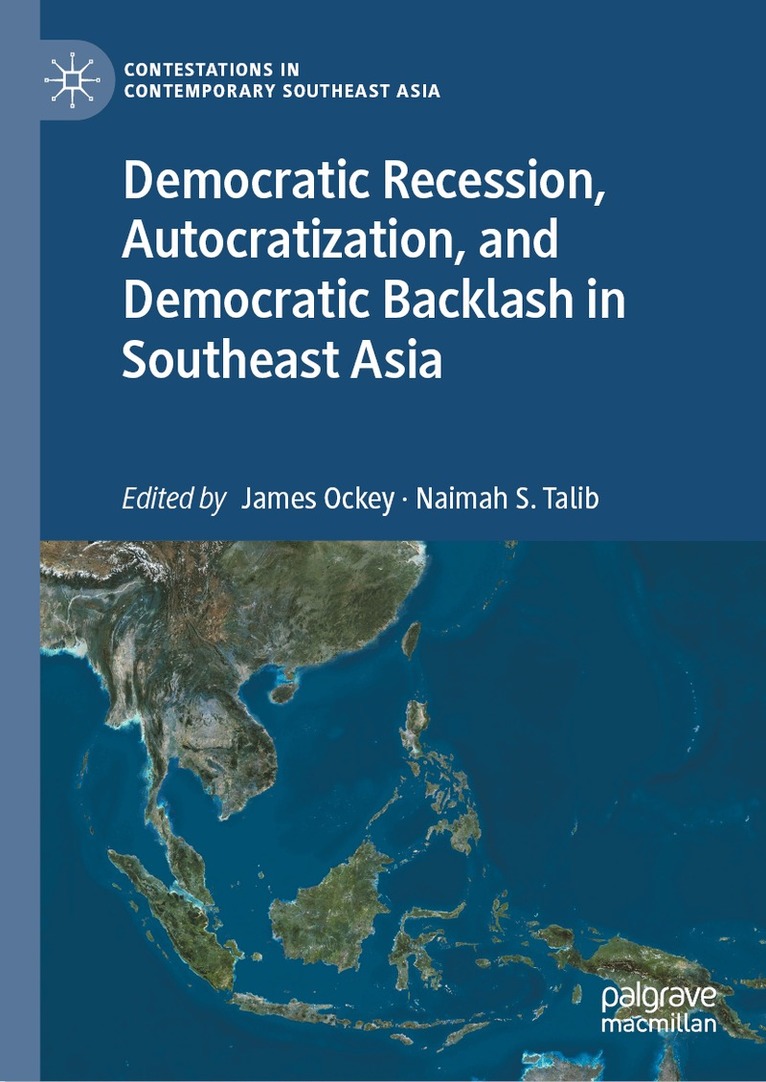
This book presents a new organizing framework for studying democratic recession and autocratization in Southeast Asia. By introducing a new concept, “democratic backlash,” the book details how democratic recession inevitably provokes resistance that often forms the nucleus of new democratic movements, and in doing so, argues that it is important to identify these reverse trends that may eventually become dominant.The book contributes to current literature which thus far has sought to understand the causes and consequences of the decline in democracy around the world. Previous literature has focused primarily on advanced democracies, or alternatively, on large scale quantitative comparison. As such, this book helps fill a research gap with its focus on Southeast Asia, employing a comparative case study approach.Chapter authors are experts on Southeast Asia, a region that has experienced democratic recession and autocratization in a variety of ways, from rising populism to military coups.
1 825 kr
Läs direkt efter köp
This book presents a new organizing framework for studying democratic recession and autocratization in Southeast Asia. By introducing a new concept, “democratic backlash,” the book details how democratic recession inevitably provokes resistance that often forms the nucleus of new democratic movements, and in doing so, argues that it is important to identify these reverse trends that may eventually become dominant.
The book contributes to current literature which thus far has sought to understand the causes and consequences of the decline in democracy around the world. Previous literature has focused primarily on advanced democracies, or alternatively, on large scale quantitative comparison. As such, this book helps fill a research gap with its focus on Southeast Asia, employing a comparative case study approach.Chapter authors are experts on Southeast Asia, a region that has experienced democratic recession and autocratization in a variety of ways, from rising populism to military coups.625 kr
Skickas inom 5-8 vardagar
Häftad, Engelska, 2024
1 525 kr
Skickas inom 10-15 vardagar
This book presents a new organizing framework for studying democratic recession and autocratization in Southeast Asia. By introducing a new concept, “democratic backlash,” the book details how democratic recession inevitably provokes resistance that often forms the nucleus of new democratic movements, and in doing so, argues that it is important to identify these reverse trends that may eventually become dominant.The book contributes to current literature which thus far has sought to understand the causes and consequences of the decline in democracy around the world. Previous literature has focused primarily on advanced democracies, or alternatively, on large scale quantitative comparison. As such, this book helps fill a research gap with its focus on Southeast Asia, employing a comparative case study approach.Chapter authors are experts on Southeast Asia, a region that has experienced democratic recession and autocratization in a variety of ways, from rising populism to military coups.