
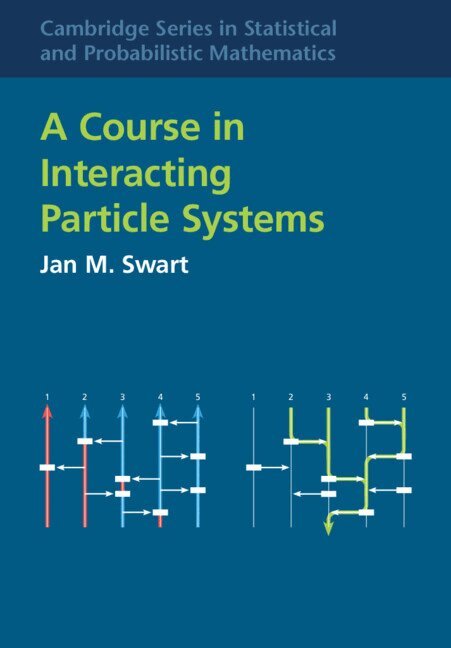
The culmination of years of teaching experience, this book provides a modern introduction to the mathematical theory of interacting particle systems. Assuming a background in probability and measure theory, it has been designed to support a one-semester course at a Master or Ph.D. level. It also provides a useful reference for researchers, containing several results that have not appeared in print in this form before. An emphasis is placed on graphical representations, which are used to give a construction that is intuitively easier to grasp than the traditional generator approach. Also included is an extensive look at duality theory, along with discussions of mean-field methods, phase transitions and critical behaviour. The text is illustrated with the results of numerical simulations and features exercises in every chapter. The theory is demonstrated on a range of models, reflecting the modern state of the subject and highlighting the scope of possible applications.
Del 38 - LECTURE NOTES SERIES, INSTITUTE FOR MATHEMATICAL SCIENCES, NATIONAL UNIVERSITY OF SINGAPORE
Interacting particle systems are Markov processes involving infinitely many interacting components. Since their introduction in the 1970s, researchers have found many applications in statistical physics and population biology. Genealogies, which follow the origin of the state of a site backwards in time, play an important role in their studies, especially for the biologically motivated systems.The program Genealogies of Interacting Particle Systems held at the Institute for Mathematical Sciences, National University of Singapore, from 17 July to 18 Aug 2017, brought together experts and young researchers interested in this modern topic. Central to the program were learning sessions where lecturers presented work outside of their own research, as well as a normal workshop. This is reflected in the present volume which contains two types of articles: Lecture notes of the learning sessions, which provide valuable introductions to topics of active interest;Original contributions by participants, which include both survey articles and original research.;Written by respected researchers, including experts in the field such as Steve Evans, member of the US National Academy of Sciences, as well as Anton Wakolbinger, Andreas Greven, and many others, this volume will no doubt be a valuable contribution to the probability community.
The culmination of years of teaching experience, this book provides a modern introduction to the mathematical theory of interacting particle systems. Assuming a background in probability and measure theory, it has been designed to support a one-semester course at a Master or Ph.D. level. It also provides a useful reference for researchers, containing several results that have not appeared in print in this form before. An emphasis is placed on graphical representations, which are used to give a construction that is intuitively easier to grasp than the traditional generator approach. Also included is an extensive look at duality theory, along with discussions of mean-field methods, phase transitions and critical behaviour. The text is illustrated with the results of numerical simulations and features exercises in every chapter. The theory is demonstrated on a range of models, reflecting the modern state of the subject and highlighting the scope of possible applications.
Del 38 - LECTURE NOTES SERIES, INSTITUTE FOR MATHEMATICAL SCIENCES, NATIONAL UNIVERSITY OF SINGAPORE
Interacting particle systems are Markov processes involving infinitely many interacting components. Since their introduction in the 1970s, researchers have found many applications in statistical physics and population biology. Genealogies, which follow the origin of the state of a site backwards in time, play an important role in their studies, especially for the biologically motivated systems.The program Genealogies of Interacting Particle Systems held at the Institute for Mathematical Sciences, National University of Singapore, from 17 July to 18 Aug 2017, brought together experts and young researchers interested in this modern topic. Central to the program were learning sessions where lecturers presented work outside of their own research, as well as a normal workshop. This is reflected in the present volume which contains two types of articles: Lecture notes of the learning sessions, which provide valuable introductions to topics of active interest;Original contributions by participants, which include both survey articles and original research.;Written by respected researchers, including experts in the field such as Steve Evans, member of the US National Academy of Sciences, as well as Anton Wakolbinger, Andreas Greven, and many others, this volume will no doubt be a valuable contribution to the probability community.