Jan Winiecki – författare
Visar alla böcker från författaren Jan Winiecki. Handla med fri frakt och snabb leverans.
38 produkter
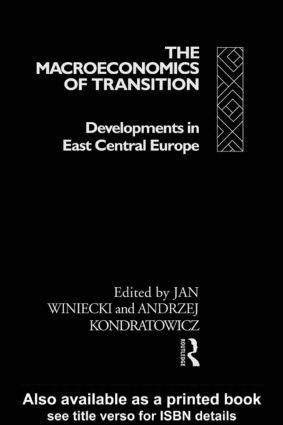
Macroeconomics of Transition
Av Andrzej Kondratowicz, Jan Winiecki
Inbunden, 1993
2504 kr
Lägg i varukorg
How successful has the transition to market economies proved in East-Central Europe? The decision by the East European countries to move to market economies was accompanied by much hypothesising and expounding of economic theories. However, now that the initial euphoria has passed it is time for a …
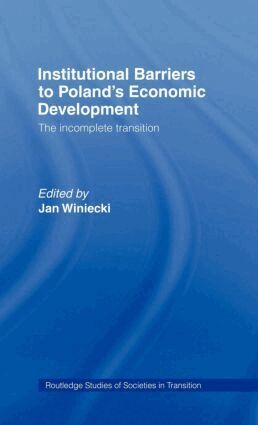
Institutional Barriers to Economic Development
Poland's Incomplete Transition
Av Jan Winiecki
Inbunden, 1997
2818 kr
Lägg i varukorg
Poland's transition from socialism to capitalism has largely been praised as a success story. In reality, however, according to this study, Poland's case is an 'incomplete' transition.Looking at the processes involved in economic transition, covering key issues including financial markets, labour …
Transition Economies and Foreign Trade
Av Jan Winiecki
Inbunden, 2002
2578 kr
Lägg i varukorg
Transition Economies and Foreign Trade makes the bold claim to have solved puzzles that have hindered the subject for years. By taking the distortions of the Communist era into consideration, Winiecki has explained the phenomenon of the decline in output and trade, as well as explaining the dual …
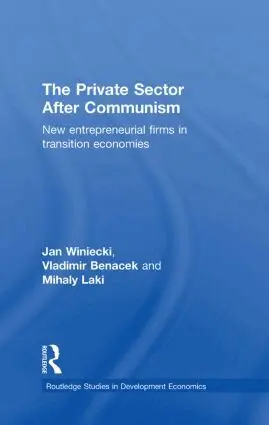
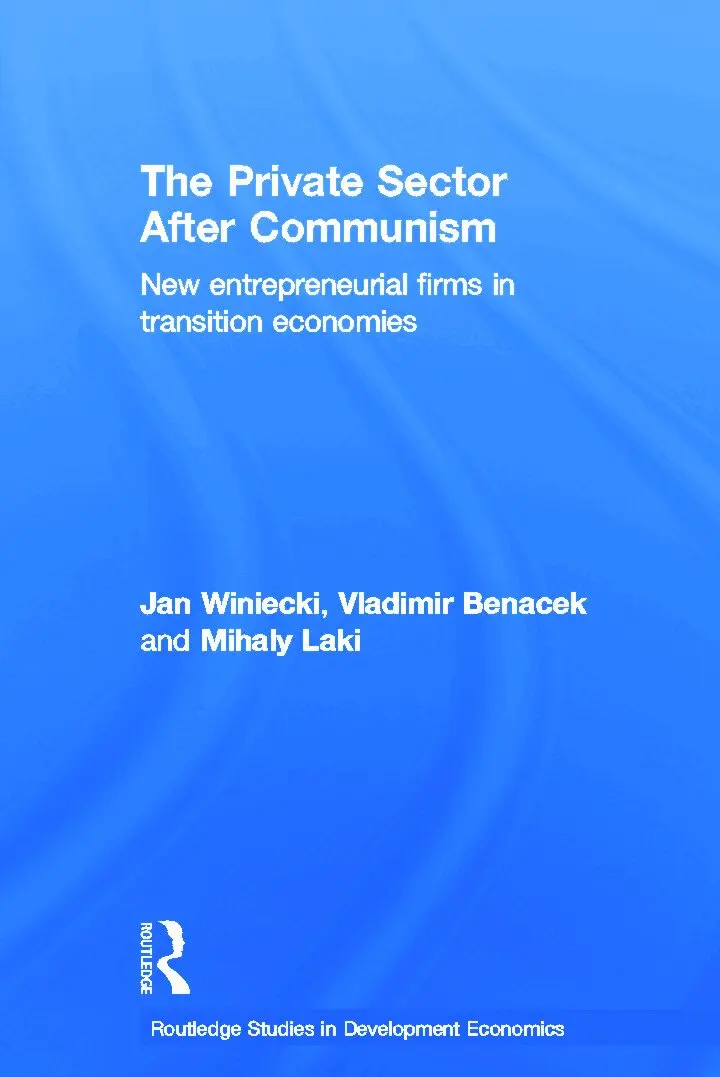
Private Sector after Communism
New Entrepreneurial Firms in Transition Economies
Av Vladimir Banacek, Mihaly Laki m. fl.
Inbunden, 2004
3262 kr
Lägg i varukorg
The transformation of state-owned enterprises into privately owned ones is commonly referred to as 'privatization'. Just as important as this process, though sometimes not given the attention it deserves and requires, is the establishment and expansion of new private firms.This book analyzes new …
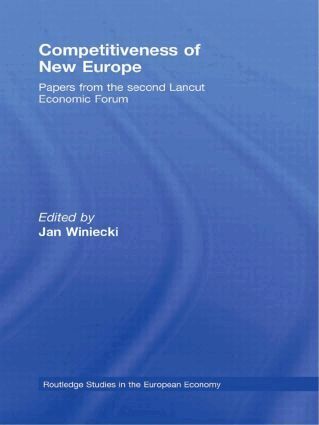
Competitiveness of New Europe
Papers from the Second Lancut Economic Forum
Av Jan Winiecki
Inbunden, 2008
1567 kr
Lägg i varukorg
New Europe is a rhetorical term used by some analysts to describe European post-communist transition success stories. The term implies their recent return to European, or more precisely Western civilization, but suggests - given their (forced) communist detour - that there is no single Pan-European …
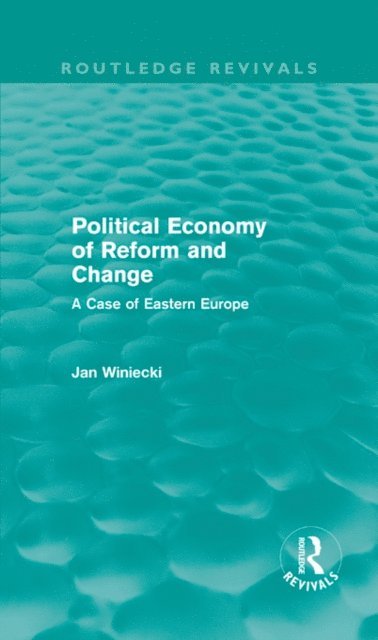
Political Economy of Reform and Change (Routledge Revivals)
Av Jan Winiecki
Häftad, 2012
382 kr
Lägg i varukorg
First published in 1997, this collection of articles and essays analyses the political economy of reform and change in Eastern Europe during the years of Gorbachev’s perestroika and the years immediately following the fall of the Berlin wall and the collapse of the Soviet Union. Written by Polish …
Economic Prospects - East and West
A View from the East
Av Jan Winiecki
Häftad, 2013
648 kr
Lägg i varukorg
First published in 1987, this is an analysis of the contemporary breakdown of political and economic systems within the Eastern European communist countries. Rather than passively following the developments of this crisis, the author seeks instead to identify the reasons for failure and to examine …
Resistance to Change in the Soviet Economic System (Routledge Revivals)
A property rights approach
Av Jan Winiecki
Inbunden, 2010
1861 kr
Lägg i varukorg
First published in 1991, this book uses a property rights perspective to analyse why there is such widespread resistance to change in the Soviet Economic System. Many within the ruling stratum benefit considerably from their positions, particularly in terms of access to goods and services. In an …
Resistance to Change in the Soviet Economic System (Routledge Revivals)
A property rights approach
Av Jan Winiecki
Häftad, 2012
457 kr
Lägg i varukorg
First published in 1991. This book uses a property rights perspective to analyse why there is such widespread resistance to change in the Soviet Economic System. Many within the ruling stratum benefit considerably from their positions, particularly in terms of access to goods and services. In an …
Private Sector after Communism
New Entrepreneurial Firms in Transition Economies
Av Vladimir Banacek, Mihaly Laki m. fl.
Häftad, 2013
1110 kr
Lägg i varukorg
The transformation of state-owned enterprises into privately owned ones is commonly referred to as 'privatization'. Just as important as this process, though sometimes not given the attention it deserves and requires, is the establishment and expansion of new private firms.This book analyzes new …
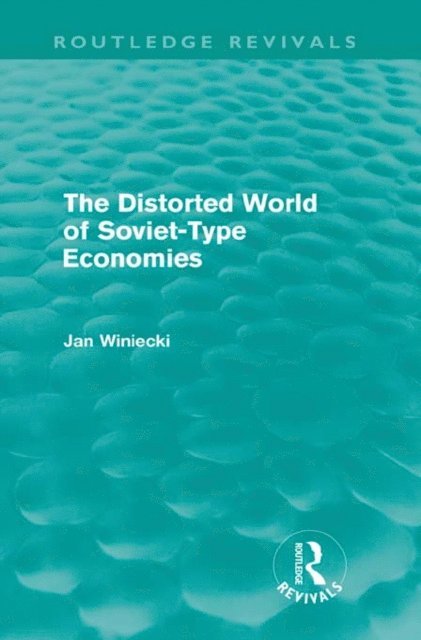
Distorted World of Soviet-Type Economies (Routledge Revivals)
Av Jan Winiecki
Inbunden, 2011
762 kr
Lägg i varukorg
The Soviet Union and Eastern Europe provide unique examples of large-scale relatively highly developed centrally planned economies. In the 1980s economists in both the East and West began to focus with increasingly critical attention on the economies of the Soviet Bloc, in an attempt to explain why …
Distorted World of Soviet-Type Economies (Routledge Revivals)
Av Jan Winiecki
Häftad, 2012
312 kr
Lägg i varukorg
The Soviet Union and Eastern Europe provide unique examples of large-scale relatively highly developed centrally planned economies. In the 1980s economists in both the East and West began to focus with increasingly critical attention on the economies of the Soviet Bloc, in an attempt to explain why …
Political Economy of Reform and Change (Routledge Revivals)
Av Jan Winiecki
Inbunden, 2011
785 kr
Lägg i varukorg
First published in 1997, this collection of articles and essays analyses the political economy of reform and change in Eastern Europe during the years of Gorbachev’s perestroika and the years immediately following the fall of the Berlin wall and the collapse of the Soviet Union. Written by Polish …
Competitiveness of New Europe
Papers from the Second Lancut Economic Forum
Av Jan Winiecki
E-bok, 2008
663 kr
Lägg i varukorg
New Europe is a rhetorical term used by some analysts to describe European post-communist transition success stories. The term implies their recent return to European, or more precisely Western civilization, but suggests - given their (forced) communist detour - that there is no single Pan-European …
Competitiveness of New Europe
Papers from the Second Lancut Economic Forum
Av Jan Winiecki
E-bok, 2008
663 kr
Lägg i varukorg
New Europe is a rhetorical term used by some analysts to describe European post-communist transition success stories. The term implies their recent return to European, or more precisely Western civilization, but suggests - given their (forced) communist detour - that there is no single Pan-European …
Private Sector after Communism
New Entrepreneurial Firms in Transition Economies
Av Jan Winiecki, Mihaly Laki m. fl.
E-bok, 2004
1034 kr
Lägg i varukorg
The transformation of state-owned enterprises into privately owned ones is commonly referred to as ''privatization''. Just as important as this process, though sometimes not given the attention it deserves and requires, is the establishment and expansion of new private firms. This book analyzes new …
Private Sector after Communism
New Entrepreneurial Firms in Transition Economies
Av Jan Winiecki, Mihaly Laki m. fl.
E-bok, 2004
1002 kr
Lägg i varukorg
The transformation of state-owned enterprises into privately owned ones is commonly referred to as ''privatization''. Just as important as this process, though sometimes not given the attention it deserves and requires, is the establishment and expansion of new private firms. This book analyzes new …
Transition Economies and Foreign Trade
Av Jan Winiecki
E-bok, 2002
838 kr
Lägg i varukorg
Transition Economies and Foreign Trade makes the bold claim to have solved puzzles that have hindered the subject for years. By taking the distortions of the Communist era into consideration, Winiecki has explained the phenomenon of the decline in output and trade, as well as explaining the dual …
Transition Economies and Foreign Trade
Av Jan Winiecki
E-bok, 2002
838 kr
Lägg i varukorg
Transition Economies and Foreign Trade makes the bold claim to have solved puzzles that have hindered the subject for years. By taking the distortions of the Communist era into consideration, Winiecki has explained the phenomenon of the decline in output and trade, as well as explaining the dual …
Institutional Barriers to Economic Development
Poland's Incomplete Transition
Av Jan Winiecki
E-bok, 2002
813 kr
Lägg i varukorg
Poland''s transition from socialism to capitalism has largely been praised as a success story. In reality, however, according to this study, Poland''s case is an ''incomplete'' transition. Looking at the processes involved in economic transition, covering key issues including financial markets, …
Institutional Barriers to Economic Development
Poland's Incomplete Transition
Av Jan Winiecki
E-bok, 2002
813 kr
Lägg i varukorg
Poland''s transition from socialism to capitalism has largely been praised as a success story. In reality, however, according to this study, Poland''s case is an ''incomplete'' transition. Looking at the processes involved in economic transition, covering key issues including financial markets, …
Macroeconomics of Transition
Av Jan Winiecki, Andrzej Kondratowicz
E-bok, 2005
856 kr
Lägg i varukorg
How successful has the transition to market economies proved in East-Central Europe? The decision by the East European countries to move to market economies was accompanied by much hypothesising and expounding of economic theories. However, now that the initial euphoria has passed it is time for a …
Macroeconomics of Transition
Av Jan Winiecki, Andrzej Kondratowicz
E-bok, 2005
838 kr
Lägg i varukorg
How successful has the transition to market economies proved in East-Central Europe? The decision by the East European countries to move to market economies was accompanied by much hypothesising and expounding of economic theories. However, now that the initial euphoria has passed it is time for a …
Economic Prospects - East and West
A View from the East
Av Jan Winiecki
E-bok, 2013
785 kr
Lägg i varukorg
First published in 1987, this is an analysis of the contemporary breakdown of political and economic systems within the Eastern European communist countries. Rather than passively following the developments of this crisis, the author seeks instead to identify the reasons for failure and to examine …
Economic Prospects - East and West
A View from the East
Av Jan Winiecki
E-bok, 2013
785 kr
Lägg i varukorg
First published in 1987, this is an analysis of the contemporary breakdown of political and economic systems within the Eastern European communist countries. Rather than passively following the developments of this crisis, the author seeks instead to identify the reasons for failure and to examine …
Political Economy of Reform and Change (Routledge Revivals)
Av Jan Winiecki
E-bok, 2013
419 kr
Lägg i varukorg
First published in 1997, this collection of articles and essays analyses the political economy of reform and change in Eastern Europe during the years of Gorbachev’s perestroika and the years immediately following the fall of the Berlin wall and the collapse of the Soviet Union. Written by Polish …
Political Economy of Reform and Change (Routledge Revivals)
Av Jan Winiecki
E-bok, 2013
433 kr
Lägg i varukorg
First published in 1997, this collection of articles and essays analyses the political economy of reform and change in Eastern Europe during the years of Gorbachev’s perestroika and the years immediately following the fall of the Berlin wall and the collapse of the Soviet Union. Written by Polish …
Distorted World of Soviet-Type Economies (Routledge Revivals)
Av Jan Winiecki
E-bok, 2013
375 kr
Lägg i varukorg
The Soviet Union and Eastern Europe provide unique examples of large-scale relatively highly developed centrally planned economies. In the 1980s economists in both the East and West began to focus with increasingly critical attention on the economies of the Soviet Bloc, in an attempt to explain why …
Distorted World of Soviet-Type Economies (Routledge Revivals)
Av Jan Winiecki
E-bok, 2013
375 kr
Lägg i varukorg
The Soviet Union and Eastern Europe provide unique examples of large-scale relatively highly developed centrally planned economies. In the 1980s economists in both the East and West began to focus with increasingly critical attention on the economies of the Soviet Bloc, in an attempt to explain why …
Competitiveness of New Europe
Papers from the Second Lancut Economic Forum
Av Jan Winiecki
Häftad, 2014
575 kr
Lägg i varukorg
New Europe is a rhetorical term used by some analysts to describe European post-communist transition success stories. The term implies their recent return to European, or more precisely Western civilization, but suggests - given their (forced) communist detour - that there is no single Pan-European …