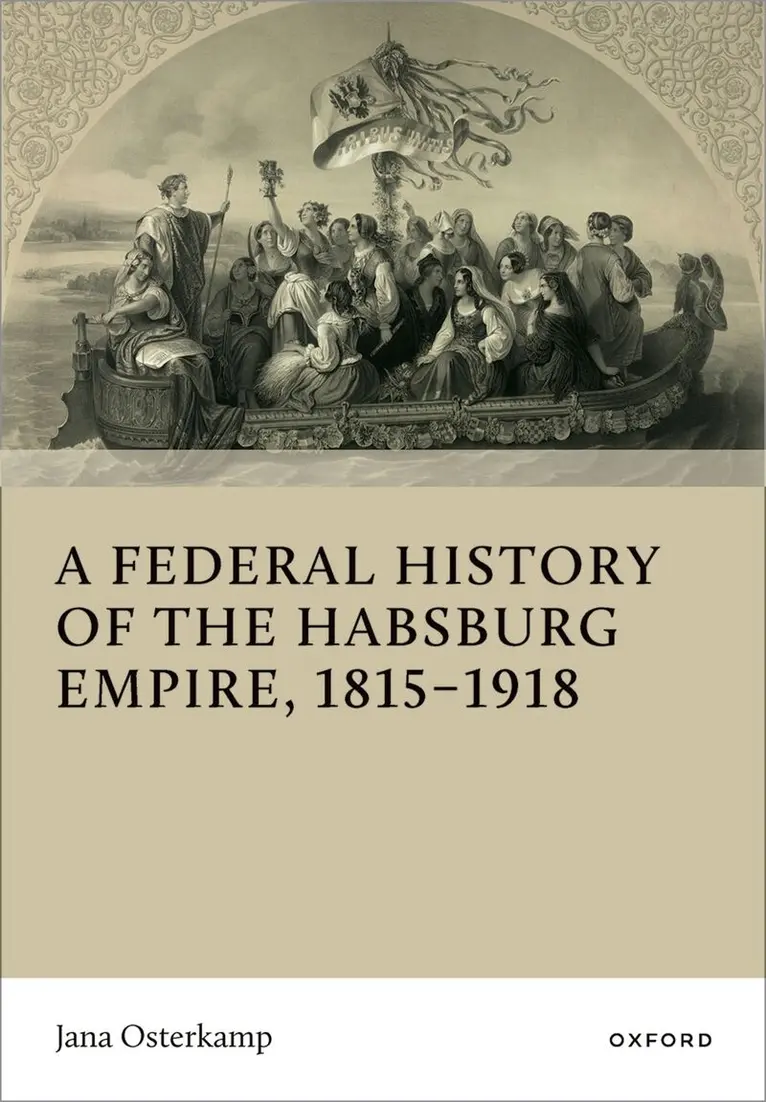
The Habsburg Monarchy was a Europe in miniature. In the nineteenth and twentieth centuries, it served as one of the world's most innovative laboratories for federal concepts, navigating an immense multiplicity of peoples, languages, and cultures. Based on extensive archival material and new sources, A Federal History of the Habsburg Empire, 1815-1918 provides a groundbreaking and new political history, exploring federalism not just as an abstract idea, but as a living practice of multi-level governance.From the executive federalism of Metternich to the fin-de-siècle 'cooperative empire', the study examines how power was distributed across the Habsburg empire, its imperial halves Austria and Hungary, and its historic crown lands such as Bohemia, Austria, Tyrol, and Galicia. It illuminates a system where elites collaborated on new tasks--from education and public health to social security and infrastructure--bridging the gap between pre-modern traditions of governance and the challenges of modern times.By analyzing unique federal models like 'non-territorial personal autonomy', which was implemented in diverse regions ranging from Moravia to the Bucovina and Bosnia-Herzegovina, Jana Osterkamp provides new answers to what held this complex polity together and why it ultimately fell apart. Habsburg federalism was always in tension, balancing imperial integration with claims for national self-determination. Serving as a prequel to modern Europe, this work reveals how federalism sought to secure a balance where diversity is not absorbed into unity. The history of the Habsburg Monarchy teaches us that a sense of community and cohesion must be constantly recreated, even in today's Europe.
The Habsburg Monarchy, with the diversity of its peoples, languages and historical regions, was a fascinating "Europe in miniature". Federalism became a hotly contested central theme in the 19th century. The federal laboratory ranged from Metternich's "federal state" to the personal autonomy of the Austromarxists and drafts of a constitution under Franz Ferdinand and Emperor Karl's nationality state from 1918. In addition to federal reform drafts, the book describes the Habsburg Empire as a living federation. This included a common foreign and security policy, the dualistic competition between Austria and Hungary and the increasing independence and cooperation of the Austrian crown lands, especially in modern policy areas such as education, health, welfare and infrastructure. This federal history in the European 19th century leads far beyond the history of the Habsburg Empire to the present day in Europe.
The Habsburg Monarchy was a Europe in miniature. In the nineteenth and twentieth centuries, it served as one of the world's most innovative laboratories for federal concepts, navigating an immense multiplicity of peoples, languages, and cultures. Based on extensive archival material and new sources, A Federal History of the Habsburg Empire, 1815-1918 provides a groundbreaking and new political history, exploring federalism not just as an abstract idea, but as a living practice of multi-level governance.From the executive federalism of Metternich to the fin-de-siècle 'cooperative empire', the study examines how power was distributed across the Habsburg empire, its imperial halves Austria and Hungary, and its historic crown lands such as Bohemia, Austria, Tyrol, and Galicia. It illuminates a system where elites collaborated on new tasks--from education and public health to social security and infrastructure--bridging the gap between pre-modern traditions of governance and the challenges of modern times.By analyzing unique federal models like 'non-territorial personal autonomy', which was implemented in diverse regions ranging from Moravia to the Bucovina and Bosnia-Herzegovina, Jana Osterkamp provides new answers to what held this complex polity together and why it ultimately fell apart. Habsburg federalism was always in tension, balancing imperial integration with claims for national self-determination. Serving as a prequel to modern Europe, this work reveals how federalism sought to secure a balance where diversity is not absorbed into unity. The history of the Habsburg Monarchy teaches us that a sense of community and cohesion must be constantly recreated, even in today's Europe.
The Habsburg Monarchy, with the diversity of its peoples, languages and historical regions, was a fascinating "Europe in miniature". Federalism became a hotly contested central theme in the 19th century. The federal laboratory ranged from Metternich's "federal state" to the personal autonomy of the Austromarxists and drafts of a constitution under Franz Ferdinand and Emperor Karl's nationality state from 1918. In addition to federal reform drafts, the book describes the Habsburg Empire as a living federation. This included a common foreign and security policy, the dualistic competition between Austria and Hungary and the increasing independence and cooperation of the Austrian crown lands, especially in modern policy areas such as education, health, welfare and infrastructure. This federal history in the European 19th century leads far beyond the history of the Habsburg Empire to the present day in Europe.