Janet Beavin Bavelas – författare
Visar alla böcker från författaren Janet Beavin Bavelas. Handla med fri frakt och snabb leverans.
5 produkter
5 produkter
Häftad, Engelska, 2011
384 kr
Skickas inom 5-8 vardagar
Called “one of the best books ever about human communication,” and a perennial bestseller, Pragmatics of Human Communication has formed the foundation of much contemporary research into interpersonal communication, in addition to laying the groundwork for context-based approaches to psychotherapy. The authors present the simple but radical idea that problems in life often arise from issues of communication, rather than from deep psychological disorders, reinforcing their conceptual explorations with case studies and well-known literary examples. Written with humor and for a variety of readers, this book identifies simple properties and axioms of human communication and demonstrates how all communications are actually a function of their contexts.Topics covered in this wide-ranging book include: the origins of communication; the idea that all behavior is communication; meta-communication; the properties of an open system; the family as a system of communication; the nature of paradox in psychotherapy; existentialism and human communication.
Inbunden, Engelska, 2022
1 333 kr
Skickas inom 7-10 vardagar
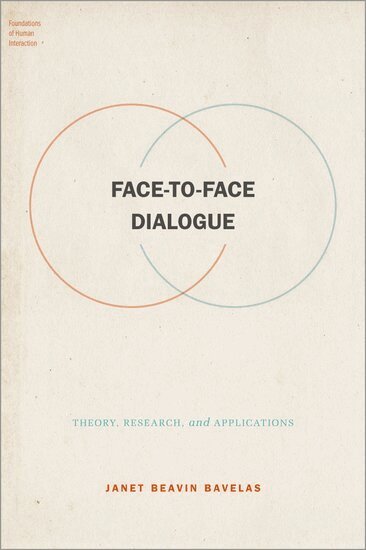
Face-to-face dialogue is our basic form of language use. It is, and always has been, the only form of language use that spans all cultures and societies. Face-to-Face Dialogue: Theory, Research, and Applications focuses on the unique combination of features that make face-to-face dialogue the fastest, most precise, and most skillful activity that ordinary individuals do together. Writing for an inter-disciplinary readership, Bavelas draws on her research program of over three decades to reveal the unique features of face-to-face dialogue. Unlike written or mediated forms, face-to-face dialogue uses both speech and co-speech gestures and also permits rapid-even simultaneous-exchanges. This book demonstrates the importance of focusing on interactions rather than individuals and on specific multi-modal acts rather than all nonverbal communication. Bavelas's mixed research methods begin inductively, leading to experiments with qualitative measures. Second-by-second microanalysis uncovers details of how a dialogue works. By focusing on communication as joint action, Face-to-Face Dialogue refocuses the conversation around the science of human communication, with realizable practical applications for researchers and professionals alike.
E-bok
PDF, Engelska, 20221 137 kr
Läs direkt efter köp
Face-to-face dialogue is our basic form of language use. It is, and always has been, the only form of language use that spans all cultures and societies. Face-to-Face Dialogue: Theory, Research, and Applications focuses on the unique combination of features that make face-to-face dialogue the fastest, most precise, and most skillful activity that ordinary individuals do together. Writing for an inter-disciplinary readership, Bavelas draws on her research program of over three decades to reveal the unique features of face-to-face dialogue. Unlike written or mediated forms, face-to-face dialogue uses both speech and co-speech gestures and also permits rapid-even simultaneous-exchanges. This book demonstrates the importance of focusing on interactions rather than individuals and on specific multi-modal acts rather than all nonverbal communication. Bavelas''s mixed research methods begin inductively, leading to experiments with qualitative measures. Second-by-second microanalysis uncovers details of how a dialogue works. By focusing on communication as joint action, Face-to-Face Dialogue refocuses the conversation around the science of human communication, with realizable practical applications for researchers and professionals alike.
E-bok
Engelska, 20221 097 kr
Läs direkt efter köp
Face-to-face dialogue is our basic form of language use. It is, and always has been, the only form of language use that spans all cultures and societies. Face-to-Face Dialogue: Theory, Research, and Applications focuses on the unique combination of features that make face-to-face dialogue the fastest, most precise, and most skillful activity that ordinary individuals do together. Writing for an inter-disciplinary readership, Bavelas draws on her research program of over three decades to reveal the unique features of face-to-face dialogue. Unlike written or mediated forms, face-to-face dialogue uses both speech and co-speech gestures and also permits rapid-even simultaneous-exchanges. This book demonstrates the importance of focusing on interactions rather than individuals and on specific multi-modal acts rather than all nonverbal communication. Bavelas''s mixed research methods begin inductively, leading to experiments with qualitative measures. Second-by-second microanalysis uncovers details of how a dialogue works. By focusing on communication as joint action, Face-to-Face Dialogue refocuses the conversation around the science of human communication, with realizable practical applications for researchers and professionals alike.
E-bok
Spanska, 2011125 kr
Läs direkt efter köp
Los autores, miembros del equipo que trabajó diez años en Palo Alto (California) con Gregory Bateson, estudian aquí la pragmática de la comunicación interpersonal. La comunicación es considerada como una relación cualitativamente diferente de las propiedades de los individuos que participan en ella.Después de definir ciertos conceptos generales, los autores presentan las características básicas de la comunicación humana e ilustran sus manifestaciones y sus posibles perturbaciones. Los distintos aspectos de la teoría son ejemplificados mediante un análisis de la pieza ¿Quién teme a Virginia Woolf?, de Edward Albee.Se analiza la importancia especial de la paradoja y la contradicción en la comunicación humana, tanto desde el punto de vista de la patología como de la terapia. La conducta perturbada es vista como una reacción comunicacional ante una situación que tiene determinadas propiedades, y no como una enfermedad localizada en la mente del individuo. Se discute también la famosa teoría del doble vínculo sobre la esquizofrenia, y se ejemplifica la situación contradictoria que caracteriza al doble vínculo en unas variadas situaciones interpersonales, incluida la psicoterapia. En el último capítulo se establece una comparación entre la teoría de la comunicación y el punto de vista existencial.Dentro de la nueva literatura sobre los fenómenos de la comunicación humana, este libro está ya en camino de convertirse en un clásico.