Janet Scott - Böcker
Visar alla böcker från författaren Janet Scott. Handla med fri frakt och snabb leverans.
5 produkter
5 produkter
123 kr
Skickas inom 5-8 vardagar
3 444 kr
Skickas inom 5-8 vardagar
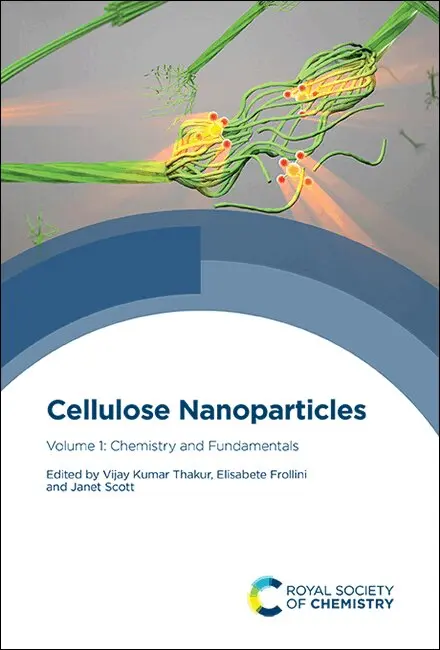
Cellulose nanoparticles (CNP) are a class of bio-based nanoscale materials, which are of interest due to their unique structural features and properties such as biocompatibility, biodegradability, and renewability. They are promising candidates for applications including in biomedicine, pharmaceuticals, electronics, barrier films, nanocomposites, membranes, and supercapacitors. New resources, extraction procedures and treatments are currently under development to satisfy increasing demands for cost-effective and sustainable methods of manufacturing new types of cellulose nanoparticle-based materials on an industrial scale. Cellulose Nanoparticles: Chemistry and Fundamentals covers the synthesis, characterization and processing of cellulose nanomaterials. It aims to address the recent progress in the production methodologies for cellulose nanoparticles, covering principal cellulose resources and the main processes used for isolation. Chapters cover the preparation and characterisation of cellulose nanocrystals and nanofibrils. Together with Volume 2, these books form a useful reference work for graduate students and researchers in chemistry, materials science, nanoscience and green nanotechnology.
3 099 kr
Skickas inom 5-8 vardagar
Cellulose nanoparticles (CNP) are a class of bio-based nanoscale materials, which are of interest due to their unique structural features and properties such as biocompatibility, biodegradability, and renewability. They are promising candidates for applications including in biomedicine, pharmaceuticals, electronics, barrier films, nanocomposites, membranes, and supercapacitors. New resources, extraction procedures and treatments are currently under development to satisfy increasing demands for cost-effective and sustainable methods of manufacturing new types of cellulose nanoparticle-based materials on an industrial scale. Cellulose Nanoparticles: Synthesis and Manufacturing concentrates on advanced high performance cellulose nanocomposites. Chapters cover the synthesis of advanced materials, manufacturing, and applications of cellulose nanocrystals and nanofibrils. Together with Volume 1, these books form a useful reference work for graduate students and researchers in chemistry, materials science, nanoscience and green nanotechnology.
6 520 kr
Skickas inom 5-8 vardagar
Cellulose nanoparticles (CNP) are a class of bio-based nanoscale materials, which are of interest due to their unique structural features and properties such as biocompatibility, biodegradability, and renewability. They are promising candidates for applications including in biomedicine, pharmaceuticals, electronics, barrier films, nanocomposites, membranes, and supercapacitors. New resources, extraction procedures and treatments are currently under development to satisfy increasing demands for cost-effective and sustainable methods of manufacturing new types of cellulose nanoparticle-based materials on an industrial scale. This two-volume set covers Cellulose Nanoparticles: Chemistry and Fundamentals and Cellulose Nanoparticles: Synthesis and Manufacturing. Written by an international collection of contributors in the field, these books form a useful reference work for graduate students and researchers in chemistry, materials science, nanoscience and green nanotechnology.
1 479 kr
Skickas inom 5-8 vardagar
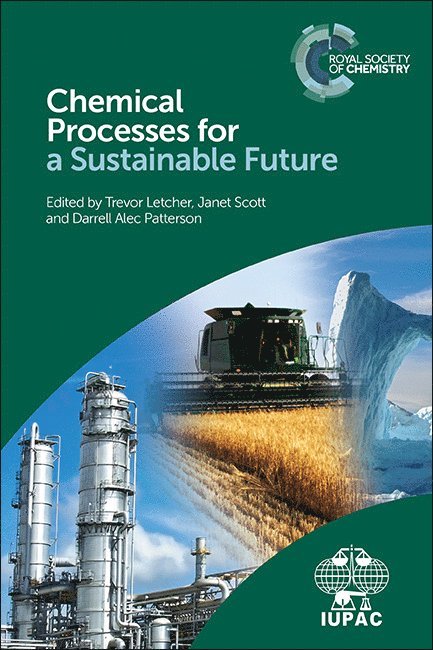
This comprehensive book approaches sustainability from two directions, the reduction of pollution and the maintaining of existing resources, both of which are addressed in a thorough examination of the main chemical processes and their impact. Divided into five sections, each introduced by a leading expert in the field, the book takes the reader through the various types of chemical processes, demonstrating how we must find ways to lower the environmental cost (of both pollution and contributions to climate change) of producing chemicals. Each section consists of several chapters, presenting the latest facts and opinion on the methodologies being adopted by the chemical industry to provide a more sustainable future. A follow-up to Materials for a Sustainable Future (Royal Society of Chemistry 2012), this book will appeal to the same broad readership - industrialists and investors; policy makers in local and central governments; students, teachers, scientists and engineers working in the field; and finally editors, journalists and the general public who need information on the increasingly popular concepts of sustainable living.