
Jørgen Møller – författare
Visar alla böcker från författaren Jørgen Møller. Handla med fri frakt och snabb leverans.
3 produkter
3 produkter
Inbunden, Engelska, 2022
1 249 kr
Skickas inom 7-10 vardagar
Generations of social scientists and historians have argued that the escape from empire and consequent fragmentation of power - across and within polities - was a necessary condition for the European development of the modern territorial state, modern representative democracy, and modern levels of prosperity. The Catholic Church and European State Formation, AD 1000-1500 inserts the Catholic Church as the main engine of this persistent international and domestic power pluralism, which has moulded European state-formation for almost a millennium.The 'crisis of church and state' that began in the second half of the eleventh century is argued here as having fundamentally reshaped European patterns of state formation and regime change. It did so by doing away with the norm in historical societies - sacral monarchy - and by consolidating the two great balancing acts European state builders have been engaged in since the eleventh century: against strong social groups and against each other. The book traces the roots of this crisis to a large-scale breakdown of public authority in the Latin West, which began in the ninth century, and which at one and the same time incentivised and permitted a religious reform movement to radically transform the Catholic Church in the period from the late tenth century onwards.Drawing on a unique dataset of towns, parliaments, and ecclesiastical institutions such as bishoprics and monasteries, the book documents how this church reform movement was crucial for the development and spread of self-government (the internal balancing act) and the weakening of the Holy Roman Empire (the external balancing act) in the period AD 1000-1500.
Inbunden, Engelska, 2022
1 369 kr
Skickas inom 5-8 vardagar
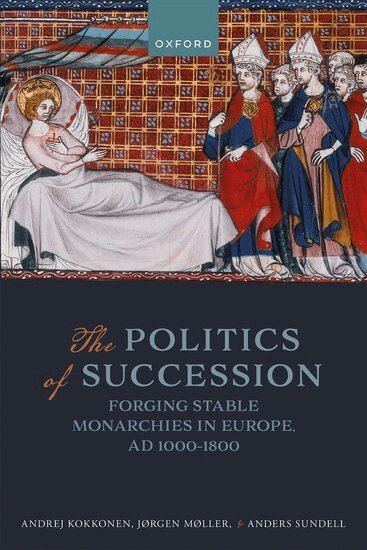
The death of the ruler poses a significant threat to the stability of any polity. Arranging for a peaceful and orderly succession has been a formidable challenge in most historical societies, and it continues to be a test that modern authoritarian regimes regularly face and often fail. Drawing on a unique dataset of the life and fates of monarchs in all major monarchies in Medieval and Early Modern Europe, The Politics of Succession documents how succession have historically been moments of violence and insecurity. Deaths of rulers were often associated with civil war, and the shadow cast by looming successions caused coups and depositions. But this book also shows that the development and spread of primogeniture - the eldest-son-taking-the-throne - mitigated the problem of succession in Europe in the period after AD 1000. The predictability and stability that followed from a clear hereditary principle outweighed the problems of incompetent and irrational rulers sometimes inheriting power. The data used in the book demonstrates that primogeniture reduced the risk of depositions and civil war following the inevitable deaths of leaders. In this way, hereditary monarchy helped create political stability and lengthen the time horizons of rulers and elites alike, thereby facilitating state-building. The book thus sheds light on the rationale of a system of leader selection that today often appears illogical and outdated - and it uses these findings to shed light on the key advantage of modern representative democracy: its ability to complete power transfers peacefully.
Inbunden, Engelska, 2020
1 626 kr
Skickas inom 5-8 vardagar
The interwar period has left a deep impression on later generations. This was an age of crises where representative democracy, itself a relatively recent political invention, seemed unable to cope with the challenges that confronted it. Against the backdrop of the economic crisis that began in 2008 and the rise of populist parties, a new body of scholarship - frequently invoked by the media - has used interwar political developments to warn that even long-established Western democracies are fragile. Democratic Stability in an Age of Crisis challenges this 'interwar analogy' based on the fact that a relatively large number of interwar democracies were able to survive the recurrent crises of the 1920s and 1930s. The main aim of this book is to understand the striking resilience of these democracies, and how they differed from the many democracies that broke down in the same period. The authors advance an explanation that emphasizes the importance of democratic legacies and the strength of the associational landscape (i.e., organized civil society and institutionalized political parties). Moreover, they underline that these factors were themselves associated with a set of deeper structural conditions, which on the eve of the interwar period had brought about different political pathways. The authors' empirical strategy consists of a combination of comparative analyses of all interwar democratic spells and illustrative case studies. The book's main takeaway point is that the interwar period shows how resilient democracy is once it has had time to consolidate. On this basis, recent warnings about the fragility of contemporary democracies in Western Europe and North America seem exaggerated - or, at least, that they cannot be sustained by interwar evidence. Comparative Politics is a series for researchers, teachers, and students of political science that deals with contemporary government and politics. Global in scope, books in the series are characterized by a stress on comparative analysis and strong methodological rigour. The series is published in association with the European Consortium for Political Research. For more information visit: www.ecprnet.eu The series is edited by Susan Scarrow, Chair of the Department of Political Science, University of Houston, and Jonathan Slapin, Professor, Department of Political Science, University of Zurich.