Jason Clarke - Böcker
Visar alla böcker från författaren Jason Clarke. Handla med fri frakt och snabb leverans.
4 produkter
4 produkter
180 kr
Skickas inom 5-8 vardagar
234 kr
Skickas inom 7-10 vardagar
This Element examines the influence of expectation and attention on conscious perception. It explores the debate on whether attention is necessary for conscious perception by presenting empirical evidence from studies on inattentional blindness, change blindness, and the attentional blink. While the evidence strongly suggests that attention is necessary for conscious perception, other research has shown that expectation can shape perception, sometimes leading to illusory experiences where predicted stimuli are perceived despite their absence. This phenomenon, termed 'expectation awareness', suggests that attention may not be necessary for all conscious experiences. These findings are explored within the predictive processing framework, where the brain is characterized as a prediction engine, continuously updating its internal models to minimize prediction errors. Integrating findings from psychology, neuroscience, and cognitive science, this Element provides a predictive processing model of how attention and expectation construct perceptual reality. It also discusses clinical and theoretical implications and suggests future research.
753 kr
Skickas inom 7-10 vardagar
This Element examines the influence of expectation and attention on conscious perception. It explores the debate on whether attention is necessary for conscious perception by presenting empirical evidence from studies on inattentional blindness, change blindness, and the attentional blink. While the evidence strongly suggests that attention is necessary for conscious perception, other research has shown that expectation can shape perception, sometimes leading to illusory experiences where predicted stimuli are perceived despite their absence. This phenomenon, termed 'expectation awareness', suggests that attention may not be necessary for all conscious experiences. These findings are explored within the predictive processing framework, where the brain is characterized as a prediction engine, continuously updating its internal models to minimize prediction errors. Integrating findings from psychology, neuroscience, and cognitive science, this Element provides a predictive processing model of how attention and expectation construct perceptual reality. It also discusses clinical and theoretical implications and suggests future research.
Iron Age, Roman and Anglo-Saxon Settlement along the Empingham to Hannington Pipeline in Northamptonshire and Rutland
Häftad, Engelska, 2017
396 kr
Skickas
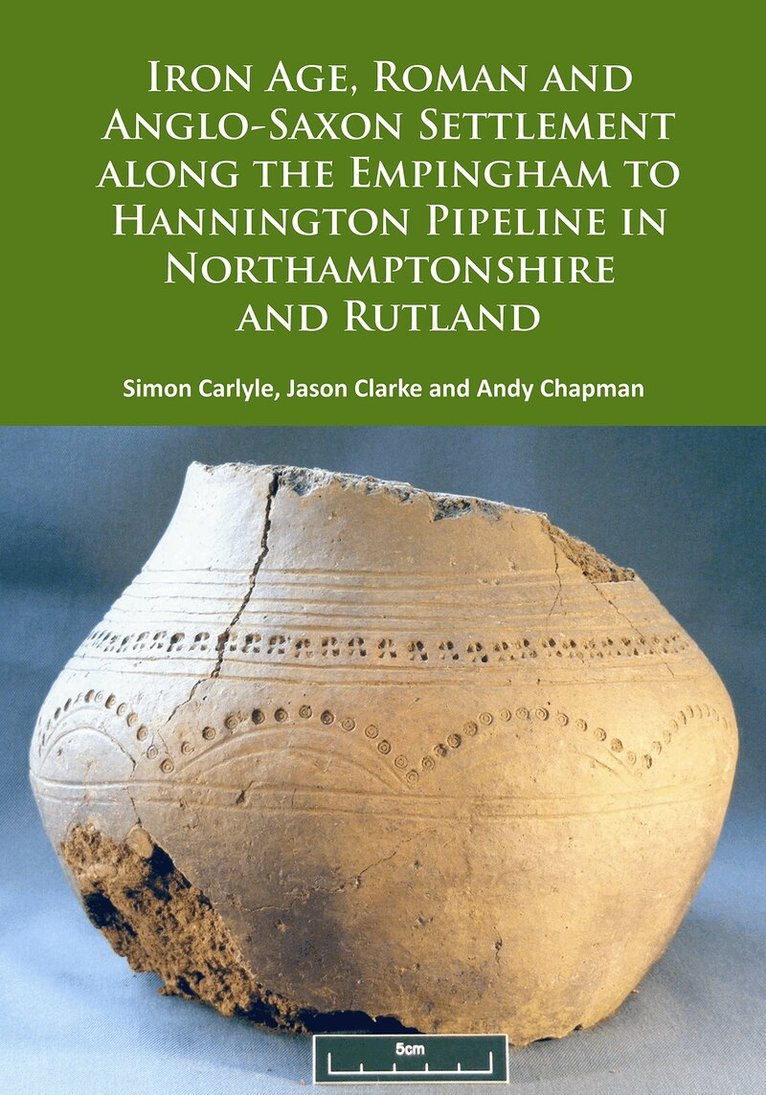
Between January 2008 and July 2009, Northamptonshire Archaeology, now part of MOLA (Museum of London Archaeology), carried out a series of excavations along the route of a new water pipeline being constructed by Anglian Water Services as part of a major project to increase the supply of water to new homes and businesses in the south-east Midlands region. Nineteen sites were investigated, dating primarily to the Iron Age, Roman and Anglo-Saxon periods. The earliest remains were a late Bronze Age/early Iron Age pit alignment near Seaton, Rutland. The Iron Age and Roman sites were small rural settlements comprising ditched enclosures, the remains of roundhouses and pits. Settlements were located near Seaton and Caldecott in Rutland and in Northamptonshire at Swinawe Barn near Corby, Thorpe Malsor, White Hill Lodge, Great Cransley and Willows Nursery. A Roman site near Rushton, Northamptonshire may be associated with a villa estate. Other sites included part of a Roman field system at Violet Lane, near Corby, and Roman cremation burials near Gretton, Northamptonshire. The settlements mainly date from the late middle Iron Age, 2nd century BC, through to the 4th century AD, although there was little evidence for direct continuity of settlement between the Iron Age and Roman periods. An Anglo-Saxon cremation cemetery dated to the late 5th century to mid-7th century AD, at Glaston, Rutland, contained 16 cremation burials deposited in decorated and plain urns along with small assemblages of grave goods, often also burnt on the pyre, and including a brooch, glass beads, and fragments of a bone comb and mount. Later features generally comprised medieval and post-medieval furrows from ridge and furrow field systems and field boundary ditches.