Jason Jackson - Böcker
Visar alla böcker från författaren Jason Jackson. Handla med fri frakt och snabb leverans.
8 produkter
8 produkter
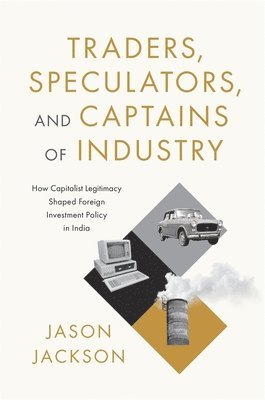
Traders, Speculators, and Captains of Industry
How Capitalist Legitimacy Shaped Foreign Investment Policy in India
Inbunden, Engelska, 2025
414 kr
Skickas inom 7-10 vardagar
An incisive account of the moral beliefs that have guided foreign investment policy in India since the late colonial period, with an eye toward their implications for the twenty-first-century global economy.Is foreign capital an agent of economic growth in developing countries or a vehicle of extraction? Examining how Indian elites wrestled with this question in the late colonial and postcolonial periods, Jason Jackson argues that it reflects a false binary. Instead of simply choosing between domestic and foreign capital, Indian policymakers have long considered the business ethics of individual firms. Indian economic nationalism, in other words, has never been characterized by a straightforward preference for domestic over foreign capital.Jackson demonstrates that Indian policymakers have sought to favor firms that they believe are most likely to advance industrial development and societal progress at home. In particular, official policy and discourse have sought to confer a kind of moral legitimacy on businesses that invest their profits in local professional development and technological innovation—practices deemed synonymous with economic modernization. Meanwhile, firms seen as simply trading rather than producing, or as engaging in financial speculation and other allegedly regressive activities, have been viewed unfavorably. Jackson argues that these moral categories of capitalist legitimacy have shaped policymaking from the demise of the East India Company and rise of a new class of Indian industrialists in the late nineteenth century; to clashes between companies including Coca-Cola, Thums Up, Hero, and Honda in the twentieth; to more recent efforts to centralize political power through controversial market-governance projects.An incisive look at the contested terms of capitalist self-interest and business ethics, Traders, Speculators, and Captains of Industry sheds new light on debates over investment policy and state-market relations in a global economy.
241 kr
Skickas inom 7-10 vardagar
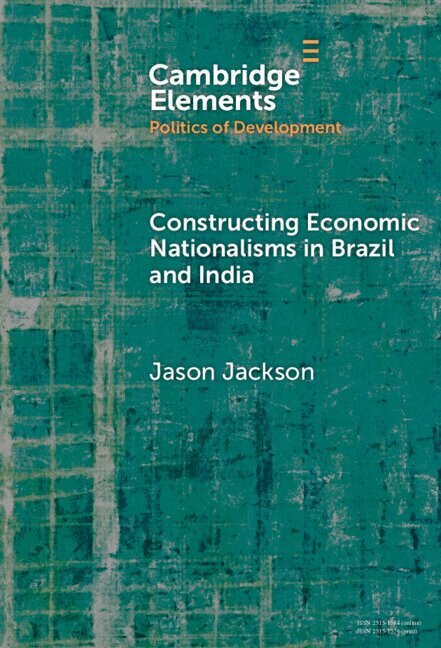
While the concept of economic nationalism is frequently deployed it is often poorly defined, posited as the cause of protectionism in some cases while providing a rationale for liberalization in others. This Element provides a more rigorous articulation by analyzing variation in foreign investment regulation in postwar Brazil and India. Conventional approaches cite India's leftist "socialism" and Brazil's right-wing authoritarianism to explain why India resisted foreign direct investment (FDI) while Brazil welcomed foreign firms. However, this ignores puzzling industry-level variation: India restricted FDI in auto manufacturing but allowed multinationals in oil, while Brazil welcomed foreign auto companies but prohibited FDI in oil. This variation is inadequately explained by pluralist theories, structural-material approaches, or constructivist ideas. This Element argues that FDI policies were shaped by contrasting colonial experiences that generated distinct economic nationalisms and patterns of industrialization in both countries. This title is also available as Open Access on Cambridge Core.
775 kr
Skickas inom 7-10 vardagar
While the concept of economic nationalism is frequently deployed it is often poorly defined, posited as the cause of protectionism in some cases while providing a rationale for liberalization in others. This Element provides a more rigorous articulation by analyzing variation in foreign investment regulation in postwar Brazil and India. Conventional approaches cite India's leftist "socialism" and Brazil's right-wing authoritarianism to explain why India resisted foreign direct investment (FDI) while Brazil welcomed foreign firms. However, this ignores puzzling industry-level variation: India restricted FDI in auto manufacturing but allowed multinationals in oil, while Brazil welcomed foreign auto companies but prohibited FDI in oil. This variation is inadequately explained by pluralist theories, structural-material approaches, or constructivist ideas. This Element argues that FDI policies were shaped by contrasting colonial experiences that generated distinct economic nationalisms and patterns of industrialization in both countries. This title is also available as Open Access on Cambridge Core.
133 kr
Skickas
Moving from 1930s Camden to a Royal Wedding "riot", via football fights, office steeplechases and awkward dates in art galleries, London Lies is a bizarre, funny, moving and sometimes unnerving glimpse into the secret life of the city we all love and know.Featuring nineteen writers and twenty-three stories showcased at award-winning monthly live literature event, London's Liars' League.
150 kr
Skickas inom 5-8 vardagar
Del 1 - Rise to Clarity
Rise to Clarity - A Guide to Quitting Marijuana and Learning to Live a Happy Life Without It
Häftad, Engelska, 2024
116 kr
Skickas inom 5-8 vardagar
203 kr
Skickas inom 5-8 vardagar
133 kr
Skickas inom 5-8 vardagar