Jaume Barceló – författare
Visar alla böcker från författaren Jaume Barceló. Handla med fri frakt och snabb leverans.
8 produkter
8 produkter
Del 144 - International Series in Operations Research & Management Science
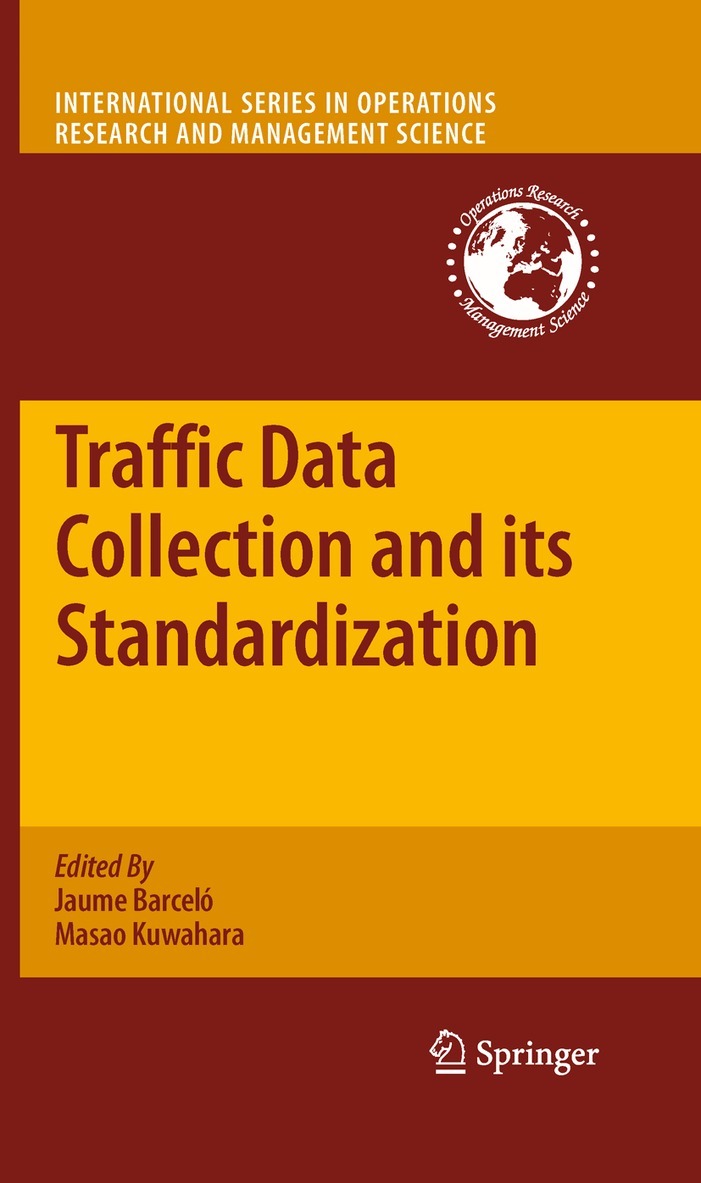
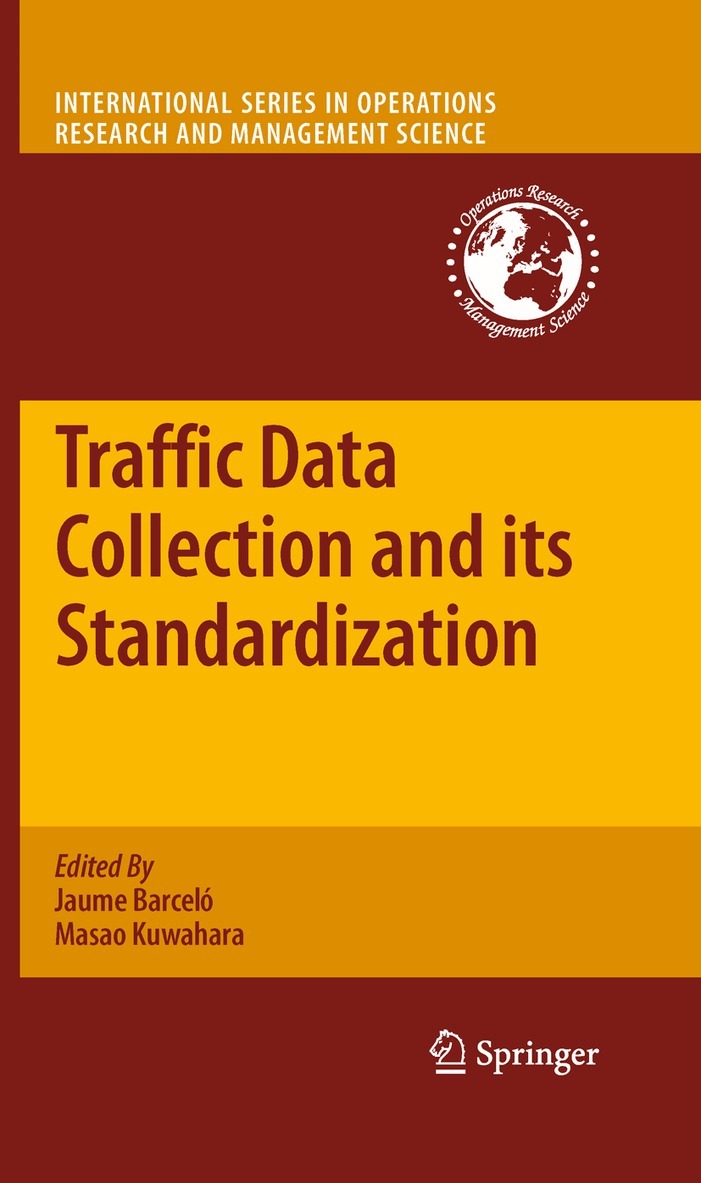
Traffic Data Collection and its Standardization
Inbunden, Engelska, 2010
1 123 kr
Skickas inom 10-15 vardagar
A nice night of October 2007, in Beijing, during the XV World Conference on ITS a number of colleagues met informally for a dinner party that spontaneously became a vivid discussion on the importance of traffic data for all types of p- poses. Researchers can hardly do any progress in modeling, developing, and te- ing theories without suitable data, and what practitioners can do in real life is limited not only by technology but also by the availability of the required data. Quite frequently, the data and not the technologies are what determine how far we can go. Any discussion about traffic data leads in a natural way to a discussion on the variety of traffic data sources, formats, levels of aggregation, accuracies, and so on. Consequently, we moved to talk on the initiative that Kuwahara had undertaken in his traffic laboratory at the University of Tokyo, known as the International Traffic Data Base, and thus smoothly but inexorably we came to agree that it would be convenient to organize a workshop to continue our discussion at a more formal level, share our points of view with other colleagues, listen what they had to say and, if possible, d- seminate the findings in our professional and academic communities.
E-bok
PDF, Engelska, 20101 408 kr
Läs direkt efter köp
A nice night of October 2007, in Beijing, during the XV World Conference on ITS a number of colleagues met informally for a dinner party that spontaneously became a vivid discussion on the importance of traffic data for all types of p- poses. Researchers can hardly do any progress in modeling, developing, and te- ing theories without suitable data, and what practitioners can do in real life is limited not only by technology but also by the availability of the required data. Quite frequently, the data and not the technologies are what determine how far we can go. Any discussion about traffic data leads in a natural way to a discussion on the variety of traffic data sources, formats, levels of aggregation, accuracies, and so on. Consequently, we moved to talk on the initiative that Kuwahara had undertaken in his traffic laboratory at the University of Tokyo, known as the International Traffic Data Base, and thus smoothly but inexorably we came to agree that it would be convenient to organize a workshop to continue our discussion at a more formal level, share our points of view with other colleagues, listen what they had to say and, if possible, d- seminate the findings in our professional and academic communities.
Del 145 - International Series in Operations Research & Management Science
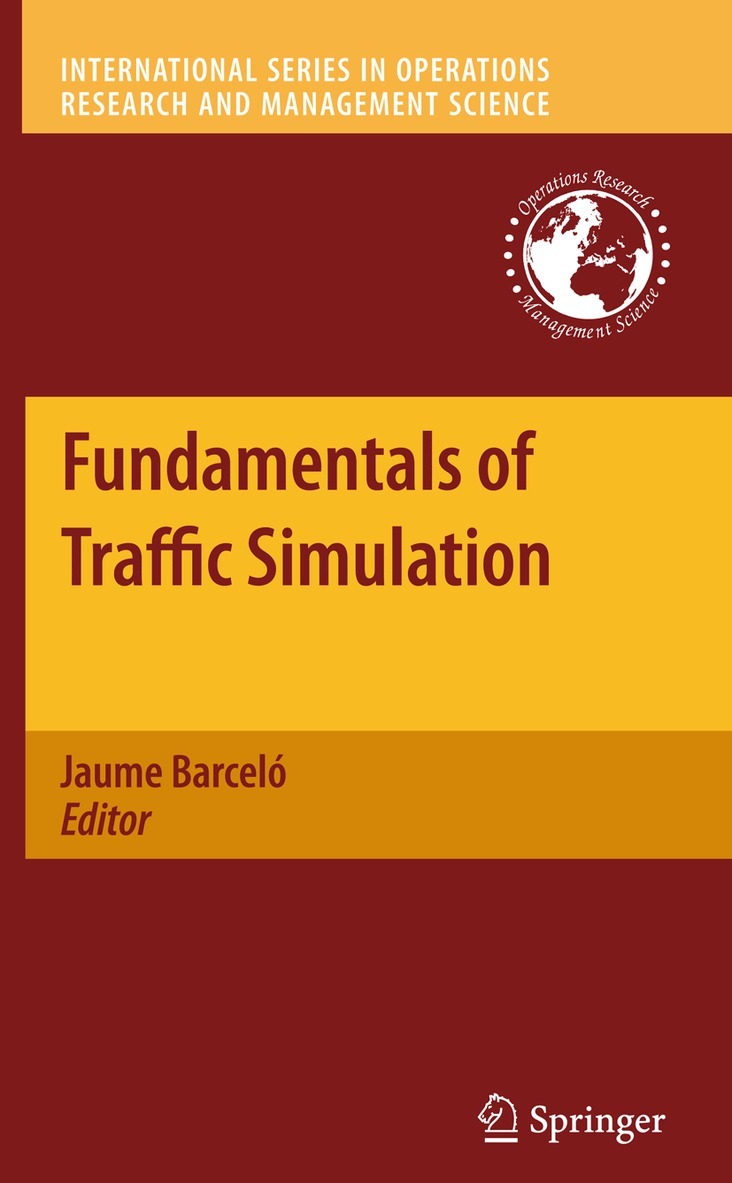
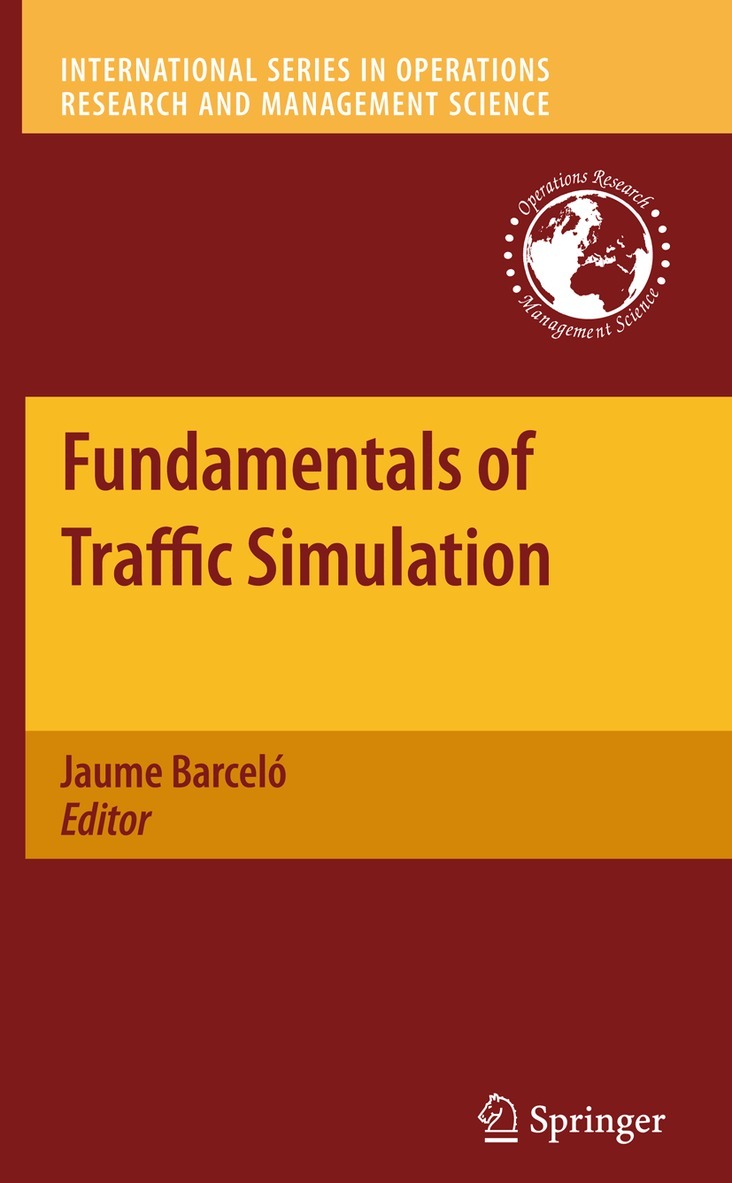
Fundamentals of Traffic Simulation
Inbunden, Engelska, 2010
3 583 kr
Skickas inom 10-15 vardagar
The increasing power of computer technologies, the evolution of software en- neering and the advent of the intelligent transport systems has prompted traf c simulation to become one of the most used approaches for traf c analysis in s- port of the design and evaluation of traf c systems. The ability of traf c simulation to emulate the time variability of traf c phenomena makes it a unique tool for capturing the complexity of traf c systems. In recent years, traf c simulation – and namely microscopic traf c simulation – has moved from the academic to the professional world. A wide variety of traf- c simulation software is currently available on the market and it is utilized by thousands of users, consultants, researchers and public agencies. Microscopic traf c simulation based on the emulation of traf c ows from the dynamics of individual vehicles is becoming one the most attractive approaches. However, traf c simulation still lacks a uni ed treatment. Dozens of papers on theory and applications are published in scienti c journals every year. A search of simulation-related papers and workshops through the proceedings of the last annual TRB meetings would support this assertion, as would a review of the minutes from speci cally dedicated meetings such as the International Symposiums on Traf c Simulation (Yokohama, 2002; Lausanne, 2006; Brisbane, 2008) or the International Workshops on Traf c Modeling and Simulation (Tucson, 2001; Barcelona, 2003; Sedona, 2005; Graz 2008). Yet, the only comprehensive treatment of the subject to be found so far is in the user’s manuals of various software products.
E-bok
PDF, Engelska, 20114 552 kr
Läs direkt efter köp
The increasing power of computer technologies, the evolution of software en- neering and the advent of the intelligent transport systems has prompted traf c simulation to become one of the most used approaches for traf c analysis in s- port of the design and evaluation of traf c systems. The ability of traf c simulation to emulate the time variability of traf c phenomena makes it a unique tool for capturing the complexity of traf c systems. In recent years, traf c simulation – and namely microscopic traf c simulation – has moved from the academic to the professional world. A wide variety of traf- c simulation software is currently available on the market and it is utilized by thousands of users, consultants, researchers and public agencies. Microscopic traf c simulation based on the emulation of traf c ows from the dynamics of individual vehicles is becoming one the most attractive approaches. However, traf c simulation still lacks a uni ed treatment. Dozens of papers on theory and applications are published in scienti c journals every year. A search of simulation-related papers and workshops through the proceedings of the last annual TRB meetings would support this assertion, as would a review of the minutes from speci cally dedicated meetings such as the International Symposiums on Traf c Simulation (Yokohama, 2002; Lausanne, 2006; Brisbane, 2008) or the International Workshops on Traf c Modeling and Simulation (Tucson, 2001; Barcelona, 2003; Sedona, 2005; Graz 2008). Yet, the only comprehensive treatment of the subject to be found so far is in the user’s manuals of various software products.
Del 144 - International Series in Operations Research & Management Science
Traffic Data Collection and its Standardization
Häftad, Engelska, 2012
1 123 kr
Skickas inom 10-15 vardagar
A nice night of October 2007, in Beijing, during the XV World Conference on ITS a number of colleagues met informally for a dinner party that spontaneously became a vivid discussion on the importance of traffic data for all types of p- poses. Researchers can hardly do any progress in modeling, developing, and te- ing theories without suitable data, and what practitioners can do in real life is limited not only by technology but also by the availability of the required data. Quite frequently, the data and not the technologies are what determine how far we can go. Any discussion about traffic data leads in a natural way to a discussion on the variety of traffic data sources, formats, levels of aggregation, accuracies, and so on. Consequently, we moved to talk on the initiative that Kuwahara had undertaken in his traffic laboratory at the University of Tokyo, known as the International Traffic Data Base, and thus smoothly but inexorably we came to agree that it would be convenient to organize a workshop to continue our discussion at a more formal level, share our points of view with other colleagues, listen what they had to say and, if possible, d- seminate the findings in our professional and academic communities.
Häftad, Engelska, 2012
3 583 kr
Skickas inom 10-15 vardagar
The increasing power of computer technologies, the evolution of software en- neering and the advent of the intelligent transport systems has prompted traf c simulation to become one of the most used approaches for traf c analysis in s- port of the design and evaluation of traf c systems. The ability of traf c simulation to emulate the time variability of traf c phenomena makes it a unique tool for capturing the complexity of traf c systems. In recent years, traf c simulation – and namely microscopic traf c simulation – has moved from the academic to the professional world. A wide variety of traf- c simulation software is currently available on the market and it is utilized by thousands of users, consultants, researchers and public agencies. Microscopic traf c simulation based on the emulation of traf c ows from the dynamics of individual vehicles is becoming one the most attractive approaches. However, traf c simulation still lacks a uni ed treatment. Dozens of papers on theory and applications are published in scienti c journals every year. A search of simulation-related papers and workshops through the proceedings of the last annual TRB meetings would support this assertion, as would a review of the minutes from speci cally dedicated meetings such as the International Symposiums on Traf c Simulation (Yokohama, 2002; Lausanne, 2006; Brisbane, 2008) or the International Workshops on Traf c Modeling and Simulation (Tucson, 2001; Barcelona, 2003; Sedona, 2005; Graz 2008). Yet, the only comprehensive treatment of the subject to be found so far is in the user’s manuals of various software products.
Häftad, Engelska, 2012
522 kr
Skickas inom 10-15 vardagar
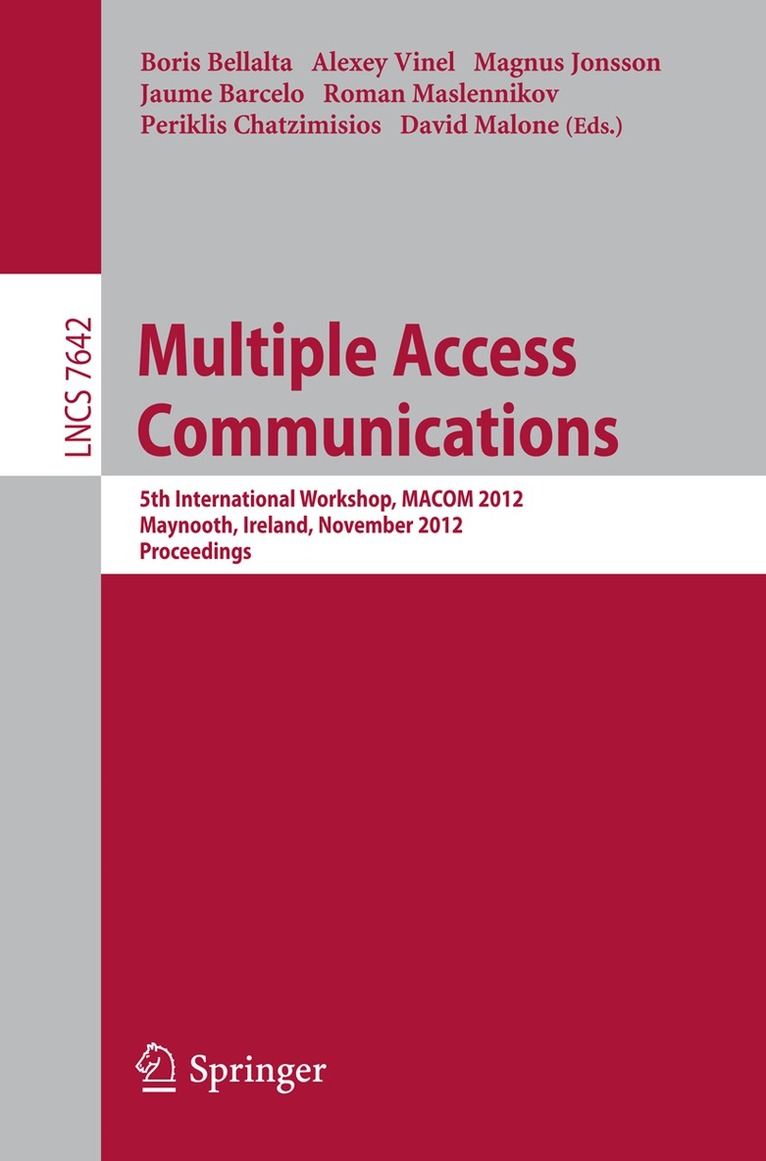
This book constitutes the refereed proceedings of the 5th International Workshop on Multiple Access Communications, MACOM 2012, held in Maynooth, Ireland, in November 2012. The 13 full papers and 5 demo and poster papers presented were carefully reviewed and selected from various submissions. The papers are organized in topical sections on network coding, handling interference and localization techniques at PHY/MAC layers, wireless access networks, and medium access control.
E-bok
PDF, Engelska, 2012661 kr
Läs direkt efter köp
This book constitutes the refereed proceedings of the 5th International Workshop on Multiple Access Communications, MACOM 2012, held in Maynooth, Ireland, in November 2012. The 13 full papers and 5 demo and poster papers presented were carefully reviewed and selected from various submissions. The papers are organized in topical sections on network coding, handling interference and localization techniques at PHY/MAC layers, wireless access networks, and medium access control.