Javier Segovia – författare
Visar alla böcker från författaren Javier Segovia. Handla med fri frakt och snabb leverans.
10 produkter
10 produkter
Häftad, Engelska, 2003
566 kr
Skickas inom 10-15 vardagar
We are pleased to present the proceedings of the 2003 Atlantic Web Intelligence C- ference, AWIC 2003. The conference was located in Madrid, Spain during May 5–6, 2003, organized locally by the Technical University of Madrid. AWIC 2003 aimed to be the rst of a series of conferences on Web Intelligence, to be celebrated annually, alternatively in Europe and America, starting in Madrid. It was born as an activity of the recently created WIC-Poland Research Centre and the WIC-Spain Research Centre, bothbelongingtotheWebIntelligenceConsortium(WIC) (http://wi-consortium.org).AWIC 2003 was supported with grants from the S- nish Ministry for Science and Technology and the European Network of Excellence in Knowledge Discovery, KDNet. AWIC 2003 brought together scientists, engineers, computer users, and students to exchange and share their experiences, new ideas, and research results about all aspects (theory,applications,andtools)ofarti cialintelligencetechniquesappliedtoWeb-based systems, and to discuss the practical challenges encountered and the solutions adopted. Almost 70 contributions were submitted. After a preliminary evaluation, 60 of these papers were accepted to the conference and were assigned at least two reviewers from the international program committee. Out of this 60, 33 were conditionally accepted, and 32 of them were nally accepted after the conditions set by the reviewers had been met, which resulted in an acceptance ratio of 45%.
E-bok
PDF, Engelska, 2003693 kr
Läs direkt efter köp
We are pleased to present the proceedings of the 2003 Atlantic Web Intelligence C- ference, AWIC 2003. The conference was located in Madrid, Spain during May 5–6, 2003, organized locally by the Technical University of Madrid. AWIC 2003 aimed to be the rst of a series of conferences on Web Intelligence, to be celebrated annually, alternatively in Europe and America, starting in Madrid. It was born as an activity of the recently created WIC-Poland Research Centre and the WIC-Spain Research Centre, bothbelongingtotheWebIntelligenceConsortium(WIC) (http://wi-consortium.org).AWIC 2003 was supported with grants from the S- nish Ministry for Science and Technology and the European Network of Excellence in Knowledge Discovery, KDNet. AWIC 2003 brought together scientists, engineers, computer users, and students to exchange and share their experiences, new ideas, and research results about all aspects (theory,applications,andtools)ofarti cialintelligencetechniquesappliedtoWeb-based systems, and to discuss the practical challenges encountered and the solutions adopted. Almost 70 contributions were submitted. After a preliminary evaluation, 60 of these papers were accepted to the conference and were assigned at least two reviewers from the international program committee. Out of this 60, 33 were conditionally accepted, and 32 of them were nally accepted after the conditions set by the reviewers had been met, which resulted in an acceptance ratio of 45%.
Engelska, 2012
653 kr
Skickas inom 5-8 vardagar
Engelska, 2014
667 kr
Skickas inom 5-8 vardagar
Inbunden, Engelska, 2002
1 681 kr
Skickas inom 10-15 vardagar
The book contains an up-to-date collection of world wide representative works which cover a wide spectrum of problems related to e-Commerce applications, including: Customer Service and Support, Negotiation and Trading Strategies, Logistic Design and Support, Inventory Optimisation, e-CRM, Customer and/or Product Profiling, Personalization, Modelling and Segmentation, Security in Payments and Transactions, etc. The Intelligent Methods used fall into the so-called category of Soft Computing and cover Neural Networks, Bayesian Networks, Fuzzy Logic, Evolutionary Programming, Agents, and Case Based Reasoning. The book is aimed at researchers and insightful practitioners, lecturers as well as students of e-Commerce and Artificial Intelligence.
Inbunden, Engelska, 2002
1 681 kr
Skickas inom 10-15 vardagar
The book contains an up-to-date collection of contributions from around the world that cover the wide spectrum of problems related to the World Wide Web. These problems include: organization of Web resources, information retrieval including browsing and Web data mining. Particular emphasis has been put on the creative and innovative application of intelligent methods for effective operations on the Web (information retrieval, extraction, and interpretation). The methods involve but are not restricted to fuzzy logic, neural networks, intelligent clustering, intelligent agents, and expert systems; and operate on textual and - in some cases - multimedia-based Web databases.
E-bok
PDF, Engelska, 20122 054 kr
Läs direkt efter köp
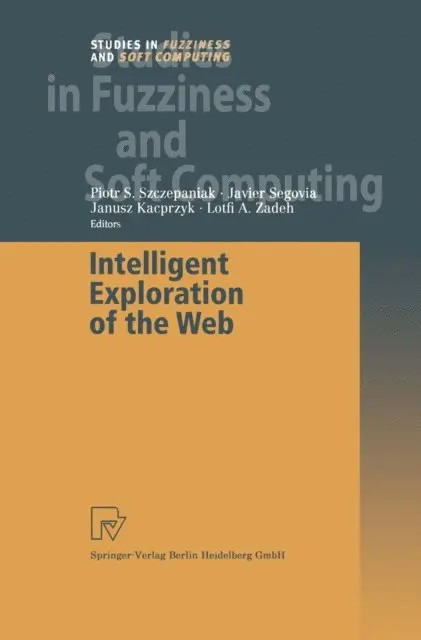
The Web is the nervous system of information society. As such, it has a pervasive influence on our daily lives. And yet, in some ways the Web does not have a high MIQ (Machine IQ). What can be done to enhance it? This is the leitmotif of "Intelligent Exploration of the Web," (lEW)--a collection of articles co-edited by Drs. Szczepaniak, Segovia, Kacprzyk and, to a small degree, myself. The articles that comprise lEW address many basic problems ranging from structure analysis of Internet documents and Web dialogue management to intelligent Web agents for extraction of information, and bootstrapping an ontology-based information extraction system. Among the basic problems, one that stands out in importance is the problem of search. Existing search engines have many remarkable capabilities. But what is not among them is the deduction capability--the capability to answer a query by drawing on information which resides in various parts of the knowledge base. An example of a query might be "How many Ph.D. degrees in computer science were granted by European universities in 1996?" No existing search engine is capable of dealing with queries of comparable or even much lower complexity. Basically, what we would like to do is to add deduction capability to a search engine, with the aim of transforming it into a question-answering system, or a QI A system, for short. This is a problem that is of major importance and a challenge that is hard to meet.
E-bok
PDF, Engelska, 20131 977 kr
Läs direkt efter köp
This book covers significant recent developments in the field of Intelligent Meth ods applied to eCommerce. The Intelligent Methods considered are mainly Soft Computing Methods that include fuzzy sets, rough sets, neural networks, evolutionary computations, probabilistic and evidential reasoning, multivalued logic, and related fields. There is not doubt about the relevance of eCommerce in our daily environ ments and in the work carried out at many research centers throughout the world. The application of AI to Commerce is growing as fast as the computers and net works are being integrated in all business and commerce aspects. We felt that it was time to sit down and see how was the impact into that field of low-level AI, i.e. softcomputing. We found many scattered contributions disseminated in con ferences, workshops, journal, books or even technical reports, but nothing like a common framework that could serve as a basis for further research, comparison or even prototyping for a direct transfer to the industry. We felt then the need to set up a reference point, a book like this. We planned this book as a recompilation of the newest developments of re searchers who already made some contribution into the field. The authors were se lected based on the originality and quality of their work and its relevance to the field. Authors came from prestigious universities and research centers with differ ent backgrounds.
Del 105 - Studies in Fuzziness and Soft Computing
E-Commerce and Intelligent Methods
Häftad, Engelska, 2010
1 633 kr
Skickas inom 10-15 vardagar
This book covers significant recent developments in the field of Intelligent Meth ods applied to eCommerce. The Intelligent Methods considered are mainly Soft Computing Methods that include fuzzy sets, rough sets, neural networks, evolutionary computations, probabilistic and evidential reasoning, multivalued logic, and related fields. There is not doubt about the relevance of eCommerce in our daily environ ments and in the work carried out at many research centers throughout the world. The application of AI to Commerce is growing as fast as the computers and net works are being integrated in all business and commerce aspects. We felt that it was time to sit down and see how was the impact into that field of low-level AI, i.e. softcomputing. We found many scattered contributions disseminated in con ferences, workshops, journal, books or even technical reports, but nothing like a common framework that could serve as a basis for further research, comparison or even prototyping for a direct transfer to the industry. We felt then the need to set up a reference point, a book like this. We planned this book as a recompilation of the newest developments of re searchers who already made some contribution into the field. The authors were se lected based on the originality and quality of their work and its relevance to the field. Authors came from prestigious universities and research centers with differ ent backgrounds.
Del 111 - Studies in Fuzziness and Soft Computing
Intelligent Exploration of the Web
Häftad, Engelska, 2010
1 681 kr
Skickas inom 10-15 vardagar
The Web is the nervous system of information society. As such, it has a pervasive influence on our daily lives. And yet, in some ways the Web does not have a high MIQ (Machine IQ). What can be done to enhance it? This is the leitmotif of "Intelligent Exploration of the Web," (lEW)--a collection of articles co-edited by Drs. Szczepaniak, Segovia, Kacprzyk and, to a small degree, myself. The articles that comprise lEW address many basic problems ranging from structure analysis of Internet documents and Web dialogue management to intelligent Web agents for extraction of information, and bootstrapping an ontology-based information extraction system. Among the basic problems, one that stands out in importance is the problem of search. Existing search engines have many remarkable capabilities. But what is not among them is the deduction capability--the capability to answer a query by drawing on information which resides in various parts of the knowledge base. An example of a query might be "How many Ph.D. degrees in computer science were granted by European universities in 1996?" No existing search engine is capable of dealing with queries of comparable or even much lower complexity. Basically, what we would like to do is to add deduction capability to a search engine, with the aim of transforming it into a question-answering system, or a QI A system, for short. This is a problem that is of major importance and a challenge that is hard to meet.