Jay Drydyk - Böcker
Visar alla böcker från författaren Jay Drydyk. Handla med fri frakt och snabb leverans.
8 produkter
8 produkter
670 kr
Skickas inom 10-15 vardagar
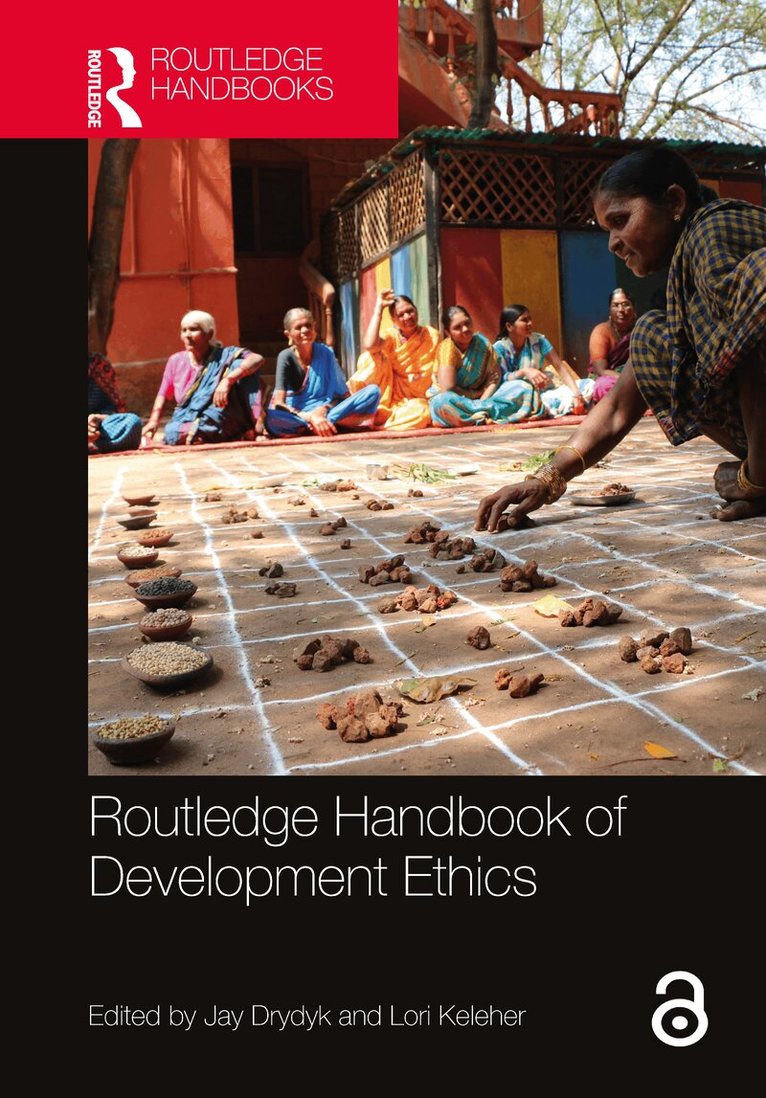
The Routledge Handbook of Development Ethics provides readers with insight into the central questions of development ethics, the main approaches to answering them, and areas for future research. Over the past seventy years, it has been argued and increasingly accepted that worthwhile development cannot be reduced to economic growth. Rather, a number of other goals must be realised:Enhancement of people's well-beingEquitable sharing in benefits of developmentEmpowerment to participate freely in developmentEnvironmental sustainabilityPromotion of human rightsPromotion of cultural freedom, consistent with human rightsResponsible conduct, including integrity over corruptionAgreement that these are essential goals has also been accompanied by disagreements about how to conceptualize or apply them in different cases or contexts. Using these seven goals as an organizing principle, this handbook presents different approaches to achieving each one, drawing on academic literature, policy documents and practitioner experience.This international and multi-disciplinary handbook will be of great interest to development policy makers and program workers, students and scholars in development studies, public policy, international studies, applied ethics and other related disciplines.
397 kr
Skickas inom 7-10 vardagar
For decades, policy-makers in government, development banks and foundations, NGOs, researchers and students have struggled with the problem of how to protect people who are displaced from their homes and livelihoods by development projects. This book addresses these concerns and explores how debates often become deadlocked between 'managerial' and 'movementist' perspectives. Using development ethics to determine the rights and responsibilities of various stakeholders, the authors find that displaced people must be empowered so as to share equitably in benefits rather than being victimized. They propose a governance model for development projects that would transform conflict over displacement into a more manageable collective bargaining process and would empower displaced people to achieve equitable results. Their book will be valuable for readers in a wide range of fields including ethics, development studies, politics and international relations as well as policy making, project management and community development.
652 kr
Skickas inom 7-10 vardagar
For decades, policy-makers in government, development banks and foundations, NGOs, researchers and students have struggled with the problem of how to protect people who are displaced from their homes and livelihoods by development projects. This book addresses these concerns and explores how debates often become deadlocked between 'managerial' and 'movementist' perspectives. Using development ethics to determine the rights and responsibilities of various stakeholders, the authors find that displaced people must be empowered so as to share equitably in benefits rather than being victimized. They propose a governance model for development projects that would transform conflict over displacement into a more manageable collective bargaining process and would empower displaced people to achieve equitable results. Their book will be valuable for readers in a wide range of fields including ethics, development studies, politics and international relations as well as policy making, project management and community development.
2 103 kr
Skickas inom 10-15 vardagar
Should people in the way lose out as new reservoirs, mines, plantations, or superhighways displace them from their homes and livelihoods? What if the process of resettlement were made accountable to those impacted, empowering them to achieve just outcomes and to share in the benefits of development projects? This book seeks to answer these questions, putting forward powerful counterfactual case studies to assess what problems real-world development projects would likely have avoided if the project had included the affected people in decision making about whether and how they should resettle.Drawing on contributions from leading and emerging scholars from around the world, this book considers cases involving dams, mines, roads, and housing, amongst others, from Asia, Africa, and South America. In each case, the counterfactual approach invites us to reconsider how the dynamics of accountability play out through resettlement hazards and the asymmetries of power relations in the negotiation of displacement benefits and redress. Considering a range of theoretical and ethical perspectives, the book concludes with practical, alternative policy suggestions for displacement arising both from development and from slow onset climate change.This book’s novel approach focussing on the people's agency in the dynamics of governance, accountability, and (dis)empowerment in development projects with displacement and resettlement will appeal to academic researchers, development practitioners, and policymakers.
579 kr
Skickas inom 10-15 vardagar
Should people in the way lose out as new reservoirs, mines, plantations, or superhighways displace them from their homes and livelihoods? What if the process of resettlement were made accountable to those impacted, empowering them to achieve just outcomes and to share in the benefits of development projects? This book seeks to answer these questions, putting forward powerful counterfactual case studies to assess what problems real-world development projects would likely have avoided if the project had included the affected people in decision making about whether and how they should resettle.Drawing on contributions from leading and emerging scholars from around the world, this book considers cases involving dams, mines, roads, and housing, amongst others, from Asia, Africa, and South America. In each case, the counterfactual approach invites us to reconsider how the dynamics of accountability play out through resettlement hazards and the asymmetries of power relations in the negotiation of displacement benefits and redress. Considering a range of theoretical and ethical perspectives, the book concludes with practical, alternative policy suggestions for displacement arising both from development and from slow onset climate change.This book’s novel approach focussing on the people's agency in the dynamics of governance, accountability, and (dis)empowerment in development projects with displacement and resettlement will appeal to academic researchers, development practitioners, and policymakers.
3 185 kr
Skickas inom 10-15 vardagar
The Routledge Handbook of Development Ethics provides readers with insight into the central questions of development ethics, the main approaches to answering them, and areas for future research. Over the past seventy years, it has been argued and increasingly accepted that worthwhile development cannot be reduced to economic growth. Rather, a number of other goals must be realised:Enhancement of people's well-beingEquitable sharing in benefits of developmentEmpowerment to participate freely in developmentEnvironmental sustainabilityPromotion of human rightsPromotion of cultural freedom, consistent with human rightsResponsible conduct, including integrity over corruptionAgreement that these are essential goals has also been accompanied by disagreements about how to conceptualize or apply them in different cases or contexts. Using these seven goals as an organizing principle, this handbook presents different approaches to achieving each one, drawing on academic literature, policy documents and practitioner experience.This international and multi-disciplinary handbook will be of great interest to development policy makers and program workers, students and scholars in development studies, public policy, international studies, applied ethics and other related disciplines.
1 703 kr
Skickas inom 10-15 vardagar
One of the most important contributions to contemporary political philosophy, Rawls’s A Theory of Justice, re-ignited political philosophy and revolutionized how we theorize about justice. Rawls’s approach to justice advanced political philosophy in important and valuable ways – most significantly in the way that it showed that political philosophy remained relevant for our lives and our world.Unsurprisingly, over forty years later, social and global realities present theories of justice with new challenges. This volume examines what these new challenges are, and whether contemporary theories are in a position to respond to them. The collection brings together essays that push the boundaries of justice theorizing in new directions, and that begin to construct a new paradigm. The collection contributes to the creation of a platform from which new ideas and new conversations, about the challenges and opportunities for justice in our world, can be further explored and developed.
595 kr
Skickas inom 10-15 vardagar
One of the most important contributions to contemporary political philosophy, Rawls’s A Theory of Justice, re-ignited political philosophy and revolutionized how we theorize about justice. Rawls’s approach to justice advanced political philosophy in important and valuable ways – most significantly in the way that it showed that political philosophy remained relevant for our lives and our world.Unsurprisingly, over forty years later, social and global realities present theories of justice with new challenges. This volume examines what these new challenges are, and whether contemporary theories are in a position to respond to them. The collection brings together essays that push the boundaries of justice theorizing in new directions, and that begin to construct a new paradigm. The collection contributes to the creation of a platform from which new ideas and new conversations, about the challenges and opportunities for justice in our world, can be further explored and developed.