
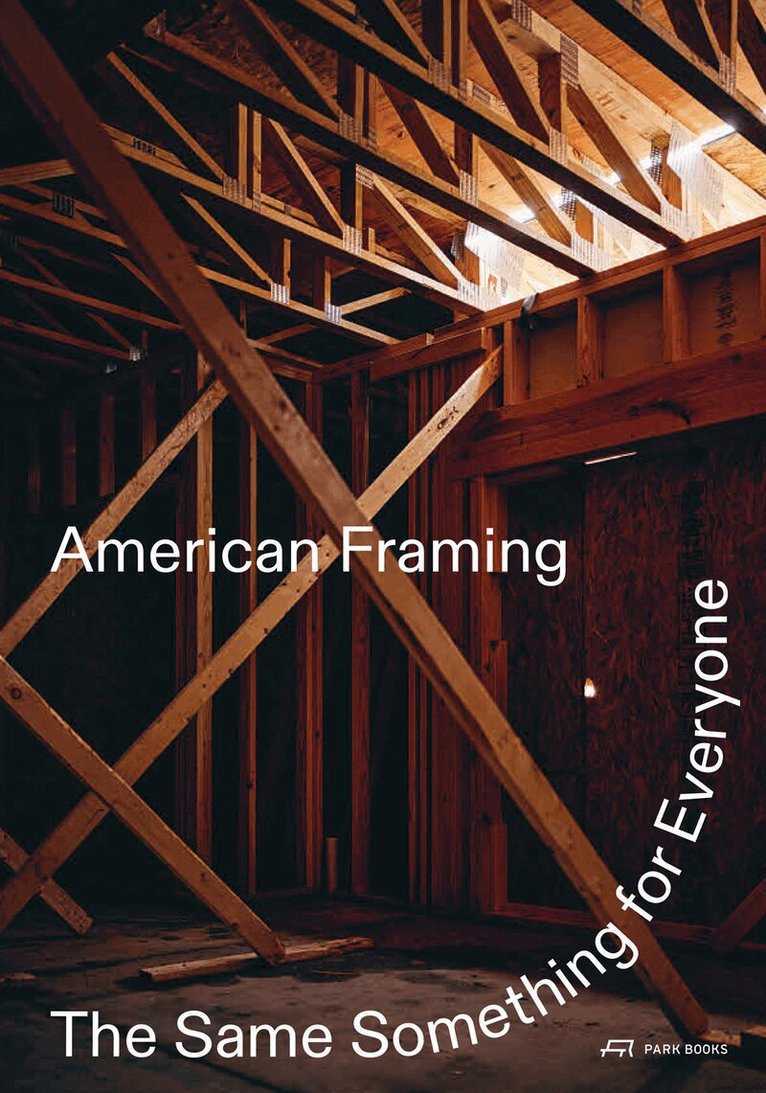
From its origins in the Midwest in the early nineteenth century, the technique of light timber framing—also known at the time as “Chicago construction”—quickly came to underwrite the territorial and ideological expansion of the United States. Softwood construction was inherently practical, as its materials were readily available and required little skill to assemble. The result was a built environment that erased typological and class distinctions: no amount of money can buy you a better 2 x 4. This fundamental sameness paradoxically underlies the American culture of individuality, unifying all superficial differences. It has been both a cause and effect of the country’s high regard for novelty, in contrast with the stability that is often assumed to be essential to architecture.American Framing is a visual and textual exploration of the social, environmental, and architectural conditions and consequences of this ubiquitous form of construction. For architecture, it offers a story of an American project that is bored with tradition, eager to choose economy over technical skill, and accepting of a relaxed idea of craft in the pursuit of something useful and new—the forming of an architecture that enables architecture.

Marina City is a Chicago architecture icon and one of the rare examples of a famous building that enjoys both popular recognition and international respect from architects and critics. Prentice Women’s Hospital, located just a few blocks away and sadly demolished in 2013, is still mourned; the debate around its preservation brought in testimonials from the architectural community worldwide. Their architect Bertrand Goldberg (1913–1997) has many fans in Chicago—but his work as a whole has never successfully escaped the city’s gravitational pull.Bertrand Goldberg: Projects 1932–1997 deeply engages with Goldberg’s inspiring body of work and thinking. It contributes as well to a wider discovery of non-dominant regional modernisms pursued by architects who set out to study at modernist schools like the Bauhaus and then returned to find productive practices in specific contexts. The volume constitutes the first full monograph exploring Goldberg’s complete work. It is a scholarly guidebook to his practice, based in the unique archival materials that allow readers to encounter his built work and unrealised projects and his thought with fresh eyes. It brings to the fore the simultaneous mix of scales and concerns—urban, social, technological, typological, formal, material—that makes his oeuvre so distinctive.Goldberg’s work as a whole has never successfully escaped Chicago’s gravitational pull. This book will create new fans of his outstanding architecture just as ardent as those in his hometown.
Martine De Maeseneer and Dirk Van den Brande, principals of Brussels-based practice Martine De Maeseneer Architects (MDMA), are “not compulsive builders.” From the outset in 1988, they have advanced an architecture self-consciously embedded in text, oscillating between theorisation and realisation. In their award-winning built and conceptual work, MDMA's interest is in spatial organisations that initiate nonlinear stories and shift identities.The first of two intended volumes—the second one to present MDMA’s design work— A Register of Wording assembles the practice’s text-based production to show how writing establishes a fertile—if unstable—ground for design. The book is more than a representation of words: it unfolds thinking expansively, across pages and decades, meandering yet distinctively committed to the search for a wide field of motives and plots for architecture.It offers previously published essays conjuring the energy of the 1990s and early 2000s alongside unpublished explorations that extend, recast, and complexify earlier lines of thinking. Departing from an early analysis of existing buildings, MDMA’s texts become more autonomous over time, invoking an unexpected array of visual, creative, and philosophical references. Sources are sampled, interrogated, circled around, juxtaposed, elided, played with. Pieces developed as lectures seize the theme, time, and place of the invitation to provide a distinctive perspective, without shying away from provocation.
From its origins in the Midwest in the early nineteenth century, the technique of light timber framing—also known at the time as “Chicago construction”—quickly came to underwrite the territorial and ideological expansion of the United States. Softwood construction was inherently practical, as its materials were readily available and required little skill to assemble. The result was a built environment that erased typological and class distinctions: no amount of money can buy you a better 2 x 4. This fundamental sameness paradoxically underlies the American culture of individuality, unifying all superficial differences. It has been both a cause and effect of the country’s high regard for novelty, in contrast with the stability that is often assumed to be essential to architecture.American Framing is a visual and textual exploration of the social, environmental, and architectural conditions and consequences of this ubiquitous form of construction. For architecture, it offers a story of an American project that is bored with tradition, eager to choose economy over technical skill, and accepting of a relaxed idea of craft in the pursuit of something useful and new—the forming of an architecture that enables architecture.
Marina City is a Chicago architecture icon and one of the rare examples of a famous building that enjoys both popular recognition and international respect from architects and critics. Prentice Women’s Hospital, located just a few blocks away and sadly demolished in 2013, is still mourned; the debate around its preservation brought in testimonials from the architectural community worldwide. Their architect Bertrand Goldberg (1913–1997) has many fans in Chicago—but his work as a whole has never successfully escaped the city’s gravitational pull.Bertrand Goldberg: Projects 1932–1997 deeply engages with Goldberg’s inspiring body of work and thinking. It contributes as well to a wider discovery of non-dominant regional modernisms pursued by architects who set out to study at modernist schools like the Bauhaus and then returned to find productive practices in specific contexts. The volume constitutes the first full monograph exploring Goldberg’s complete work. It is a scholarly guidebook to his practice, based in the unique archival materials that allow readers to encounter his built work and unrealised projects and his thought with fresh eyes. It brings to the fore the simultaneous mix of scales and concerns—urban, social, technological, typological, formal, material—that makes his oeuvre so distinctive.Goldberg’s work as a whole has never successfully escaped Chicago’s gravitational pull. This book will create new fans of his outstanding architecture just as ardent as those in his hometown.
Martine De Maeseneer and Dirk Van den Brande, principals of Brussels-based practice Martine De Maeseneer Architects (MDMA), are “not compulsive builders.” From the outset in 1988, they have advanced an architecture self-consciously embedded in text, oscillating between theorisation and realisation. In their award-winning built and conceptual work, MDMA's interest is in spatial organisations that initiate nonlinear stories and shift identities.The first of two intended volumes—the second one to present MDMA’s design work— A Register of Wording assembles the practice’s text-based production to show how writing establishes a fertile—if unstable—ground for design. The book is more than a representation of words: it unfolds thinking expansively, across pages and decades, meandering yet distinctively committed to the search for a wide field of motives and plots for architecture.It offers previously published essays conjuring the energy of the 1990s and early 2000s alongside unpublished explorations that extend, recast, and complexify earlier lines of thinking. Departing from an early analysis of existing buildings, MDMA’s texts become more autonomous over time, invoking an unexpected array of visual, creative, and philosophical references. Sources are sampled, interrogated, circled around, juxtaposed, elided, played with. Pieces developed as lectures seize the theme, time, and place of the invitation to provide a distinctive perspective, without shying away from provocation.