Jayson L. Lusk - Böcker
Visar alla böcker från författaren Jayson L. Lusk. Handla med fri frakt och snabb leverans.
5 produkter
5 produkter
1 374 kr
Skickas inom 5-8 vardagar
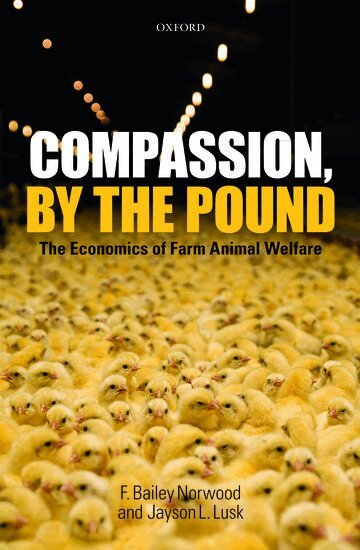
For much of human history, most of the population lived and worked on farms but today, information about livestock is more likely to come from children's books than hands-on experience. When romanticized notions of an agrarian lifestyle meet with the realities of the modern industrial farm, the result is often a plea for a return to antiquated production methods. The result is a brewing controversy between animal activist groups, farmers, and consumers that is currently being played out in ballot boxes, courtrooms, and in the grocery store. Where is one to turn for advice when deciding whether to pay double the price for cage-free eggs, or in determining how to vote on ballot initiates seeking to ban practices such as the use of gestation crates in pork production or battery cage egg production? At present, there is no clear answer. What is missing from the animal welfare debate is an objective approach that can integrate the writings of biologists and philosophers, while providing a sound and logical basis for determining the consequences of farm animal welfare policies. What is missing in the debate? Economics. This book journeys from the earliest days of animal domestication to modern industrial farms. Delving into questions of ethics and animal sentience, the authors use data from ingenious consumers' experiments conducted with real food, real money, and real animals to compare the costs and benefits of improving animal care. They show how the economic approach to animal welfare raises new questions and ethical conundrums, as well as providing unique and counter-intuitive results.
2 059 kr
Skickas inom 7-10 vardagar
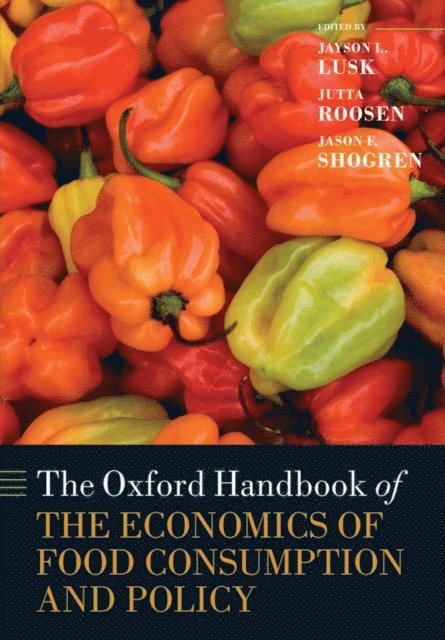
Historically, the challenge for humans has been to secure a sufficient supply of food to stave off hunger and starvation. As a result, much of the research on food and agriculture in the past century has focused on issues related to production efficiency, food supply, and farm profitability. In recent years, however, farmers, agribusiness, policy makers, and academics have increasingly turned their attention away from the farm and toward the food consumer and to issues related to food consumption. This handbook provides an overview of the economics of food consumption and policy and is a useful reference for academics and graduate students interested in food economics and the consumer-end of the supply chain. It is also relevant to those employed in food and agricultural industries, policy makers, and activist groups. The first section covers the application of the core theoretical and methodological approaches of the economics of food consumption and policy. The second part concentrates on policy issues related to food consumption. Several chapters focus on the theoretical and conceptual issues relevant in food markets, such as product bans, labeling, food standards, political economy, and scientific uncertainty. Additional chapters discuss policy issues of particular interest to the consumer-end of the food supply chain, such as food safety, nutrition, food security, and development. The final section serves as an introduction to particular issues and current topics in food consumption and policy.
834 kr
Skickas inom 5-8 vardagar
Historically, the challenge for humans has been to secure a sufficient supply of food to stave off hunger and starvation. As a result, much of the research on food and agriculture in the past century has focused on issues related to production efficiency, food supply, and farm profitability. In recent years, however, farmers, agribusiness, policy makers, and academics have increasingly turned their attention away from the farm and toward the food consumer and to issues related to food consumption. This handbook provides an overview of the economics of food consumption and policy and is a useful reference for academics and graduate students interested in food economics and the consumer-end of the supply chain. It is also relevant to those employed in food and agricultural industries, policy makers, and activist groups. The first section covers the application of the core theoretical and methodological approaches of the economics of food consumption and policy. The second part concentrates on policy issues related to food consumption. Several chapters focus on the theoretical and conceptual issues relevant in food markets, such as product bans, labeling, food standards, political economy, and scientific uncertainty. Additional chapters discuss policy issues of particular interest to the consumer-end of the food supply chain, such as food safety, nutrition, food security, and development. The final section serves as an introduction to particular issues and current topics in food consumption and policy.
Experimental Auctions
Methods and Applications in Economic and Marketing Research
Häftad, Engelska, 2007
500 kr
Skickas inom 7-10 vardagar
Economists, psychologists, and marketers are interested in determining the monetary value people place on non-market goods for a variety of reasons: to carry out cost-benefit analysis, to determine the welfare effects of technological innovation or public policy, to forecast new product success, and to understand individual and consumer behavior. Unfortunately, many currently available techniques for eliciting individuals' values suffer from a serious problem in that they involve asking individuals hypothetical questions about intended behavior. Experimental auctions circumvent this problem because they involve individuals exchanging real money for real goods in an active market. This represents a promising means for eliciting non-market values. Lusk and Shogren provide a comprehensive guide to the theory and practice of experimental auctions. It will be a valuable resource to graduate students, practitioners and researchers concerned with the design and utilization of experimental auctions in applied economic and marketing research.
Experimental Auctions
Methods and Applications in Economic and Marketing Research
Inbunden, Engelska, 2007
780 kr
Skickas inom 7-10 vardagar
Economists, psychologists, and marketers are interested in determining the monetary value people place on non-market goods for a variety of reasons: to carry out cost-benefit analysis, to determine the welfare effects of technological innovation or public policy, to forecast new product success, and to understand individual and consumer behavior. Unfortunately, many currently available techniques for eliciting individuals' values suffer from a serious problem in that they involve asking individuals hypothetical questions about intended behavior. Experimental auctions circumvent this problem because they involve individuals exchanging real money for real goods in an active market. This represents a promising means for eliciting non-market values. Lusk and Shogren provide a comprehensive guide to the theory and practice of experimental auctions. It will be a valuable resource to graduate students, practitioners and researchers concerned with the design and utilization of experimental auctions in applied economic and marketing research.