Jean-Claude Heudin – författare
Visar alla böcker från författaren Jean-Claude Heudin. Handla med fri frakt och snabb leverans.
14 produkter
14 produkter
Häftad, Franska
248 kr
Skickas inom 3-6 vardagar
Häftad, Franska
309 kr
Skickas inom 3-6 vardagar
E-bok
Franska, 2008247 kr
Läs direkt efter köp
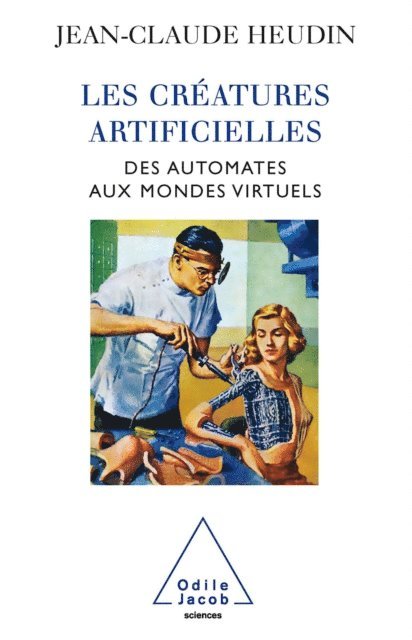
De l’érotique Galatée à l’Ève future, du Golem de glaise au corps rapiécé du monstre de Frankenstein, des robots de Capek au Terminator de Cameron, de l’ordinateur paranoïaque de Kubrick à l’agent Smith de Matrix, les créatures artificielles ont toujours peuplé notre imaginaire et alimenté fascinations et peurs. Jean-Claude Heudin raconte leur histoire. Sur plus de deux mille ans, il en révèle toutes les dimensions, artistiques et mythiques aussi bien que scientifiques et techniques. Depuis les peintures rupestres et les statues animées antiques, les Jacquemarts et les automates des Lumières jusqu’aux robots chiens de compagnie, aux héros virtuels des jeux vidéo, aux virus informatiques et aux intelligences artificielles d’aujourd’hui. Explorant aussi les tendances actuelles et les perspectives prochaines, il s’interroge : sommes-nous en passe de créer de la vie ? Et laquelle ?Jean-Claude Heudin est directeur du laboratoire de recherche de l’Institut international du multimédia-Association Léonard de Vinci. Il est l’auteur de nombreux articles scientifiques au niveau international ainsi que de plusieurs ouvrages dans le domaine des sciences de la complexité et de la vie artificielle.
E-bok
PDF, Engelska, 2003714 kr
Läs direkt efter köp
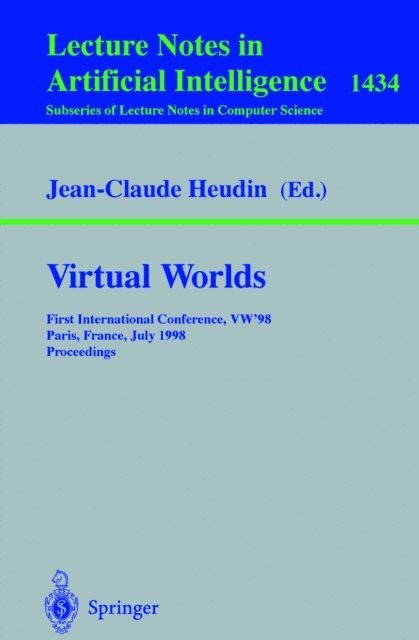
Virtual Worlds 2000 is the second in a series of international scientific conferences on virtual worlds held at the International Institute of Multimedia in Paris La Défense (Pôle Universitaire Léonard de Vinci). The term "virtual worlds" generally refers to virtual reality applications or experi ences. We extend the use of these terms to describe experiments that deal with the idea of synthesizing digital worlds on computers. Thus, virtual worlds could be de fined as the study of computer programs that implement digital worlds. Constructing such complex artificial worlds seems to be extremely difficult to do in any sort of complete and realistic manner. Such a new discipline must benefit from a large amount of work in various fields: virtual reality and advanced computer graphics, artificial life and evolutionary computation, simulation of physical systems, and more. Whereas virtual reality has largely concerned itself with the design of 3D immersive graphical spaces, and artificial life with the simulation of living organisms, the field of virtual worlds, is concerned with the synthesis of digital universes considered as wholes, with their own "physical" and "biological" laws.
Häftad, Engelska, 1998
565 kr
Skickas inom 10-15 vardagar
1 Introduction Imagine a virtual world with digital creatures that looks like real life, sounds like real life, and even feels like real life. Imagine a virtual world not only with nice three dimensional graphics and animations, but also with realistic physical laws and forces. This virtual world could be familiar, reproducing some parts of our reality, or unfa miliar, with strange “physical” laws and artificial life forms. As a researcher interested in the sciences of complexity, the idea of a conference about virtual worlds emerged from frustration. In the last few years, there has been an increasing interest in the design of artificial environments using image synthesis and virtual reality. The emergence of industry standards such as VRML [1] is an illustra tion of this growing interest. At the same time, the field of Artificial Life has ad dressed and modeled complex phenomena such as self organization, reproduction, development, and evolution of artificial life like systems [2]. One of the most popular works in this field has been Tierra designed by Tom Ray: an environment producing synthetic organisms based on a computer metaphor of organic life in which CPU time is the “energy” resource and memory is the “material” resource [3]. Memory is or ganized into informational patterns that exploit CPU time for self replication. Muta tion generates new forms, and evolution proceeds by natural selection as different creatures compete for CPU time and memory space.
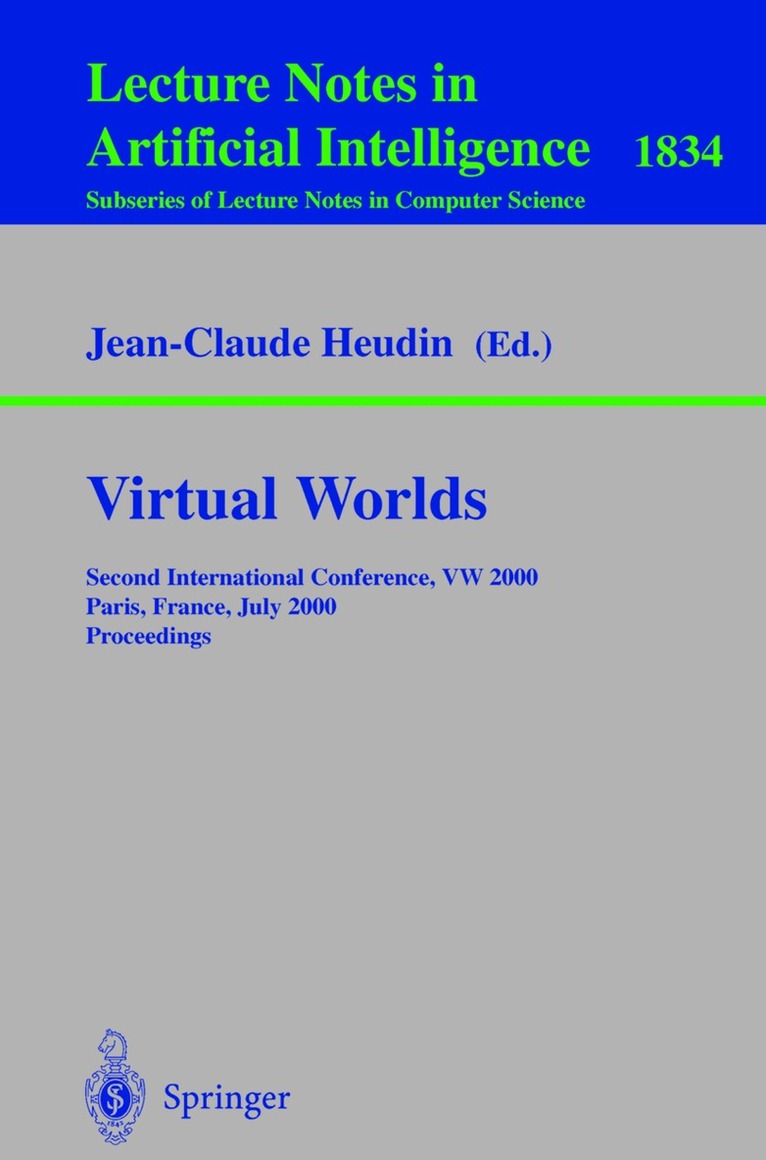
Häftad, Engelska, 2000
566 kr
Skickas inom 10-15 vardagar
Virtual Worlds 2000 is the second in a series of international scientific conferences on virtual worlds held at the International Institute of Multimedia in Paris La Défense (Pôle Universitaire Léonard de Vinci). The term "virtual worlds" generally refers to virtual reality applications or experi ences. We extend the use of these terms to describe experiments that deal with the idea of synthesizing digital worlds on computers. Thus, virtual worlds could be de fined as the study of computer programs that implement digital worlds. Constructing such complex artificial worlds seems to be extremely difficult to do in any sort of complete and realistic manner. Such a new discipline must benefit from a large amount of work in various fields: virtual reality and advanced computer graphics, artificial life and evolutionary computation, simulation of physical systems, and more. Whereas virtual reality has largely concerned itself with the design of 3D immersive graphical spaces, and artificial life with the simulation of living organisms, the field of virtual worlds, is concerned with the synthesis of digital universes considered as wholes, with their own "physical" and "biological" laws.
E-bok
PDF, Engelska, 2003734 kr
Läs direkt efter köp
1 Introduction Imagine a virtual world with digital creatures that looks like real life, sounds like real life, and even feels like real life. Imagine a virtual world not only with nice three dimensional graphics and animations, but also with realistic physical laws and forces. This virtual world could be familiar, reproducing some parts of our reality, or unfa miliar, with strange “physical” laws and artificial life forms. As a researcher interested in the sciences of complexity, the idea of a conference about virtual worlds emerged from frustration. In the last few years, there has been an increasing interest in the design of artificial environments using image synthesis and virtual reality. The emergence of industry standards such as VRML [1] is an illustra tion of this growing interest. At the same time, the field of Artificial Life has ad dressed and modeled complex phenomena such as self organization, reproduction, development, and evolution of artificial life like systems [2]. One of the most popular works in this field has been Tierra designed by Tom Ray: an environment producing synthetic organisms based on a computer metaphor of organic life in which CPU time is the “energy” resource and memory is the “material” resource [3]. Memory is or ganized into informational patterns that exploit CPU time for self replication. Muta tion generates new forms, and evolution proceeds by natural selection as different creatures compete for CPU time and memory space.
Häftad, Franska, 2016
395 kr
Skickas inom 3-6 vardagar
Häftad, Franska
241 kr
Skickas inom 3-6 vardagar
Häftad, Franska
263 kr
Skickas inom 3-6 vardagar
Häftad, Franska, 2016
357 kr
Skickas inom 3-6 vardagar
248 kr
Skickas inom 3-6 vardagar
Häftad, Franska
263 kr
Skickas inom 3-6 vardagar
Häftad, Franska, 2015
240 kr
Skickas inom 3-6 vardagar