Jean Demaison - Böcker
Visar alla böcker från författaren Jean Demaison. Handla med fri frakt och snabb leverans.
12 produkter
12 produkter
1 064 kr
Skickas inom 10-15 vardagar
Many satellites have recently been launched or are in preparation, which operate in the microwave to IR ranges, the main objective being to observe the earth's atmosphere or interstellar clouds. Analysis of the data they supply requires extensive laboratory work because we still only have sufficiently accurate data (line positions, intensities, and profiles) for only a few species. Furthermore, the observer community is making increasing calls for laboratory data, as new development open up new observational possibilities (such as submillimeter observation). Research on these subjects involves many different areas of specialization in fields of research that generate a wealth of data. In "Spectroscopy from Space" the people responsible for field observations explain which results they are expecting from their measurements and how laboratory people can help them to analyze their satellite data. Laboratory spectroscopists explain developments that touch on their field and what kinds of experiment and theoretical development that might undertake to meet the needs of the remote sensing community. The problems of distributing reliable laboratory data in a timely way are also addressed.
1 064 kr
Skickas inom 10-15 vardagar
Many satellites have recently been launched or are in preparation, which operate in the microwave to IR ranges, the main objective being to observe the earth's atmosphere or interstellar clouds. Analysis of the data they supply requires extensive laboratory work because we still only have sufficiently accurate data (line positions, intensities, and profiles) for only a few species. Furthermore, the observer community is making increasing calls for laboratory data, as new development open up new observational possibilities (such as submillimeter observation). Research on these subjects involves many different areas of specialization in fields of research that generate a wealth of data. In "Spectroscopy from Space" the people responsible for field observations explain which results they are expecting from their measurements and how laboratory people can help them to analyze their satellite data. Laboratory spectroscopists explain developments that touch on their field and what kinds of experiment and theoretical development that might undertake to meet the needs of the remote sensing community. The problems of distributing reliable laboratory data in a timely way are also addressed.
1 578 kr
Skickas inom 10-15 vardagar
Recent ecological disasters make human beings aware of changes in the Earth’s climate. At the present time anthropogenic activities lead to the emission of greenhouse gases, pollutants, aerosols and ozone depleting substances and the scientific community in general feels responsible for understanding how changes in atmospheric chemistry can affect the Earth’s climate. The first part of these proceedings describes the current capabilities of various satellite experiments which are performing measurements of the Earth’s atmosphere, as for example some of the results obtained recently by three experiments onboard the Environment Satellite (ENVISAT), namely, the Global Ozone Monitoring Experiment (GOME), the SCanning Imaging Absorption for Atmospheric CHartographY (SCIAMACHY) and the Michelson Interferometer for Passive Atmospheric Sounding (MIPAS). For the analysis of spectra recorded by these instruments it is necessary to make good use of efficient radiative transfer codes. These computer codes need as input, a dataset of high quality spectroscopic parameters which can be generated only through a careful analysis of high quality laboratory measurements. In addition some of the future satellite missions which are under preparation at the European Space Agency (ESA) are briefly described.
1 578 kr
Skickas inom 10-15 vardagar
Recent ecological disasters make human beings aware of changes in the Earth’s climate. At the present time anthropogenic activities lead to the emission of greenhouse gases, pollutants, aerosols and ozone depleting substances and the scientific community in general feels responsible for understanding how changes in atmospheric chemistry can affect the Earth’s climate. The first part of these proceedings describes the current capabilities of various satellite experiments which are performing measurements of the Earth’s atmosphere, as for example some of the results obtained recently by three experiments onboard the Environment Satellite (ENVISAT), namely, the Global Ozone Monitoring Experiment (GOME), the SCanning Imaging Absorption for Atmospheric CHartographY (SCIAMACHY) and the Michelson Interferometer for Passive Atmospheric Sounding (MIPAS). For the analysis of spectra recorded by these instruments it is necessary to make good use of efficient radiative transfer codes. These computer codes need as input, a dataset of high quality spectroscopic parameters which can be generated only through a careful analysis of high quality laboratory measurements. In addition some of the future satellite missions which are under preparation at the European Space Agency (ESA) are briefly described.
2 289 kr
Skickas inom 10-15 vardagar
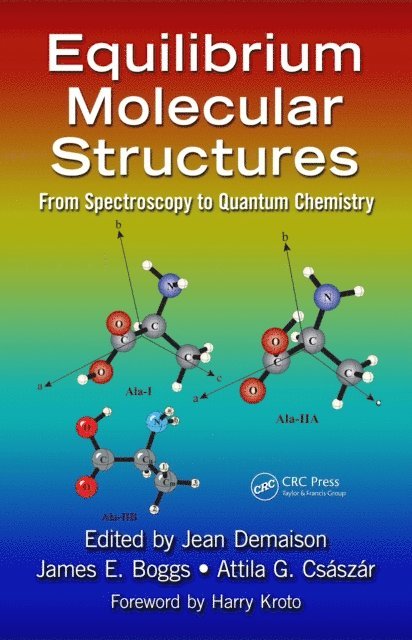
Molecular structure is the most basic information about a substance, determining most of its properties. Determination of accurate structures is hampered in that every method applies its own definition of "structure" and thus results from different sources can yield significantly different results. Sophisticated protocols exist to account for these differences, but until now, no textbook has been written to discuss such topics in a widely accessible manner.Balancing quantum theory with practical experiments, Equilibrium Molecular Structures focuses on the theory involved in determining and converting measured and computed data sets into accurate and well-defined equilibrium structures.This textbook begins with a discussion of quantum chemistry and the concept of potential energy surfaces, quantum chemical computation of structures and anharmonic force fields. The reader is next introduced to the method of least squares and the problem of ill-conditioning, leverage points, perturbation theory, computational aspects of determining semi-experimental equilibrium structures, the determination of moments of inertia from spectra, and the treatment of resonances. The textbook also examines the determination of diatomic molecular potentials using semiclassical and quantum mechanical methods as well as position and distance averages.From basic elements to the latest advances and current best practices, Equilibrium Molecular Structures contains abundant references, examples, and exercises. Additional examples are also available as downloadable support material on the publishers website. These features make the book ideal for class instruction but also user-friendly for self-instruction. It is recommended for newcomers to the field and also for experienced spectroscopists who want to expand their area of knowledge.
Del 105 - Lecture Notes in Chemistry
Accurate Structure Determination of Free Molecules
Inbunden, Engelska, 2020
1 064 kr
Skickas inom 10-15 vardagar
This book presents a detailed look at experimental and computational techniques for accurate structure determination of free molecules. The most fundamental property of a molecule is its structure – it is a prerequisite for determining and understanding most other important properties of molecules.
Del 105 - Lecture Notes in Chemistry
Accurate Structure Determination of Free Molecules
Häftad, Engelska, 2021
1 170 kr
Skickas inom 10-15 vardagar
This book presents a detailed look at experimental and computational techniques for accurate structure determination of free molecules. The most fundamental property of a molecule is its structure – it is a prerequisite for determining and understanding most other important properties of molecules.
Equilibrium Structure of Free Molecules
Theory, Experiment, and Data Analysis
Inbunden, Engelska, 2023
2 101 kr
Skickas inom 10-15 vardagar
Featuring high-quality structural data and presenting modern techniques of their determinations by quantum chemistry, high-resolution spectroscopy and electron diffraction, the book is an indispensable resource for graduate students and professional scientists specializing in structural chemistry and other related fields.
2 101 kr
Skickas inom 10-15 vardagar
Featuring high-quality structural data and presenting modern techniques of their determinations by quantum chemistry, high-resolution spectroscopy and electron diffraction, the book is an indispensable resource for graduate students and professional scientists specializing in structural chemistry and other related fields.
7 785 kr
Skickas inom 10-15 vardagar
This is subvolume C of the Landolt-Börnstein Volume II/29 "Molecular Constants Mostly from Microwave, Molecular Beam, and Sub-Doppler Laser Spectroscopy", which is planned to appear as a series A, B, C and D1 and D2 for the diamagnetic, and E for the paramagnetic linear and polyatomic species, respectively. Like in the preceding volumes II/19 and II/24, which have appeared in 1992 and 1999, the diamagnetic substances are arranged in the manner suggested by Hill ("Hill's system", 1900), meaning an almost strict alphabetical order; details are given in the General Introduction on the following pages. The ionic species are included in the alphabetical arrangement of the neutral ones in each table. In the preface to the previous volume II/24 we had noted: It is somewhat surprising that the trend of reducing spectroscopic activities in universities and other research institutes has not led to a lower production rate of pertinent molecular literature data during the last say ten years. It seems that the opposite is true. The number of studies of Van der Waals complexes is still increasing, and naturally also their complexity. Similarly, the "normal" molecules studied under high-resolution conditions became more complicated and flexible, and interesting effects like inner hydrogen bonding have been investigated. The number of figures used to illustrate the molecular conformational structures is, therefore, also larger than in the foregoing volumes.
7 785 kr
Skickas inom 10-15 vardagar
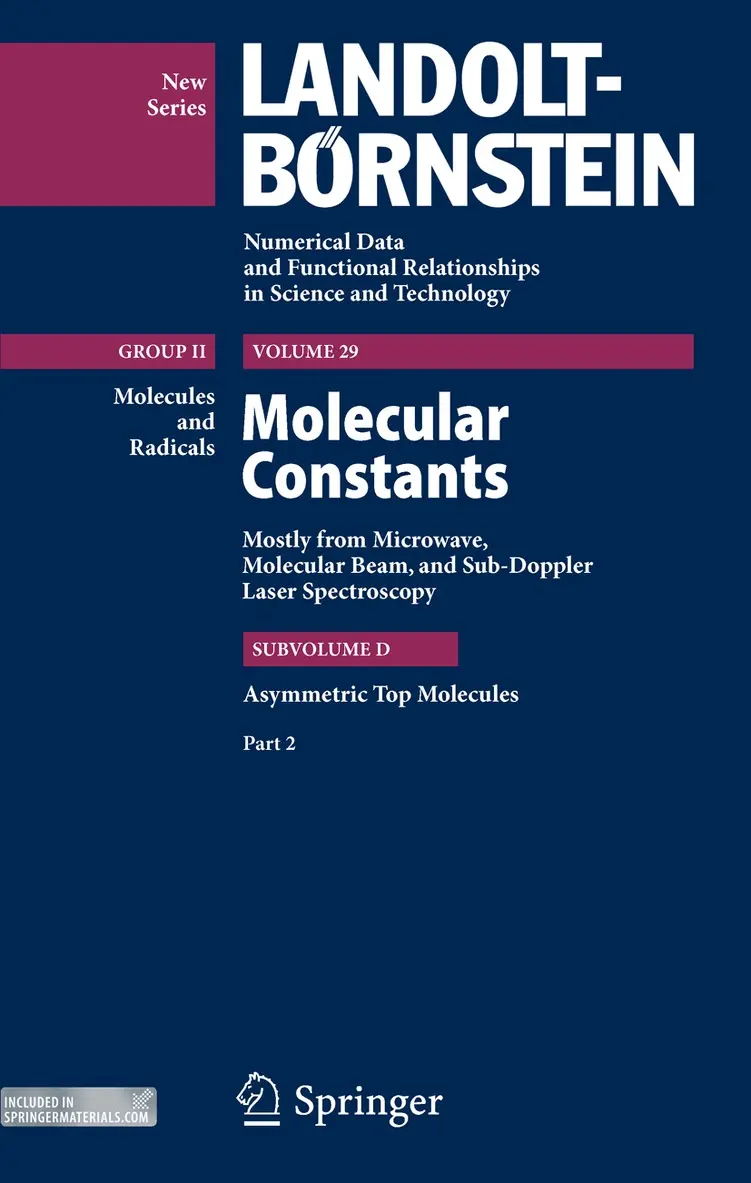
Volume II/29 "Molecular Constants Mostly from Microwave, Molecular Beam, and Sub-Doppler Laser Spectroscopy" is planned to appear as a series A, B, C and D1, D2, D3 for the diamagnetic, and E for the paramagnetic linear and polyatomic species, respectively. Like in the preseding volumes II/24 and II/19, which have appeared in the years around 1999 and 1992, respectively, the diamagnetic substances are arranged in the manner suggested by Hill ("Hill's system", 1900), meaning an almost strict alphabetical order. The ionic species are included in the alphabetical arrangement of the neutral ones in each table. The information is grouped differently in comparison with the previous volumes. All relevant properties of a molecule and the corresponding parameters can be found concentrated under its sum formula in volume II/29. this diminishes the need of turning pages because rotational and related constants, dipole moments, barriers to internal rotation, hyperfine coupling parameters, or Zeeman data were hitherto listed in different tables. The present subvolume II/29D2 contains data for asymmetric top molecules.
7 785 kr
Skickas inom 10-15 vardagar
Volume II/29 "Molecular Constants Mostly from Microwave, Molecular Beam, and Sub-Doppler Laser Spectroscopy" is planned to appear as a series A, B, C and D1, D2, D3 for the diamagnetic, and E for the paramagnetic linear and polyatomic species, respectively. Like in the preseding volumes II/24 and II/19, which have appeared in the years around 1999 and 1992, respectively, the diamagnetic substances are arranged in the manner suggested by Hill ("Hill's system", 1900), meaning an almost strict alphabetical order. The ionic species are included in the alphabetical arrangement of the neutral ones in each table. The information is grouped differently in comparison with the previous volumes. All relevant properties of a molecule and the corresponding parameters can be found concentrated under its sum formula in volume II/29. this diminishes the need of turning pages because rotational and related constants, dipole moments, barriers to internal rotation, hyperfine coupling parameters, or Zeeman data were hitherto listed in different tables. The present subvolume II/29D3 contains data for asymmetric top molecules.