Jean-Francois Kervegan – författare
Visar alla böcker från författaren . Handla med fri frakt och snabb leverans.
6 produkter
6 produkter
Inbunden, Engelska, 2018
488 kr
Skickas inom 5-8 vardagar
One of Hegel’s most controversial and confounding claims is that “the real is rational and the rational is real.” In this book, one of the world’s leading scholars of Hegel, Jean-François Kervégan, offers a thorough analysis and explanation of that claim, along the way delivering a compelling account of modern social, political, and ethical life.Kervégan begins with Hegel’s term “objective spirit,” the public manifestation of our deepest commitments, the binding norms that shape our existence as subjects and agents. He examines objective spirit in three realms: the notion of right, the theory of society, and the state. In conversation with Tocqueville and other theorists of democracy, whether in the Anglophone world or in Europe, Kervégan shows how Hegel—often associated with grand metaphysical ideas—actually had a specific conception of civil society and the state. In Hegel’s view, public institutions represent the fulfillment of deep subjective needs—and in that sense, demonstrate that the real is the rational, because what surrounds us is the product of our collective mindedness. This groundbreaking analysis will guide the study of Hegel and nineteenth-century political thought for years to come.
E-bok
Engelska, 2018966 kr
Läs direkt efter köp
One of Hegel’s most controversial and confounding claims is that “the real is rational and the rational is real.” In this book, one of the world’s leading scholars of Hegel, Jean-François Kervégan, offers a thorough analysis and explanation of that claim, along the way delivering a compelling account of modern social, political, and ethical life. Kervégan begins with Hegel’s term “objective spirit,” the public manifestation of our deepest commitments, the binding norms that shape our existence as subjects and agents. He examines objective spirit in three realms: the notion of right, the theory of society, and the state. In conversation with Tocqueville and other theorists of democracy, whether in the Anglophone world or in Europe, Kervégan shows how Hegel—often associated with grand metaphysical ideas—actually had a specific conception of civil society and the state. In Hegel’s view, public institutions represent the fulfillment of deep subjective needs—and in that sense, demonstrate that the real is the rational, because what surrounds us is the product of our collective mindedness. This groundbreaking analysis will guide the study of Hegel and nineteenth-century political thought for years to come.
E-bok
Franska, 2008303 kr
Läs direkt efter köp
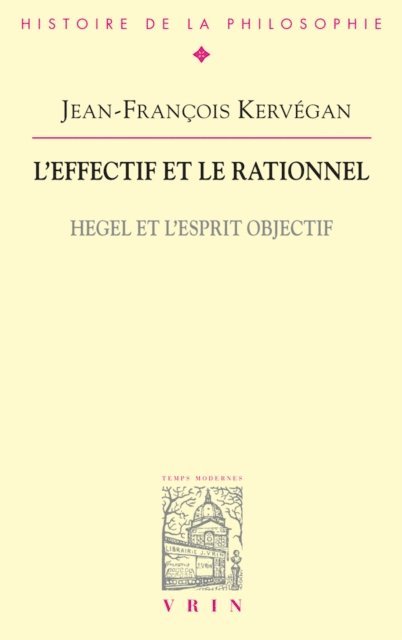
S’inscrivant dans le courant des lectures non métaphysiques de Hegel, ce livre présente le bilan de vingt-cinq années de recherches consacrées à « l’esprit objectif ». Son ambition est de comprendre ce qu’il en est de l’équation de l’effectif et du rationnel posée par les Principes de la philosophie du droit. La première partie montre que le droit abstrait (privé) a une fonction stratégique dans l’économie de l’esprit objectif et permet à Hegel de dépasser l’alternative entre droit naturel et histoire. Consacrée à la société civile, la deuxième partie met en évidence l’aporie du social, justification négative d’un espace politique qui ne soit pas simple extension de la société. Partant du dialogue silencieux entre Tocqueville et Hegel sur la modernité politique, la troisième partie étudie la critique hégélienne de la démocratie et sa conception de la représentation, qui suggèrent une révision du paradigme de la démocratie libérale. La dernière partie montre que la doctrine de l’esprit objectif pose la question de la subjectivité en des termes non subjectivistes en s’intéressant aux conditions de son institution; interface normative entre le sujet et l’univers institutionnalisé de l’éthicité, la moralité a un rôle essentiel. L’ouvrage s’achève par une réflexion sur la « passion du concept » qui anime la philosophie hégélienne.Jean-François Kervégan est professeur à l’Université Paris 1 Panthéon-Sorbonne.
Häftad, Franska
653 kr
Tillfälligt slut
Häftad, Franska
286 kr
Tillfälligt slut
Häftad, Tyska, 2019
506 kr
Tillfälligt slut
Das Buch ist das Ergebnis einer dreissigjährigen Beschäftigung mit dem Werk Carl Schmitts. Damit verfolgt Kervégan ein doppeltes, ein didaktisches sowie ein begriffliches Ziel. Der erste Teil enthält wichtige Angaben zur Lebens- und zur Werkgeschichte, die die komplizierte und polemische Rezeption seiner Schriften erklären können. Ohne irgendwelche Duldsamkeit für die Person versucht Kervégan zu zeigen, dass der absichtlich "kryptische" Charakter von Schmitts Werk durch die Bedingungen seiner Entstehung teilweise erklärbar ist. Trotz der berechtigten Abneigung, die das Engagement Carl Schmitts im Nationalsozialismus hervorgerufen hat, hat sein Werk die gegenwärtige politische Philosophie und Rechtsphilosophie stark beeinflusst. Der zweite Teil des Buchs enthält den Versuch, mit Bezug auf fünf distinkte begriffliche Felder (Theologie, Normativität, Legitimität, Politik, Welt) die Richtigkeit und Fruchtbarkeit des Schmittschen Denkens zu prüfen. Es geht sozusagen darum, "mit Carl Schmitt gegen Carl Schmitt" zu denken. Der Zweck dieser Überlegungen besteht darin, in Bezug auf die genannten Gegenstände zu zeigen, dass es sich empfiehlt, im doppelten Sinn der Redewendung "von Carl Schmitt auszugehen". Das heißt: Solange es fruchtbar scheint, sollte man sich seine Begrifflichkeit frei aneignen, ansonsten aber von ihr Abschied nehmen.