Jean-Numa Ducange - Böcker
Visar alla böcker från författaren Jean-Numa Ducange. Handla med fri frakt och snabb leverans.
11 produkter
11 produkter
French Revolution and Social Democracy
The Transmission of History and Its Political Uses in Germany and Austria, 18891934
Häftad, Engelska, 2019
356 kr
Skickas inom 5-8 vardagar
Beyond France's own national historiography, the French Revolution was a fundamental point of reference for the nineteenth-century socialist movement. While Karl Marx never wrote his planned history of the Revolution, beginning in the 1880s the German and Austrian social-democrats did embark on such a project. This was an important moment for both Marxism and the historiography of the French Revolution. Yet it has not previously been the object of any overall study. The French Revolution and Social Democracy studies both the social-democratic readings of the foundational revolutionary event and the place of this history in militant culture, as seen in sources from party educationals to leaflets and workers' calendars. First published in 2012 as La Révolution française et la social-démocratie. Transmissions et usages politiques de l'histoire en Allemagne et Autriche, 1889-1934 by Presses Universitaires de Rennes in 2012.
747 kr
Skickas inom 10-15 vardagar
This edited volume takes a close look at Nicos Poulantzas’s thought as a means of understanding the dynamics of the capitalist, neoliberal state in the 21st century.
747 kr
Skickas inom 10-15 vardagar
What explains France’s unique Left? Many works have reflected upon the importance of Marxism in France, yet few studies have been devoted to the man who did most to introduce Marxism into its political culture: the today near-forgotten figure of Jules Guesde. It was with Guesde that Karl Marx drafted the world’s first Marxist program, and Guesde who aroused the enthusiasm of countless worker-militants who saw him as their most important leader. Jules Guesde represents the first book-length study of the French socialist leader translated into the English language. For the radical Left today, Guesde is often considered a dogmatist who supported the Union sacrée during World War I and rejected the Bolshevik revolution; for the governmental Left, he embodies an intransigent ideologue who held back the modernization of the French Left. Throughout Jules Guesde, Jean-Numa Ducange argues that it is impossible to study the history of the French socialist movement without a close look at this singular figure and offers a fuller picture of the deep transformations of the Left and Marxism in France from the late 19th century up to the present. This scholarly biography of Jules Guesde seeks to put Guesde’s record on a properly historical footing, closely analysing both archival sources and accounts by his contemporaries. Chapter One begins with his early life and the mark left on him by the Paris Commune and exile. Chapter Two emphasises Guesde’s importance as leader of a distinct current of French socialism, recognised by figures like Karl Marx and Friedrich Engels. Chapter Three sees Guesde become an MP for working-class Roubaix, exploring the contradictions between his revolutionary rhetoric and concrete political practice. Chapter Four turns to the years following his electoral defeat in 1898 and his renewed intransigence in the period of the Dreyfus affair and rivalry with Jaurès. Chapter Five explores his key role inthe formation of a united Socialist Party. Chapter Six examines the test of World War I and Guesde’s anguish at the divisions of French socialism. The book then concludes with an examination of Guesde’s contested legacy, as both a “founding father” and figure subject to often pejorative framings.
747 kr
Skickas inom 10-15 vardagar
What explains France’s unique Left? Many works have reflected upon the importance of Marxism in France, yet few studies have been devoted to the man who did most to introduce Marxism into its political culture: the today near-forgotten figure of Jules Guesde. It was with Guesde that Karl Marx drafted the world’s first Marxist program, and Guesde who aroused the enthusiasm of countless worker-militants who saw him as their most important leader. Jules Guesde represents the first book-length study of the French socialist leader translated into the English language. For the radical Left today, Guesde is often considered a dogmatist who supported the Union sacrée during World War I and rejected the Bolshevik revolution; for the governmental Left, he embodies an intransigent ideologue who held back the modernization of the French Left. Throughout Jules Guesde, Jean-Numa Ducange argues that it is impossible to study the history of the French socialist movement without a close look at this singular figure and offers a fuller picture of the deep transformations of the Left and Marxism in France from the late 19th century up to the present. This scholarly biography of Jules Guesde seeks to put Guesde’s record on a properly historical footing, closely analysing both archival sources and accounts by his contemporaries. Chapter One begins with his early life and the mark left on him by the Paris Commune and exile. Chapter Two emphasises Guesde’s importance as leader of a distinct current of French socialism, recognised by figures like Karl Marx and Friedrich Engels. Chapter Three sees Guesde become an MP for working-class Roubaix, exploring the contradictions between his revolutionary rhetoric and concrete political practice. Chapter Four turns to the years following his electoral defeat in 1898 and his renewed intransigence in the period of the Dreyfus affair and rivalry with Jaurès. Chapter Five explores his key role inthe formation of a united Socialist Party. Chapter Six examines the test of World War I and Guesde’s anguish at the divisions of French socialism. The book then concludes with an examination of Guesde’s contested legacy, as both a “founding father” and figure subject to often pejorative framings.
1 205 kr
Skickas inom 10-15 vardagar
This book is an anthology of the writings of Jean Jaurès, a central figure of French socialism in the period leading up to World War I, who was born in 1859 and died in 1914, a few days before the outbreak of the conflict.
1 205 kr
Skickas inom 10-15 vardagar
This book is an anthology of the writings of Jean Jaurès, a central figure of French socialism in the period leading up to World War I, who was born in 1859 and died in 1914, a few days before the outbreak of the conflict.
1 276 kr
Skickas inom 10-15 vardagar
This edited volume takes a close look at Nicos Poulantzas’s thought as a means of understanding the dynamics of the capitalist, neoliberal state in the 21st century.
178 kr
Skickas inom 3-6 vardagar
266 kr
Skickas inom 3-6 vardagar
Del 280 - Historical Materialism Book Series
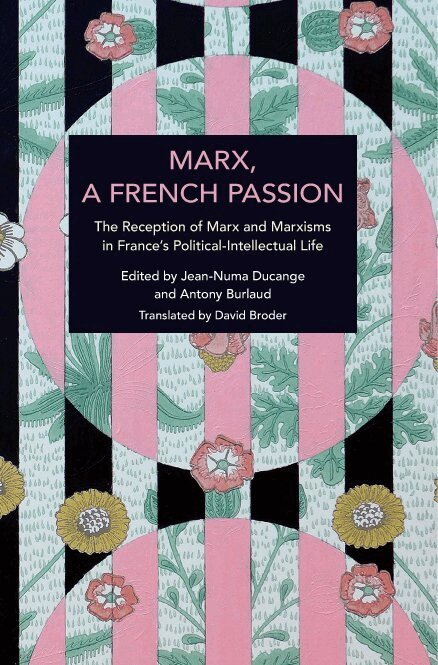
Marx, A French Passion
The Reception of Marx and Marxisms in France’s Political-Intellectual Life
Inbunden, Engelska, 2023
2 716 kr
Skickas inom 5-8 vardagar
Despite the collapse of Soviet-style socialism, the spectre of Marx still haunts the French imagination. This is no accident, in a country whose intellectual life and political history have long been marked by his multiple presences.This volume offers a historical and sociological insight into the way his thought has been received in the French context, from his own lifetime to the present. Analysing Marx’s place and influence in the French intellectual, political and artistic debate – across the political spectrum and even in the French-speaking colonial world – it helps us understand the uses and misuses of an œuvre of paramount importance.
Marx, A French Passion
The Reception of Marx and Marxisms in France's Political-Intellectual Life
Häftad, Engelska, 2024
456 kr
Skickas inom 5-8 vardagar
Despite the collapse of Soviet-style socialism, the spectre of Marx still haunts the French imagination. This is no accident, in a country whose intellectual life and political history have long been marked by his multiple presences.This volume offers a historical and sociological insight into the way his thought has been received in the French context, from his own lifetime to the present. Analysing Marx’s place and influence in the French intellectual, political and artistic debate – across the political spectrum and even in the French-speaking colonial world – it helps us understand the uses and misuses of an œuvre of paramount importance.