Jean-Paul Faguet – författare
Visar alla böcker från författaren Jean-Paul Faguet. Handla med fri frakt och snabb leverans.
4 produkter
4 produkter
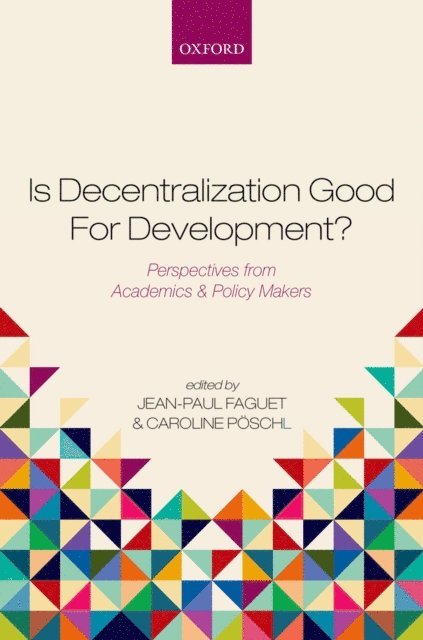
Is Decentralization Good For Development?
Perspectives from Academics and Policy Makers
Inbunden, Engelska, 2015
1 725 kr
Skickas inom 7-10 vardagar
Is decentralisation good for development? This book offers insights and lessons that help us understand when the answer is 'Yes', and when it is No'. It shows us how decentralisation can be designed to drive development forward, and focuses attention on how institutional incentives can be created for governments to improve public sector performance and strengthen economies in ways that enhance citizen well-being. It also draws attention to the political motives behind decentralisation reforms and how these shape the institutions that result.This book brings together academics working at the frontier of research on decentralization with policymakers who have implemented reform at the highest levels of government and international organizations. Its purpose is to marry policymakers' detailed knowledge and insights about real reform processes with academics' conceptual clarity and analytical rigor. This synthesis naturally shifts the analysis towards deeper questions of decentralization, stability, and the strength of the state. These are explored in Part 1, with deep studies of the effects of reform on state capacity, political and fiscal stability, and democratic inclusiveness in Bolivia, Pakistan, India, and Latin America more broadly. These complex questions - crucially important to policymakers but difficult to address with statistics - yield before a multipronged attack of quantitative and qualitative evidence combined with deep practitioner insight. How should reformers design decentralisation? Part 2 examines these issues with evidence from four decades of reform in developing and developed countries. What happens after reform is implemented? Decentralization and local service provision turns to decentralization's effects on health and education services, anti-poverty programs with original evidence from 12 countries across Africa, Asia, and Latin America.
462 kr
Skickas inom 5-8 vardagar
Bolivia decentralized in an effort to deepen democracy, improve public services, and make government more accountable. Unlike many countries, Bolivia succeeded. Over the past generation, public investment shifted dramatically toward primary services and resource distribution became far more equitable, partly due to the creation of new local governments. Many municipalities responded to decentralization with transparent, accountable government, yet others suffered ineptitude, corruption, or both. Why? Jean-Paul Faguet combines broad econometric data with deep qualitative evidence to investigate the social underpinnings of governance. He shows how the interaction of civic groups and business interests determines the quality of local decision making. In order to understand decentralization, Faguet argues, we must understand governance from the ground up. Drawing on his findings, he offers an evaluation of the potential benefits of decentralization and recommendations for structuring successful reform.
269 kr
Skickas inom 5-8 vardagar
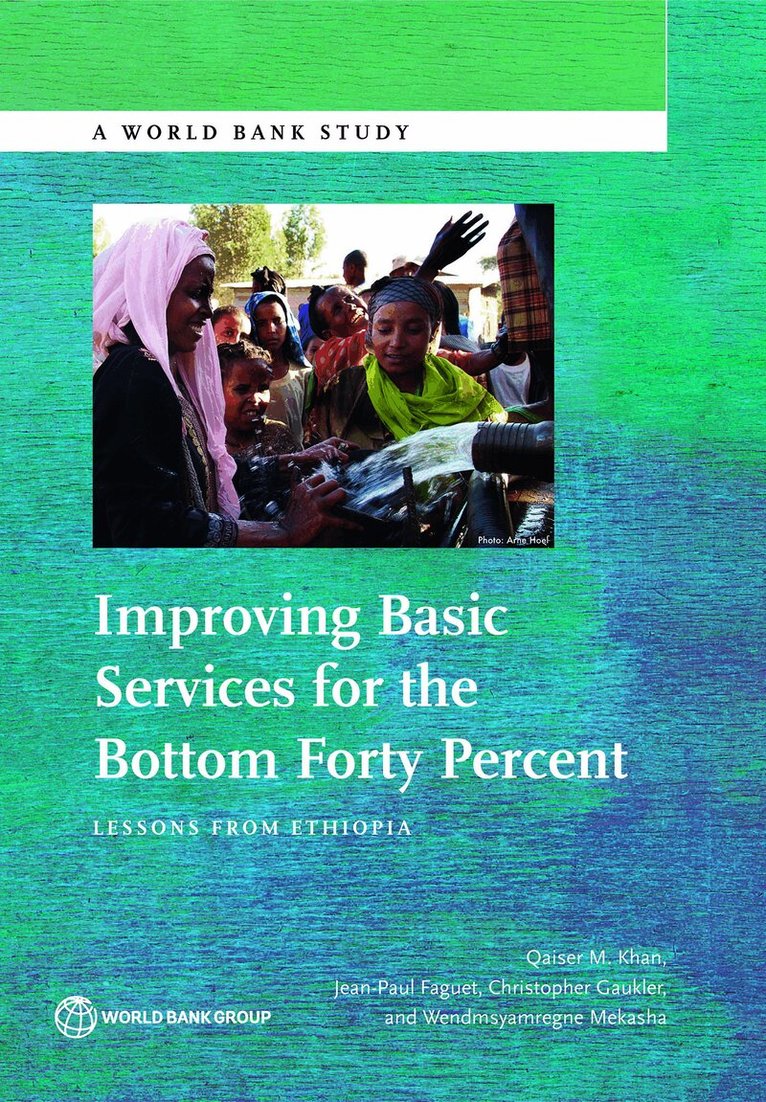
Ethiopia's model for delivering basic services appears to be succeeding and to confirm that services improve when service providers are more accountable to citizens. As discussed in the World Development Report 2004, accountability for delivering basic services can take an indirect, long route, in which citizens influence service providers through government, or a more direct, short route between service providers and citizens. When the long, indirect route of accountability is ineffective, service delivery can suffer, especially among poor or marginalized citizens who find it challenging to express their views to policymakers. In Ethiopia, the indirect route of accountability works well precisely because of decentralization. Service providers are strictly accountable to local governments for producing results, but in turn, the local authorities are held accountable by the regional and federal governments. A degree of local competition for power and influence helps to induce local authorities and service provides to remain open to feedback from citizens and take responsibility for results. The direct route of accountability has been reinforced by measures to strengthen financial transparency and accountability (educating citizens on local budgets and publicly providing information on budgets and service delivery goals), social accountability (improving citizens' opportunities to provide feedback directly to local administrators and service providers), and impartial procedures to redress grievances.Woreda-level (district) spending has been a very effective strategy for Ethiopia to attain its Millennium Development Goals (MDGs). Woreda health and education goes to pay for health extension workers (HEWs) and teachers. This study finds evidence that woreda-level spending in health and education is effective. Owing to the intervention of HEWs, the use of health services has increased, especially among the poorest quintiles. Finally, the effect of woreda-level spending on agricultural extension workers is associated with higher yields for major crops. Spending on agricultural extension workers increases the probability that farmers, regardless of the size of their plots, will use improved farming techniques. Education, health, and agriculture account for 97 percent of woreda spending. This is complemented by support for capacity building and citizen voice. Clearly, spending efficiency is improved through better capacity, more transparency, and greater accountability to citizens.
311 kr
Skickas inom 5-8 vardagar
For developing countries, decentralising power from central government to local authorities holds the promise of deepening democracy, empowering citizens, improving public services and boosting economic growth. But the evidence on when and how decentralisation can bring these benefits has been mixed. Under the wrong conditions, decentralised power can be captured by unrepresentative elites or undermined by corruption and the clientelistic distribution of public resources. The picture is complex, and we still do not understand enough about what factors can contribute to creating better local government, and to what effect. Decentralised Governance brings together a new generation of political economy studies that explore these questions analytically, blending theoretical insights with empirical innovation. Individual chapters provide fresh evidence from around the world, including broad cross-country data as well as detailed studies of Bangladesh, India, Pakistan, China, Indonesia, Ghana, Kenya and Colombia. They investigate the pros and cons of decentralisation in both democratic and autocratic regimes, and the effects of critical factors such as advances in technology, citizen-based data systems, political entrepreneurship in ethnically diverse societies, and reforms aimed at improving transparency and monitoring.This wide-ranging volume examines the conditions under which devolving power can intensify democratic competition, boost transparency, and improve local governance, providing examples of good and bad practice in both. It is essential reading for researchers investigating decentralised governance, development and democratisation, and for policymakers and practitioners drawing lessons for future reforms.