Jean-Pierre Doucet – författare
Visar alla böcker från författaren Jean-Pierre Doucet. Handla med fri frakt och snabb leverans.
5 produkter
5 produkter
E-bok
PDF, Engelska, 19961 756 kr
Läs direkt efter köp
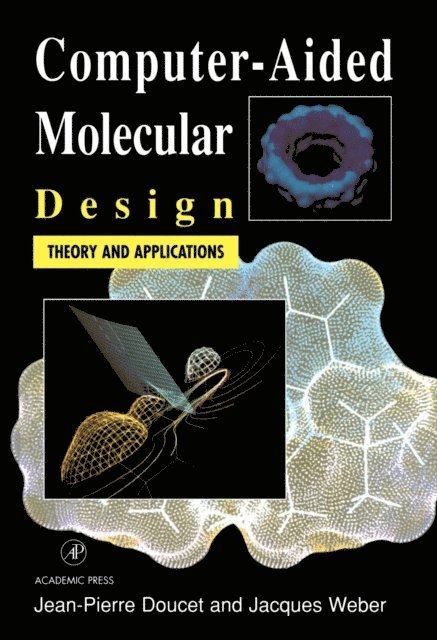
The computer-aided design of novel molecular systems has undoubtedly reached the stage of a mature discipline offering a broad range of tools available to virtually any chemist. However, there are few books coveringmost of these techniques in a single volume and using a language which may generally be understood by students or chemists with a limited knowledge of theoretical chemistry. The purpose of this book is precisely to review, in such a language, both methodological aspects and important applications of computer-aided molecular design (CAMD), with a special emphasis on drug design and protein modeling.Using numerous examples ranging from molecular models to shapes, surfaces, and volumes, Computer-Aided Molecular Design provides coverage of the role molecular graphics play in CAMD. The text also treats the very notion of the structure of molecular systems by presenting both the various experimental techniques giving access to it and the most common model builders based on force fields. Separate chapters are devoted to other important topics in CAMD, such as Monte Carlo and molecular dynamics simulations; most common quantum chemical methods; derivation and visualization of molecular properties; and molecular similarity. Finally, strategies used in protein modeling and drug design, such as receptor mapping and the pharmacophore approach, are presented and illustrated by several examples.The book is addressed to students and researchers who wish to enter this new exciting field of molecular sciences, but also practitioners in CAMD as a comprehensive source of refreshing information in their field.Key Features* Presents a comprehensive introduction to computer-aided molecular design* Describes applications of CAMD through the use of numerous examples* Emphasizes strategies used in protein modeling and drug design* Includes separate chapters devoted to other important topics in CAMD, such as:* Monte Carlo and molecular dynamics simulations* Common quantum chemical methods* Derivation and visualization of molecular properties* Molecular similarity
Häftad, Engelska, 2019
988 kr
Skickas inom 10-15 vardagar
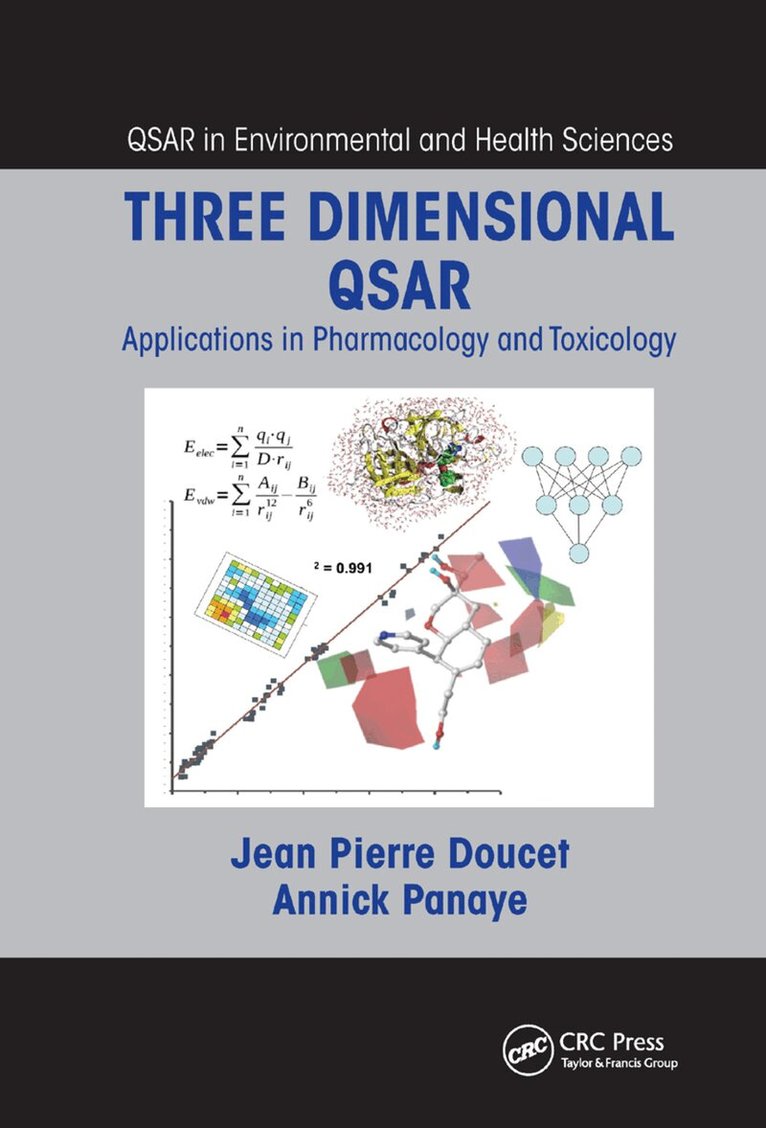
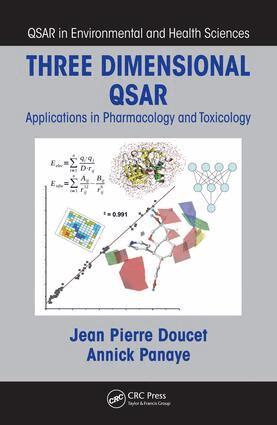
As a result of new statistical and mathematical approaches, improved visualization tools, and recognition by international regulatory groups, quantitative structure-activity relationships (QSARs) now play important roles in pharmacology for the design of new drugs as well as in toxicology and ecotoxicology for hazard identification and risk assessment. Providing up-to-date coverage of the field, Three Dimensional QSAR: Applications in Pharmacology and Toxicology presents the most recent QSAR methods and illustrates their scope, advantages, and limitations. Part I The first part of the book addresses CoMFA and related methods, such as CoMSIA, FLUFF, SOMFA. It also describes shape-, surface-, and volume-based approaches, including MSA, excluded volume, LIV, HASL, receptor surface model, COMPASS, and CoMSA.Part II Focusing on methods that use 3D information, the second part covers autocorrelation methods, such as GRIND; similarity-based methods, including similarity matrices and quantum similarity indices; and quantitative spectroscopic data–activity relationships. Some applications in data mining are also explored.Part III The third part deals with post-3D models. The authors discuss the adaptation of the receptor and simultaneous presence of several conformers or solvation mechanisms.Part IV The final part presents receptor-related approaches as well as docking and free energy calculations, which are treated at various levels. This part concerns the extensive sampling of phase space and approximate methods, such as linear interaction energy, Poisson–Boltzmann, and generalized Born models. A case study covering several parallel approaches is also developed.An appendix offers the basic principles of modeling and statistical tools routinely required in QSAR methodologies, includi
E-bok
Engelska, 20101 136 kr
Läs direkt efter köp
As a result of new statistical and mathematical approaches, improved visualization tools, and recognition by international regulatory groups, quantitative structure-activity relationships (QSARs) now play important roles in pharmacology for the design of new drugs as well as in toxicology and ecotoxicology for hazard identification and risk assessm
Inbunden, Engelska, 2010
3 542 kr
Skickas inom 10-15 vardagar
As a result of new statistical and mathematical approaches, improved visualization tools, and recognition by international regulatory groups, quantitative structure-activity relationships (QSARs) now play important roles in pharmacology for the design of new drugs as well as in toxicology and ecotoxicology for hazard identification and risk assessment. Providing up-to-date coverage of the field, Three Dimensional QSAR: Applications in Pharmacology and Toxicology presents the most recent QSAR methods and illustrates their scope, advantages, and limitations. Part I The first part of the book addresses CoMFA and related methods, such as CoMSIA, FLUFF, SOMFA. It also describes shape-, surface-, and volume-based approaches, including MSA, excluded volume, LIV, HASL, receptor surface model, COMPASS, and CoMSA.Part II Focusing on methods that use 3D information, the second part covers autocorrelation methods, such as GRIND; similarity-based methods, including similarity matrices and quantum similarity indices; and quantitative spectroscopic data–activity relationships. Some applications in data mining are also explored.Part III The third part deals with post-3D models. The authors discuss the adaptation of the receptor and simultaneous presence of several conformers or solvation mechanisms.Part IV The final part presents receptor-related approaches as well as docking and free energy calculations, which are treated at various levels. This part concerns the extensive sampling of phase space and approximate methods, such as linear interaction energy, Poisson–Boltzmann, and generalized Born models. A case study covering several parallel approaches is also developed.An appendix offers the basic principles of modeling and statistical tools routinely required in QSAR methodologies, includi
E-bok
Engelska, 20101 214 kr
Läs direkt efter köp
As a result of new statistical and mathematical approaches, improved visualization tools, and recognition by international regulatory groups, quantitative structure-activity relationships (QSARs) now play important roles in pharmacology for the design of new drugs as well as in toxicology and ecotoxicology for hazard identification and risk assessm