Jeannette Money - Böcker
Visar alla böcker från författaren Jeannette Money. Handla med fri frakt och snabb leverans.
8 produkter
8 produkter
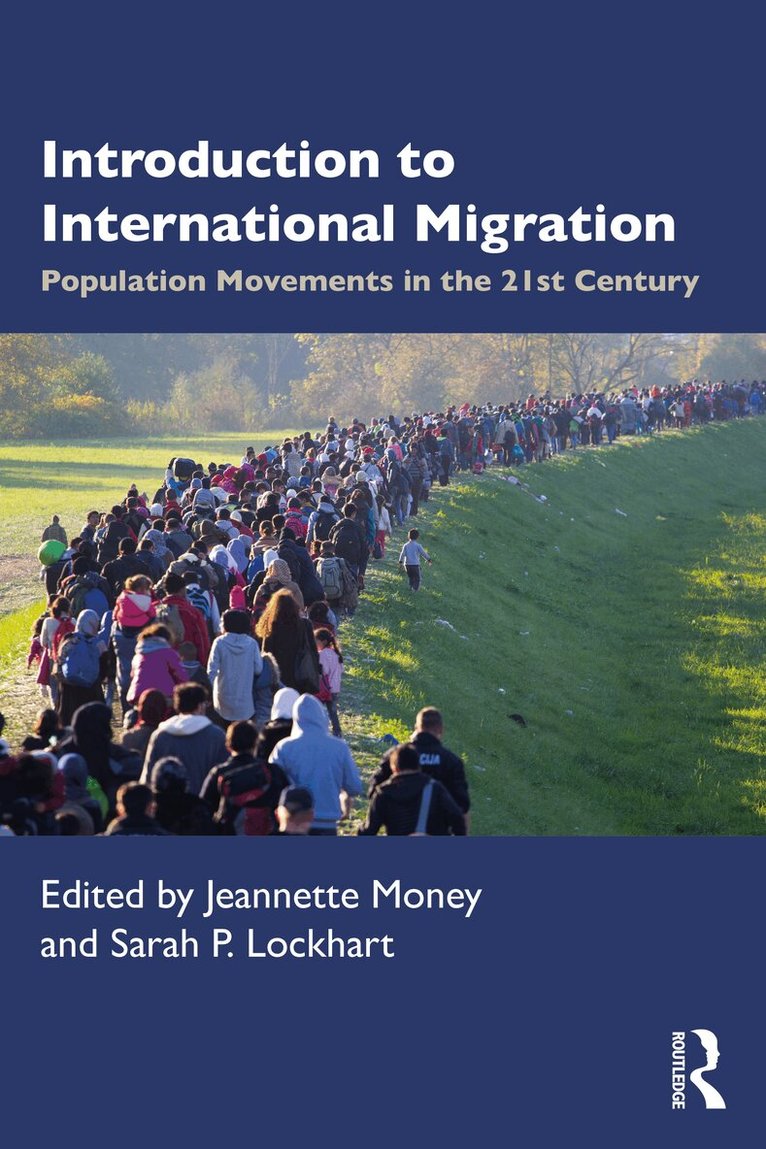
Introduction to International Migration
Population Movements in the 21st Century
Häftad, Engelska, 2021
629 kr
Skickas inom 10-15 vardagar
Introduction to International Migration introduces students to state-of-the-art knowledge on international migration, a contemporary issue of central importance to virtually all countries around the globe. Original chapters by prominent women migration scholars cover a complex and multifaceted issue area including various types of migration, the mechanisms of migration governance, the impact of migration on both host and home societies, the migrants themselves in a transnational space, and the nexus between migration and other aspects of globalization. Key topics include labor, gender, citizenship, public opinion, development, security, climate, and ethics. Refugee flows are tracked from beginning to end. Photos, figures, text boxes with real-world examples, discussion questions, and recommended readings provide pedagogical structure for each chapter. Intended as a core text for courses on migration and immigration and a supplement to more general courses in global studies, this book is appropriate for both undergraduate and graduate students in the variety of disciplines that deal with the challenges of international migration.Special Features Consistently structured original chapters by notable scholars include an Introduction, Empirical Overview, Theoretical Evolution, Continuing Issues, and Summary for every chapter. Chapter pedagogy includes Discussion Questions, Suggested Readings, and References as well as a Data Appendix for the book. Photos with thematic captions and Text Boxes on hot topics round out the visual and substantive appeal of the text.
Introduction to International Migration
Population Movements in the 21st Century
Inbunden, Engelska, 2021
2 103 kr
Skickas inom 10-15 vardagar
Introduction to International Migration introduces students to state-of-the-art knowledge on international migration, a contemporary issue of central importance to virtually all countries around the globe. Original chapters by prominent women migration scholars cover a complex and multifaceted issue area including various types of migration, the mechanisms of migration governance, the impact of migration on both host and home societies, the migrants themselves in a transnational space, and the nexus between migration and other aspects of globalization. Key topics include labor, gender, citizenship, public opinion, development, security, climate, and ethics. Refugee flows are tracked from beginning to end. Photos, figures, text boxes with real-world examples, discussion questions, and recommended readings provide pedagogical structure for each chapter. Intended as a core text for courses on migration and immigration and a supplement to more general courses in global studies, this book is appropriate for both undergraduate and graduate students in the variety of disciplines that deal with the challenges of international migration.Special Features Consistently structured original chapters by notable scholars include an Introduction, Empirical Overview, Theoretical Evolution, Continuing Issues, and Summary for every chapter. Chapter pedagogy includes Discussion Questions, Suggested Readings, and References as well as a Data Appendix for the book. Photos with thematic captions and Text Boxes on hot topics round out the visual and substantive appeal of the text.
724 kr
Skickas inom 10-15 vardagar
Against a background of past, limited examples of international cooperation, and ambitious hopes for extensive future efforts, this volume puts two related questions to the empirical test: under which conditions are states prepared to cooperate over international migration, and what form - bilateral, multilateral, formal, informal - will this cooperation take?
2 171 kr
Skickas inom 10-15 vardagar
Against a background of past, limited examples of international cooperation, and ambitious hopes for extensive future efforts, this volume puts two related questions to the empirical test: under which conditions are states prepared to cooperate over international migration, and what form - bilateral, multilateral, formal, informal - will this cooperation take?
1 034 kr
Skickas inom 7-10 vardagar
This book examines some fifty countries to ascertain how the chambers of bicameral legislatures interact when they produce legislation. An understanding of this interaction is essential because otherwise legislative behaviour in each chamber may be unintelligible or incorrectly interpreted. The book employs cooperative game theoretic models to establish that bicameral legislatures, when compared with unicameral legislatures, increase the stability of the status quo and reduce intercameral differences to one privileged dimension of conflict. Non-cooperative game theoretic models are used to investigate the significance of a series of insitutional devices used to resolve intercameral conflict where a bill is introduced, which chamber has the final word, how many times a bill can shuttle between chambers, and whether conference committees are called. Empirical evidence, mainly from the French Republic, is used to evaluate the arguments.
397 kr
Skickas inom 7-10 vardagar
This book examines some fifty countries to ascertain how the chambers of bicameral legislatures interact when they produce legislation. An understanding of this interaction is essential because otherwise legislative behaviour in each chamber may be unintelligible or incorrectly interpreted. The book employs cooperative game theoretic models to establish that bicameral legislatures, when compared with unicameral legislatures, increase the stability of the status quo and reduce intercameral differences to one privileged dimension of conflict. Non-cooperative game theoretic models are used to investigate the significance of a series of insitutional devices used to resolve intercameral conflict where a bill is introduced, which chamber has the final word, how many times a bill can shuttle between chambers, and whether conference committees are called. Empirical evidence, mainly from the French Republic, is used to evaluate the arguments.
1 238 kr
Skickas inom 3-6 vardagar
Although international cooperation on migration is often promoted, scholars have been unable to arrive at a consensus about the extent of cooperation in the current system. Under what conditions does international cooperation on migration arise, and what shape does it take? These questions are important because migrants are often vulnerable to human rights abuses during their journeys as well as in the country of destination, and international cooperation represents one mechanism for reducing this vulnerability.Jeannette Money and Sarah P. Lockhart ask these questions as they examine the patterns of migration flows during the post– World War II period, with particular attention to crises or shocks to the international system, as in the case of migration following the recent conflicts in Afghanistan and Syria. Their analysis makes several important contributions to this debate. First, they explain how the broad pattern of migration in the contemporary era—generally from poorer, less stable countries to wealthier, more stable countries—fosters cooperation that is predominantly bilateral, when cooperation does in fact occur. Second, they argue that cooperation is unlikely under most circumstances, because countries of destination prefer the current system, which privileges their sovereignty over migration flows. Finally, they posit that cooperation may arise under three conditions: when the costs of maintaining the status quo increase, when countries of origin locate a venue where their numbers allow them to control the bargaining agenda, or when migrant flows tend toward reciprocity.
567 kr
Skickas inom 3-6 vardagar
Although international cooperation on migration is often promoted, scholars have been unable to arrive at a consensus about the extent of cooperation in the current system. Under what conditions does international cooperation on migration arise, and what shape does it take? These questions are important because migrants are often vulnerable to human rights abuses during their journeys as well as in the country of destination, and international cooperation represents one mechanism for reducing this vulnerability.Jeannette Money and Sarah P. Lockhart ask these questions as they examine the patterns of migration flows during the post– World War II period, with particular attention to crises or shocks to the international system, as in the case of migration following the recent conflicts in Afghanistan and Syria. Their analysis makes several important contributions to this debate. First, they explain how the broad pattern of migration in the contemporary era—generally from poorer, less stable countries to wealthier, more stable countries—fosters cooperation that is predominantly bilateral, when cooperation does in fact occur. Second, they argue that cooperation is unlikely under most circumstances, because countries of destination prefer the current system, which privileges their sovereignty over migration flows. Finally, they posit that cooperation may arise under three conditions: when the costs of maintaining the status quo increase, when countries of origin locate a venue where their numbers allow them to control the bargaining agenda, or when migrant flows tend toward reciprocity.