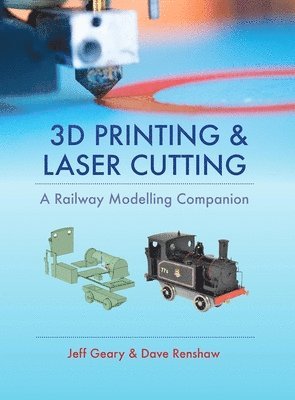
The technology for 3D printing has been around for many years but only recently have 3D printing machines become affordable for individuals or modelling societies. This has led to a rapidly expanding market among hobbyists and home users, offering the opportunity to design and build bespoke models of all kinds. This book provides an introduction to the subject with special emphasis on model railways.The authors take readers through the principles of 3D drawing and a review of some of the 3D software packages available free of charge on the internet. A series of step-by-step instructions then guide the reader through the construction of lineside structures, rolling stock and locomotives. A section on the technology of 3D printing and practical advice on using a 3D printer follows, highlighting the pitfalls and how to avoid them. The final section introduces laser cutting and etching/engraving for the modeller, again with step-by-step examples.The book is illustrated with over 300 colour pictures and diagrams, showing the reader in detail how to master the techniques needed to create excellent 3D models.
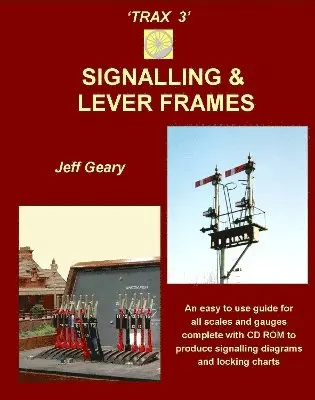
The renowned and easy to use TRAX computer programme is back. Author Jeff Geary explores the possibilities of controlling a model railway in prototypical fashion, namely by operating points and signals from a signal-box style lever frame. Making the frame mechanically interlocked, ensures that trains can only be signalled when the correct route is set, and that conflicting routes cannot be set at the same time. This new book also explains the principles of signalling, the different types of signal and their significance, and how a typical track diagram would be signalled. The application of these principles to the model railway is then discussed, showing how the block section method of working can be adapted to control the layout. In easy to follow fashion and with copious illustrations, the construction of signals and lever frames is explained, with details on how to construct a set of mechanical locks and releases to ensure exact workings of a lever frameAlso included with the book is a CD containing the third version of the TRAX program. Additional facilities available in TRAX 3 include new track formations such as scissors crossings and transition curves plus extended drawing facilities. New signal types have been added plus lever frames incorporating full locking facilities. Also included in the programme is a scripting facility to develop and test timetabling, and utility programs to make it possible to test locking on the lever frame.
The technology for 3D printing has been around for many years but only recently have 3D printing machines become affordable for individuals or modelling societies. This has led to a rapidly expanding market among hobbyists and home users, offering the opportunity to design and build bespoke models of all kinds. This book provides an introduction to the subject with special emphasis on model railways.The authors take readers through the principles of 3D drawing and a review of some of the 3D software packages available free of charge on the internet. A series of step-by-step instructions then guide the reader through the construction of lineside structures, rolling stock and locomotives. A section on the technology of 3D printing and practical advice on using a 3D printer follows, highlighting the pitfalls and how to avoid them. The final section introduces laser cutting and etching/engraving for the modeller, again with step-by-step examples.The book is illustrated with over 300 colour pictures and diagrams, showing the reader in detail how to master the techniques needed to create excellent 3D models.
The renowned and easy to use TRAX computer programme is back. Author Jeff Geary explores the possibilities of controlling a model railway in prototypical fashion, namely by operating points and signals from a signal-box style lever frame. Making the frame mechanically interlocked, ensures that trains can only be signalled when the correct route is set, and that conflicting routes cannot be set at the same time. This new book also explains the principles of signalling, the different types of signal and their significance, and how a typical track diagram would be signalled. The application of these principles to the model railway is then discussed, showing how the block section method of working can be adapted to control the layout. In easy to follow fashion and with copious illustrations, the construction of signals and lever frames is explained, with details on how to construct a set of mechanical locks and releases to ensure exact workings of a lever frameAlso included with the book is a CD containing the third version of the TRAX program. Additional facilities available in TRAX 3 include new track formations such as scissors crossings and transition curves plus extended drawing facilities. New signal types have been added plus lever frames incorporating full locking facilities. Also included in the programme is a scripting facility to develop and test timetabling, and utility programs to make it possible to test locking on the lever frame.