Jeffery A. Smith – författare
Visar alla böcker från författaren Jeffery A. Smith. Handla med fri frakt och snabb leverans.
11 produkter
11 produkter
Inbunden, Engelska, 1990
1 073 kr
Skickas inom 5-8 vardagar
At the end of his seventy-year career as a journalist, Benjamin Franklin trained his grandson, Benjamin Franklin Bache, in his profession. After his grandfather's death, Bache brought the republican and Enlightenment ideas he had been taught to the heated party controversies of the 1790s. He became the leading Jeffersonian journalist of the period and was boycotted, physically assaulted, and eventually charged with seditious libel shortly before his death in 1798. Jeffery Smith vividly illustrates the intense ideological conflict of the period through this original study of Bache's education and career.
Häftad, Engelska, 1990
526 kr
Skickas inom 5-8 vardagar
Drawing on sources ranging from political philosophers to court records and newspaper essayists, Printers and Press Freedom traces the development of a widespread conception of the press as necessarily exempt from all government restrictions, but still liable for the defamation of individuals. In this study, Smith carefully analyses libertarian press theory and practice in the context of republican ideology and Enlightenment thought.
Inbunden, Engelska, 1999
1 712 kr
Skickas inom 5-8 vardagar
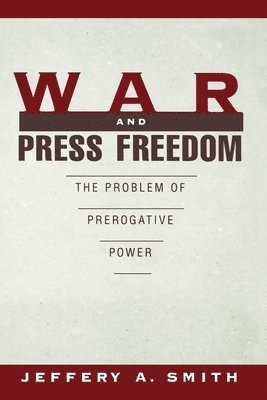
War and Press Freedom: The Problem of Prerogative Power is a groundbreaking and provocative study of one of the most perplexing civil liberties issues in American history: What authority does or should the government have to control press coverage and commentary in wartime? First Amendment scholar Jeffery A. Smith shows convincingly that no such extraordinary power exists under the Constitution, and that officials have had to rely on claiming the existenceof an autocratic "higher law" of survival. Smith carefully surveys the development of statutory restrictions and military regulations for the news media from the ratification of the Bill of Rights in 1791through the Gulf War of 1991. He concludes that the armed forces can justify refusal to divulge a narrow range of defense secrets, but that imposing other restrictions is unwise, unnecessary, and unconstitutional. In any event, as electronic communication becomes almost impossible to constrain, soldiers and journalists must learn how to respect each other's obligations in a democratic system.
Häftad, Engelska, 1999
573 kr
Skickas inom 5-8 vardagar
Over the course of the two centuries between the ratification of the First Amendment in 1791 and the Gulf War in 1991, the American press lacked an adequate right to analyse and report on this nation's armed conflicts. When restrictions were challenged as violations of the Constitution, military regulations and federal laws were justified as necessary under the "higher law" of survival. Is there some law more important than the Constitution which allows prerogative powers to be used in a time of war or national crisis? This groundbreaking and provocative study, examining law and history over these two hundred years, argues that press freedom cannot and should not be suspended during armed conflict. Author Smith maintains that the military and the media must work together on such matters, for neither has authority over the other.
E-bok
PDF, Engelska, 1999413 kr
Läs direkt efter köp
War and Press Freedom: The Problem of Prerogative Power is a groundbreaking and provocative study of one of the most perplexing civil liberties issues in American history: What authority does or should the government have to control press coverage and commentary in wartime? First Amendment scholar Jeffery A. Smith shows convincingly that no such extraordinary power exists under the Constitution, and that officials have had to rely on claiming the existence of an autocratic "higher law" of survival. Smith carefully surveys the development of statutory restrictions and military regulations for the news media from the ratification of the Bill of Rights in 1791 through the Gulf War of 1991. He concludes that the armed forces can justify refusal to divulge a narrow range of defense secrets, but that imposing other restrictions is unwise, unnecessary, and unconstitutional. In any event, as electronic communication becomes almost impossible to constrain, soldiers and journalists must learn how to respect each other''s obligations in a democratic system.
E-bok
PDF, Engelska, 1990492 kr
Läs direkt efter köp
In the United States, the press has sometimes been described as an unoffical fourth branch of government, a branch that serves as a check on the other three and provides the information necessary for a democracy to function. Freedom of the press--guaranteed but not defined by the First Amendment of the Constitution--can be fully understood only when examined in the context of the political and intellectual experiences of 18th-century America. Here, Jeffery A. Smith explores how Madison, Franklin, Jefferson, and their contemporaries came to see liberty of the press as a natural and vital part of a democratic republic. Drawing on sources ranging from political philosophers to court records and newspaper essayists, Printers and Press Freedom traces the development of a widespread conception of the press as necessarily exempt from all government restrictions, but still liable for the defamation of individuals. Smith carefully analyzes libertarian press theory and practice in the context of republican ideology and Enlightenment thought--paying particular attention to the cases of Benjamin Franklin and his relatives and associates in the printing business--and concludes that the generation that produced the First Amendment believed that government should not be trusted and that the press needed the broadest possible protection in order to serve as a check on the misuse of power.
E-bok
PDF, Engelska, 1990912 kr
Läs direkt efter köp
Fostering the "pursuit of happiness" was an avowed purpose of the American Revolution, but what was the phrase to mean in practice? How would the new society being created achieve what Enlightenment egalitarians called the "common good"? In this dual biography of Benjamin Franklin and his grandson Benjamin Franklin Bache, Jeffery A. Smith examines the careers of two of the most prominent journalists to advocate what became known as Jeffersonian republicanism. Franklin used his writings to encourage the kind of conscientious and public-spirited behavior he thought necessary if the majority of people were to secure free and prosperous lives. He impressed these ideals on Bache as he supervised his education in three countries and established him as a printer-publisher in Philadelphia. In the 1790s, as Federalists and Republicans battled over the course the United States would take in national and international affairs, Franklin''s carefully indoctrinated protege became Jefferson''s confidant and most fierce journalistic supporter. Franklin and Bache were among those envisioning a nation where liberty, learning, and a more even distribution of wealth would inaugurate a new epoch in human history. Published on the 200th anniversary of Franklin''s death, this careful study offers a much-needed illumination of early American aspirations for a democratic future.
E-bok
Engelska, 201550 kr
Läs direkt efter köp
The dimensions of a higher intelligent living being part 1 is about what dimensions are in life because I think any dimension is something for any dimension to be what any is in life, and therefore, the dimensions of a higher intelligent living being is about how dimensions are in life because I think any dimension is something for any dimension to be how any dimension is in life, even though, the dimensions of a higher intelligent living being part 1 is about the possibility of a higher intelligent living being because I think everything is created by a higher intelligent living being that I choose to call God; different aspects of God, Gods will, Gods state of consciousness, Gods thoughts, Gods mind, and Gods being; how everything is in relation to God; how any dimension is able to be overlapping, and co-existing with any other dimension; the embodiment of God, someone, something, and everything because I think there are different characteristics or features that is apart of making up the embodiment of God, someone, something, and everything; God, and someone having a choice of right or wrong because I think God, and someone can choose something that is right or wrong for God, and someone to be having a choice of right or wrong; how something doesnt have a choice of right or wrong; how something is opposite of itself; someones thoughts because I think someones thoughts is someones history of someones life; the truth or a lie because I think someone can be right or wrong for someone to be choosing the truth or a lie; someones beliefs because I think someones thoughts is someones beliefs, and someones feelings because I think someone has feelings for someone to be feeling what someone is feeling.
E-bok
Engelska, 201550 kr
Läs direkt efter köp
The dimensions of a higher intelligent living being part 2 is about Gods, someones, and somethings choices because I think God, someone, and something has a choice for God, someone, and something to be having choices; Gods, someones, and somethings intervention; how someone is in life because I think someone is somehow able to be overlapping, and co-existing along with something for someone to be how someone is in life; how something is in life because I think something is somehow able to be overlapping, and co-existing along with something for something to be how something is in life; how any body of mass is in life because I think any body of mass consists of 12 dimensions that is apart of making up any body of mass for any body of mass to be how any body of mass is in life; how the three dimensions of length are in life because I think the three dimensions of length is overlapping, and co-existing along with each others lengths for the three dimensions of length to be how the three dimensions of length are in life; how the universe is in life because I think the universe consists of someone, and any body of mass that is apart of making up everything that is able to be taking place in the universe for the universe to be how the universe is in life; how God can respond to someone because I think someone can respond to God for God to be responding to someone; forgiveness because I think someone can do something wrong for someone to be forgiving someone, and what can possibly happen to someone after someone dies because I do not think someone is nothing for nothing not to possibly happen to someone after someone dies.
Häftad, Engelska, 2015
295 kr
Skickas inom 5-8 vardagar
Häftad, Engelska, 2015
355 kr
Skickas inom 5-8 vardagar