Jeffrey Allan Johnson - Böcker
Visar alla böcker från författaren Jeffrey Allan Johnson. Handla med fri frakt och snabb leverans.
3 produkter
3 produkter
726 kr
Skickas inom 7-10 vardagar
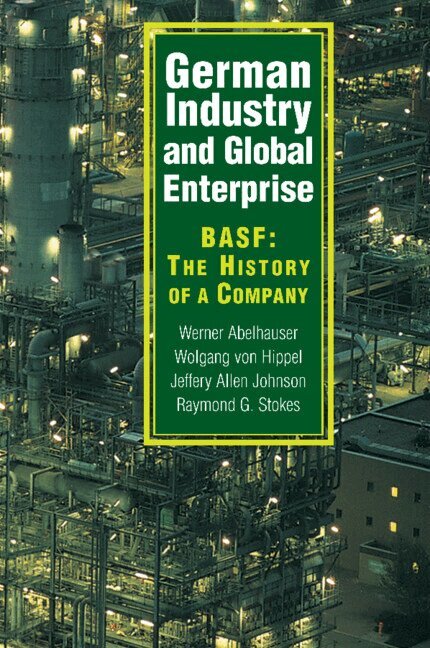
The corporate history of BASF spans an era of German and international economic history that began with the rise of the 'new industries' as of the late nineteenth century and continues today in their confrontation with the new economy. This book examines BASF's corporate governance, financial system, industrial relations, system of qualification and relation to other companies. A corporate history of BASF promises more than an insight into the functioning of an industrial organisation. It also reveals the reasons for the extraordinary economic dynamics of the German empire and the enormous expansion of the world economy before World War I. BASF's history stands at the centre of Germany's wartime economy during two world wars and highlights both its strengths and weaknesses. Just as the IG Farben trust helped support Germany's course of politicoeconomic autarky after 1933, so it was that BASF helped facilitate West Germany's startlingly quick return to the world market. BASF has since been among the transnational companies whose efforts at the leading edge of economic and technological progress are paradigmatic for Germany's entry into the new economy of the twenty-first century.
1 838 kr
Skickas inom 7-10 vardagar
The corporate history of BASF spans an era of German and international economic history that began with the rise of the 'new industries' as of the late nineteenth century and continues today in their confrontation with the new economy. This book examines BASF's corporate governance, financial system, industrial relations, system of qualification and relation to other companies. A corporate history of BASF promises more than an insight into the functioning of an industrial organisation. It also reveals the reasons for the extraordinary economic dynamics of the German empire and the enormous expansion of the world economy before World War I. BASF's history stands at the centre of Germany's wartime economy during two world wars and highlights both its strengths and weaknesses. Just as the IG Farben trust helped support Germany's course of politicoeconomic autarky after 1933, so it was that BASF helped facilitate West Germany's startlingly quick return to the world market. BASF has since been among the transnational companies whose efforts at the leading edge of economic and technological progress are paradigmatic for Germany's entry into the new economy of the twenty-first century.
528 kr
Skickas inom 10-15 vardagar
In the early twentieth century, an elite group of modern-minded scientists in Germany, led by the eminent organic chemist Emil Fischer, set out to create new centers and open new sources of funding for chemical research. Their efforts led to the establishment in 1911 of the chemical institues of the Kaiser Wilhelm Society for the Advancement of the Sciences, whose original staff included several future Nobel laureates. Although these institutes were designed to promote ""free research"" that would uphold German Leadership in international science, they also came to promote the integration of science in the German war effort after 1914. According to Jeffrey Johnson, the development of the Kaiser Wilhelm Institutes exemplifies the origins and dilemmas of one of the most significant innovations in modern science: the creation of institutions for basic research, both theoretical and practical.The Kaiser Wilhelm Society was a quasi-official institution under the ""protection"" of Kaiser Wilhelm II, but it received most of its funding from German industry rather than the Imperial Treasury. After 1914, however, the Kaiser's chemists and their institutes provided key support to the German war effort. Within a few months of the outbreak of World War I, the institutes had been integrated into war mobilization activities. They conducted research both in weapons, such as poison gas, and in strategic resources, especially synthetics to replace naturally produced goods cut off by Britain's blockade of German ports.By examining the Kaiser Wilhelm Society in the framework of both scientific and social change, Johnson is able to answer questions that seem puzzling if not viewed from this dual perspective, such as why German chemists pushed for institutional change at this particular time. Johnson argues that the new institutes arose from a characteristically modern tension between internationally set scientific goals and the competing national priorities of a country headed for war. Johnson's sources include the papers of Emil Fischer; the archives of several major German corporations, including Bayer, Hoechst, and Krupp; government records; and the archives of the Max Planck Society, which grew out of the Kaiser Wilhelm Society after World War II.A UNC Press Enduring Edition -- UNC Press Enduring Editions use the latest in digital technology to make available again books from our distinguished backlist that were previously out of print. These editions are published unaltered from the original, and are presented in affordable paperback formats, bringing readers both historical and cultural value.