Jeffrey B. Harborne - Böcker
Visar alla böcker från författaren Jeffrey B. Harborne. Handla med fri frakt och snabb leverans.
7 produkter
7 produkter
1 064 kr
Skickas inom 10-15 vardagar
The flavonoids, one of the most numerous and widespread groups of natural constituents, are important to man not only because they contribute to plant colour but also because many members (e.g. coumestrol, phloridzin, rotenone) are physiologically active. Nearly two thousand substances have been described and as a group they are universally distributed among vascular plants. Although the anthocyanins have an undisputed function as plant pigments, the raison d'etre for the more widely distributed colourless flavones and flavonols still remains a mystery. It is perhaps the challenge of discovering these yet undisc10sed functions which has caused the considerable resurgence of interest in flavonoids during the last decade. This book attempts to summarize progress that has been made in the study of these constituents since the first comprehensive monograph on the chemistry of the flavonoid compounds was published, under the editorship of T. A. Geissman, in 1962. The present volume is divided into three parts. The first section (Chapters 1-4) deals with advances in chemistry, the main emphasis being on spectral techniques to take into account the re cent successful applications of NMR and mass spectral measurements to structural identifications. Recent developments in isolation techniques and in synthesis are also covered in this section. Advances in chemical knowledge of individual c1asses of flavonoid are mentioned inter aha in later chapters of the book.
528 kr
Skickas inom 10-15 vardagar
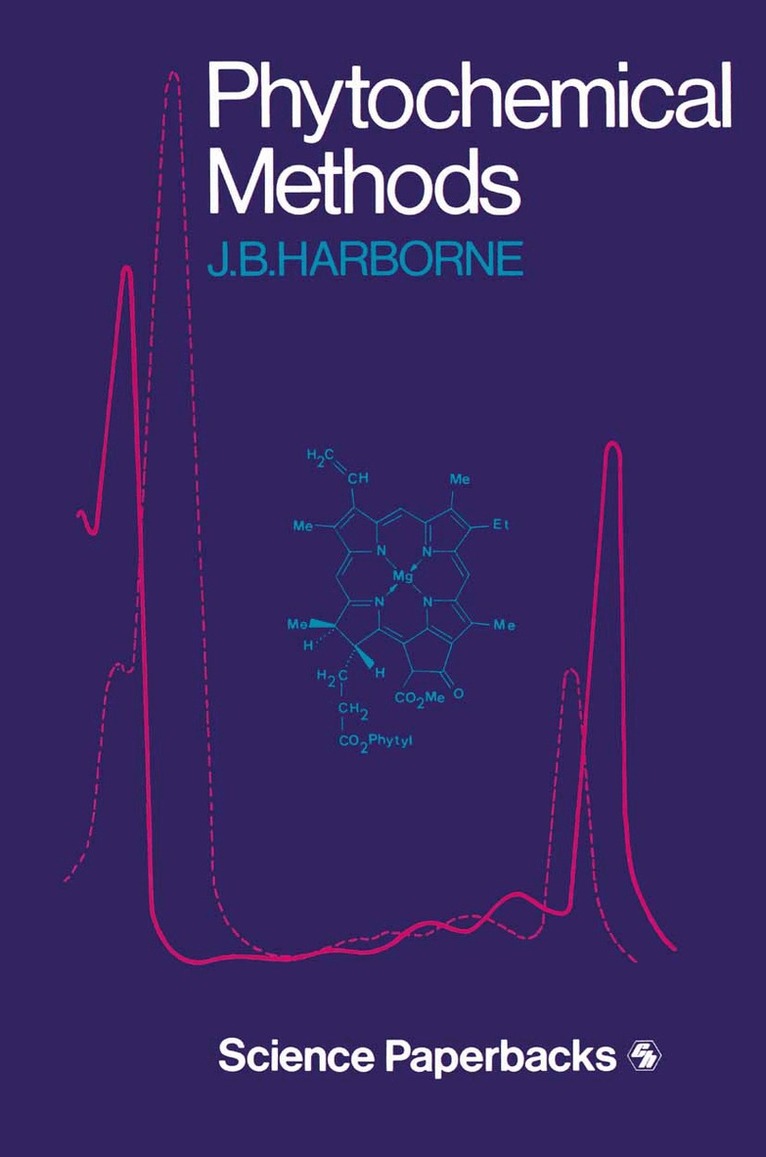
While there are many books available on methods of organic and biochemical analysis, the majority are either primarily concerned with the application of a particular technique (e.g. paper chromatography) or have been written for an audience of chemists or for biochemists work ing mainly with animaltissues. Thus, no simple guide to modern metho ds of plant analysis exists and the purpose of the present volume is to fill this gap. It is primarily intended for students in the plant sciences, who have a botanical or a general biological background. It should also be of value to students in biochemistry, pharmacognosy, food science and 'natural products' organic chemistry. Most books on chromatography, while admirably covering the needs of research workers, tend to overwhelm the student with long lists of solvent systems and spray reagents that can be applied to each class of organic constituent. The intention here is to simplify the situation by listing only a few specially recommended techniques that have wide currency in phytochemical laboratories. Sufficient details are provided to allow the student to use the techniques for themselves and most sections contain some introductory practical experiments which can be used in classwork.
7 075 kr
Tillfälligt slut
Throughout history man has utilised the bounty of plants using them as a source for food, feed, beverages, drugs and medicine, flavours, perfumes, dyes, gums, resins, fibres, timbers and numerous other applications. Modern biotechnology is centralised and devoted to the further exploitation of plant products and an example is capsicum, one of the ingredients in chilli's, that induces endorphin release in the body (a reason why many people love spicy foods) that is now added to painkillers. This book is a compilation that lists the many essential and invaluable plant substances man has found invaluable throughout his life. Where necessary the chemical structures of the plant products are included and starting with the product rather than the plant name it provides easy access to information on an extensive range of plant products - of use in many industries. A full bibliography of the books consulted during the compilation is included as well as two indexes (the plant species and common name) and a listing of the entry names of products and their synonyms. Each entry includes: Name of Plant ProductSynonymsChemical ClassificationOccurrenceDescription and CompositionComments (where applicable) Where necessary the chemical structures of the plant products are also included.
11 968 kr
Skickas inom 11-20 vardagar
Phytotoxins are poisonous substances produced by plants, mostly for reasons of protection and compound transport. The study of these substances has yielded many new medicinal products both for humans and other animals. This book provides a concise and comprehensive source of information on plant toxins.
23 729 kr
Skickas inom 7-10 vardagar
Flavonoids are a large and important group of natural products derived from 'flavone'. Some flavonoids are intensely coloured, providing a spectrum of colours from red to blue in flowers, fruit and leaves. Other flavonoids are essentially colourless, producing the 'whiteness' of white flowers. Besides their contribution to plant colour, flavonoids have a variety of other roles in the growth and development of plants. Leaf flavonoids provide protection from the potential damage of UVB radiation. Certain flavanones are formed as antifungal barriers in plant leaves in response to microbial infection and others play an important part in plant reproduction. Flavonoids also exhibit a wide range of biological properties including anti-microbial, insecticidal and oestrogenic activities. Edited by one of the world's acknowledged leading researchers in flavonoid chemistry and biochemistry, this book is the essential guide to the chemical structure and function of all known flavonoids and contains full references, CAS numbers, chemical structures, molecular formulae and several extensive indexes. The Handbook of Natural Flavonoids is the definitive reference to this large and important group of natural products for researchers in pharmaceutical and medicinal chemistry, plant biochemistry and organic chemistry.
649 kr
Skickas inom 10-15 vardagar
Didaktisch geschickt und anschaulich werden die biochemischen Beziehungen zwischen Pflanzen, Tieren und ihrer Umwelt beschrieben. Das Buch ist auch für Leser mit geringen Biochemiekenntnissen leicht verständlich. Aus dem Inhalt: Pflanzen und biochemische Adaption an Umwelt Biochemie der Pflanzenbestäubung Pflanzentoxine und ihre Wirkung auf Tiere Hormonelle Beziehungen zwischen Pflanzen und Tieren Nahrungspräferenzen Abwehrmechanismen von Pflanzen und Reaktionen der Tiere (Coevolution) Pheromone: Biochemische Kommunikation zwischen Tieren Biochemische Wechselwirkungen zwischen Pflanzen.
2 427 kr
Tillfälligt slut
This book is principally concerned with the relatively complex small molecules produced by plants, which are important as drugs, fine chemicals, fragrances, flavours and biologically-active dietary constituents. In a wide-ranging series of thematic essays, it covers key aspects of their role in plant ecology, their metabolism in the plant, their discovery, characterisation and use and their significance in the diet. Biotechnology, including prospects for the genetic engineering of metabolic pathways, for biotransformations and also for the production of biologically-active proteins, is the focus of the final section of the book. The overall aim of the volume is to provide, in each of the selected subject areas, a personal critique which is readily accessible to the advanced undergraduate student and to the non-specialist research worker alike.