Jeffrey Dudiak – författare
Visar alla böcker från författaren Jeffrey Dudiak. Handla med fri frakt och snabb leverans.
8 produkter
8 produkter
Inbunden, Engelska, 2001
1 228 kr
Skickas inom 10-15 vardagar
This work explains how human beings can live more peacefully with one another by understanding the conditions of possibility for dialogue. Philosophically, this challenge is articulated as the problem of: how dialogue as dia-logos is possible when the shared logos is precisely that which is in question. Emmanuel Levinas, in demonstrating that the shared logos is a function of interhuman relationship, helps us to make some progress in understanding the possibilities for dialogue in this situation. If the terms of the argument to this point are taken largely from Levinas's 1961 Totality and Infinity, Dudiak further proposes that Levinas's 1974 Otherwise than Being can be read as a deepening of these earlier analyses, delineating, both the conditions of possibility and impossibility for discourse itself. Throughout these analyses Dudiak discovers that in Levinas's view dialogue is ultimately possible, only for a gracious subjectivity already graced by God by way of the other, but where the word God is inseparable from my subjectivity as graciousness to the other. Finally, for Levinas, the facilitation of dialogue, the facilitation of peace, comes down to the subject's capacity and willingness to be who he or she is, to take the beautiful risk of a peaceful gesture offered to the other, and that peace, in this gesture itself. As Levinas himself puts it: "Peace then is under my responsibility. I am a hostage, for I am alone to wage it, running a fine risk, dangerously." Levinas's philosophical discourse is precisely itself to be read as such a gesture.
Häftad, Engelska, 2001
465 kr
Skickas inom 10-15 vardagar
This work explains how human beings can live more peacefully with one another by understanding the conditions of possibility for dialogue. Philosophically, this challenge is articulated as the problem of: how dialogue as dia-logos is possible when the shared logos is precisely that which is in question. Emmanuel Levinas, in demonstrating that the shared logos is a function of interhuman relationship, helps us to make some progress in understanding the possibilities for dialogue in this situation. If the terms of the argument to this point are taken largely from Levinas's 1961 Totality and Infinity, Dudiak further proposes that Levinas's 1974 Otherwise than Being can be read as a deepening of these earlier analyses, delineating, both the conditions of possibility and impossibility for discourse itself. Throughout these analyses Dudiak discovers that in Levinas's view dialogue is ultimately possible, only for a gracious subjectivity already graced by God by way of the other, but where the word God is inseparable from my subjectivity as graciousness to the other. Finally, for Levinas, the facilitation of dialogue, the facilitation of peace, comes down to the subject's capacity and willingness to be who he or she is, to take the beautiful risk of a peaceful gesture offered to the other, and that peace, in this gesture itself. As Levinas himself puts it: "Peace then is under my responsibility. I am a hostage, for I am alone to wage it, running a fine risk, dangerously." Levinas's philosophical discourse is precisely itself to be read as such a gesture.
Häftad, Engelska, 2015
260 kr
Skickas inom 3-6 vardagar
Häftad, Engelska
285 kr
Skickas inom 3-6 vardagar
285 kr
Skickas inom 3-6 vardagar
Häftad, Engelska, 2022
150 kr
Skickas inom 5-8 vardagar
Inbunden, Engelska, 2022
285 kr
Skickas inom 5-8 vardagar
E-bok
Engelska, 2022149 kr
Läs direkt efter köp
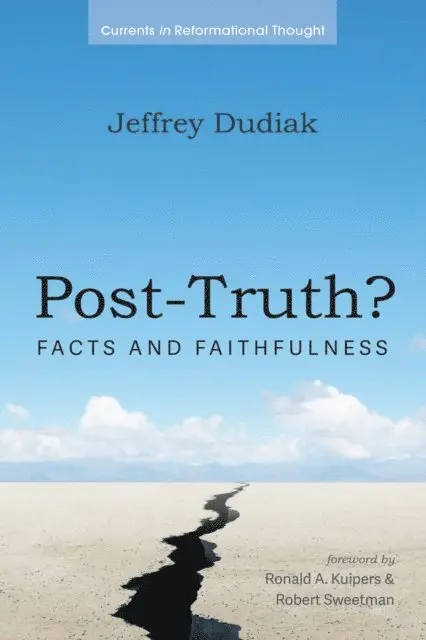
In Post-Truth? Facts and Faithfulness, Jeffrey Dudiak explores the fissures and fractures that vex our so-called "e;post-truth"e; era, searching for a deeper, dare we say truer, understanding of the cultural forces that have led North American society to become so polarized. Eschewing the kind of easy responses that trade pluralistic solidarity for tribalistic certainty, Dudiak diagnoses a deeper breakdown in social trust as the underlying issue that has everyone today scurrying for comforting, ideological cover. In this context, Dudiak reminds the reader that truth is more, and runs deeper, than simple correspondence to the facts.