Jeffrey M Shaman – författare
Visar alla böcker från författaren Jeffrey M Shaman. Handla med fri frakt och snabb leverans.
4 produkter
4 produkter
Inbunden, Engelska, 2008
764 kr
Skickas inom 5-8 vardagar
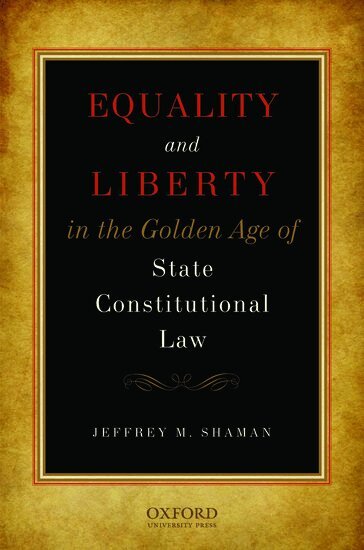
In Equality and Liberty in the Golden Age of State Constitutional Law, Jeffrey Shaman closely examines the evolution of liberty and equality under state constitutions from both a historical and jurisprudential perspective. The rise of New Judicial Federalism has allowed many states to rediscover their own empowerment in enacting their own constitutions. As the New Judicial Federalism gained ground, it was found to be that state constitutional law is an extremely important source for the protection of individual rights and liberties. These state constitutions can be interpreted however the state sees fit, and act independently of federal constitutional law. Shaman explains that this rise has caused these states to recognize individual civil rights or liberties beyond those recognized under the Federal Constitution.Professor Shaman emphasizes how important state constitutional law is in the protection of the rights of the individual. Since these states are acting under their own constitutional law and guidance, their constitutions provide an extension of the individual's rights to privacy, civil rights, and liberties. State courts and constitutions have also pioneered a trend in recognizing and expanding abortion rights and some have granted rights to same-sex civil unions, and in some states, same-sex marriages. This trend eventually caught the attention of the U.S. Supreme Court to finally follow suit. This book will prove to be an intriguing read for lawyers, judges and scholars alike who are interested in the protection of their individual state rights as well as their federal rights.
E-bok
PDF, Engelska, 2008617 kr
Läs direkt efter köp
The rise of the New Judicial Federalism movement in the 1970s marked a sea-change in the history of state constitutional law by shifting the focus of power away from the central government in ways that had not occurred since the Equal Protection Clause was enacted in 1868. With New Judicial Federalism, many states rediscovered that they were empowered to enact their own constitutions and to interpret them as they saw fit, which enabled states to recognize civil rights and liberties beyond those recognized under the Federal Constitution.Equality and Liberty in the Golden Age of State Constitutional Law closely examines the evolution of the rights of liberty and equality under state constitutions from both a historical and jurisprudential perspective. In it, Professor Jeffrey M. Shaman explains that as New Judicial Federalism gained ground, state constitutional law became an important source for the protection of individual rights and liberties. States have since expanded the right of the citizen well beyond the limits of federal law by striking down laws that led to de facto segregation in public schools, discriminated against women, or allocated public benefits inequitably. State courts were the first to recognize a right of intimate association, spurring the U.S. Supreme Court to follow suit. Equality and Liberty in the Golden Age of State Constitutional Law is essential reading for anyone interested in this manifestation of law that has developed beyond the purview of national attention and in the resulting evolution of power in U.S. constitutional law.
E-bok
PDF, Engelska, 20001 008 kr
Läs direkt efter köp
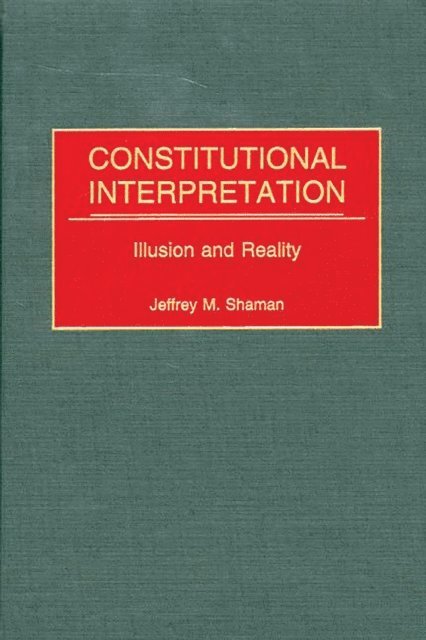
This study analyzes the process of constitutional interpretation, that is, the methodology by which the Supreme Court goes about interpreting the Constitution, and offers a comprehensive view of constitutional law through the lens of history, political science, and jurisprudence. Shaman examines the practice of creating meaning for the Constitution, the dichotomy of legal formalism and realism, the levels of judicial scrutiny, the perception of reality, and the puzzle of legislative motive. While the book traces the historical development of constitutional law, its main focus is on modern jurisprudence, including analyses of the major themes of constitutional interpretation developed by the Warren, Burger, and Rehnquist Courts.Shaman details the Warren Court's move to a more realistic jurisprudence and its development of a multi-level system of judicial review that has become increasingly more complex under the Burger and Rehnquist Courts. He critiques the Supreme Court's reversion in recent years to an old-fashioned formalistic jurisprudence and the growing tendency of the Court to look to the past rather than to future to interpret the Constitution. The book also includes discussion of recent major doctrinal developments such as constitutional theory underlying Supreme Court decisions on gender discrimination, discrimination on the basis of sexual preference, the right to die, abortion, and freedom of speech.
Inbunden, Engelska, 2000
958 kr
Skickas inom 10-15 vardagar
This study analyzes the process of constitutional interpretation, that is, the methodology by which the Supreme Court goes about interpreting the Constitution, and offers a comprehensive view of constitutional law through the lens of history, political science, and jurisprudence. Shaman examines the practice of creating meaning for the Constitution, the dichotomy of legal formalism and realism, the levels of judicial scrutiny, the perception of reality, and the puzzle of legislative motive. While the book traces the historical development of constitutional law, its main focus is on modern jurisprudence, including analyses of the major themes of constitutional interpretation developed by the Warren, Burger, and Rehnquist Courts.Shaman details the Warren Court's move to a more realistic jurisprudence and its development of a multi-level system of judicial review that has become increasingly more complex under the Burger and Rehnquist Courts. He critiques the Supreme Court's reversion in recent years to an old-fashioned formalistic jurisprudence and the growing tendency of the Court to look to the past rather than to future to interpret the Constitution. The book also includes discussion of recent major doctrinal developments such as constitutional theory underlying Supreme Court decisions on gender discrimination, discrimination on the basis of sexual preference, the right to die, abortion, and freedom of speech.