Jeffrey Schonberg – författare
Visar alla böcker från författaren Jeffrey Schonberg. Handla med fri frakt och snabb leverans.
2 produkter
2 produkter
Del 21 - California Series in Public Anthropology
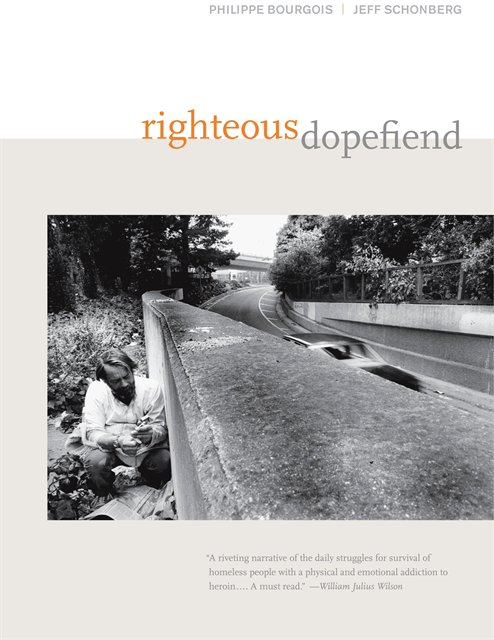
Righteous Dopefiend
Häftad, Engelska, 2009
337 kr
Skickas inom 5-8 vardagar
This powerful study immerses the reader in the world of homelessness and drug addiction in the contemporary United States. For over a decade Philippe Bourgois and Jeff Schonberg followed a social network of two dozen heroin injectors and crack smokers on the streets of San Francisco, accompanying them as they scrambled to generate income through burglary, panhandling, recycling, and day labor. "Righteous Dopefiend" interweaves stunning black-and-white photographs with vivid dialogue, detailed field notes, and critical theoretical analysis. Its gripping narrative develops a cast of characters around the themes of violence, race relations, sexuality, family trauma, embodied suffering, social inequality, and power relations.The result is a dispassionate chronicle of survival, loss, caring, and hope rooted in the addicts' determination to hang on for one more day and one more 'fix' through a 'moral economy of sharing' that precariously balances mutual solidarity and interpersonal betrayal.
E-bok
Engelska, 2009303 kr
Läs direkt efter köp
This powerful work of gonzo journalism, predating the widespread acknowledgement of the opioid epidemic as such, immerses the reader in the world of homelessness and drug and alcohol abuse in the contemporary United States. For over a decade Philippe Bourgois and Jeff Schonberg followed a social network of two dozen heroin injectors and crack smokers in the San Francisco drug scene, accompanying them as they scrambled to generate income through burglary, larceny, panhandling, recycling, and day labor. Righteous Dopefiend interweaves stunning black-and-white photography with vivid dialogue, oral biography, detailed field notes, and critical theoretical analysis to viscerally illustrate the life of a drug addict. Its gripping narrative develops a cast of characters around the themes of violence, racism and race relations, sexuality, trauma, embodied suffering, social inequality, and power relations. The result is a dispassionate chronicle of fixes and overdoses; of survival, loss, caring, and hope rooted in the drug abusers’ determination to hang on for one more day, through a "moral economy of sharing" that precariously balances mutual solidarity and interpersonal betrayal.