Jeffrey W. Alstete – författare
Visar alla böcker från författaren Jeffrey W. Alstete. Handla med fri frakt och snabb leverans.
6 produkter
6 produkter
E-bok
Engelska, 2014327 kr
Läs direkt efter köp
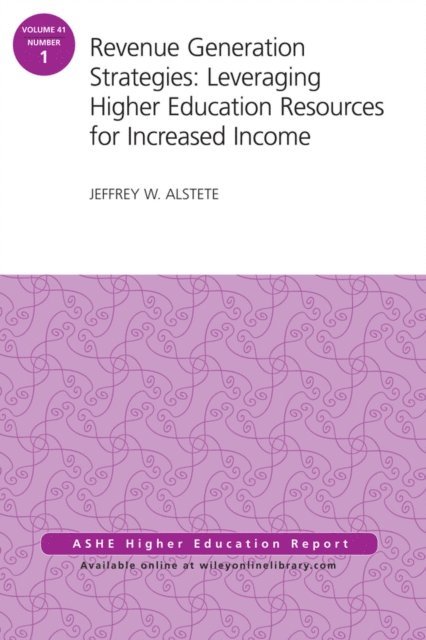
Achieving successful financial viability by broadening revenue sources is one of the most important issues facing colleges and universities today. Increasing operating costs, along with the reliance on traditional student tuition, government support, and philanthropy, are challenging universities. One way administration leaders and faculty are meeting this challenge is to establish supplemental revenue streams from a variety other sources such as: continuing education, credit and noncredit certificates, degree completion and upgrade programs, study abroad, domestic and international branch campuses, distance education, auxiliary services, technology transfer, and partnerships or alliances with other organizations. These types of activities, formerly considered secondary ventures, are now integral to lasting and responsible financial strategic planning.This monograph examines a wide variety of supplemental income options and opportunities, as well as examples of restructuring financial planning schema. While not negating the value of traditional college education, these new revenue sources in fact lead to greater institutional effectiveness.This is the 1st issue of the 41th volume of the Jossey-Bass series ASHE Higher Education Report. Each monograph is the definitive analysis of a tough higher education issue, based on thorough research of pertinent literature and institutional experiences. Topics are identified by a national survey. Noted practitioners and scholars are then commissioned to write the reports, with experts providing critical reviews of each manuscript before publication.
E-bok
PDF, Engelska, 2014327 kr
Läs direkt efter köp
Achieving successful financial viability by broadening revenue sources is one of the most important issues facing colleges and universities today. Increasing operating costs, along with the reliance on traditional student tuition, government support, and philanthropy, are challenging universities. One way administration leaders and faculty are meeting this challenge is to establish supplemental revenue streams from a variety other sources such as: continuing education, credit and noncredit certificates, degree completion and upgrade programs, study abroad, domestic and international branch campuses, distance education, auxiliary services, technology transfer, and partnerships or alliances with other organizations. These types of activities, formerly considered secondary ventures, are now integral to lasting and responsible financial strategic planning.This monograph examines a wide variety of supplemental income options and opportunities, as well as examples of restructuring financial planning schema. While not negating the value of traditional college education, these new revenue sources in fact lead to greater institutional effectiveness.This is the 1st issue of the 41th volume of the Jossey-Bass series ASHE Higher Education Report. Each monograph is the definitive analysis of a tough higher education issue, based on thorough research of pertinent literature and institutional experiences. Topics are identified by a national survey. Noted practitioners and scholars are then commissioned to write the reports, with experts providing critical reviews of each manuscript before publication.
E-bok
PDF, Engelska, 2018501 kr
Läs direkt efter köp
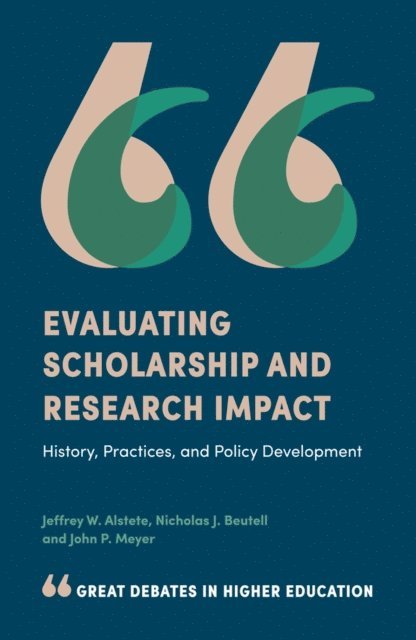
Faculty members, scholars, and researchers often ask where they should publish their work; which outlets are most suitable to showcase their research? Which journals should they publish in to ensure their work is read and cited? How can the impact of their scholarly output be maximized? The answers to these and related questions affect not only individual scholars, but also academic and research institution stakeholders who are under constant pressure to create and implement organizational policies, evaluation measures and reward systems that encourage quality, high impact research from their members. The explosion of academic research in recent years, along with advances in information technology, has given rise to omnipresent and increasingly important scholarly metrics. These measures need to be assessed and used carefully, however, as their widespread availability often tempts users to jump to improper conclusions without considering several caveats. While various quantitative tools enable the ranking, evaluating, categorizing, and comparing of journals and articles, metrics such as author or article citation counts, journal impact factors, and related measures of institutional research output are somewhat inconsistent with traditional goals and objectives of higher education research and scholarly academic endeavors. This book provides guidance to individual researchers, research organizations, and academic institutions as they grapple with rapidly developing issues surrounding scholarly metrics and their potential value to both policy-makers, as evaluation and measurement tools, and individual scholars, as a way to identify colleagues for potential collaboration, promote their position as public intellectuals, and support intellectual community engagement.
E-bok
Engelska, 2018501 kr
Läs direkt efter köp
Faculty members, scholars, and researchers often ask where they should publish their work; which outlets are most suitable to showcase their research? Which journals should they publish in to ensure their work is read and cited? How can the impact of their scholarly output be maximized? The answers to these and related questions affect not only individual scholars, but also academic and research institution stakeholders who are under constant pressure to create and implement organizational policies, evaluation measures and reward systems that encourage quality, high impact research from their members. The explosion of academic research in recent years, along with advances in information technology, has given rise to omnipresent and increasingly important scholarly metrics. These measures need to be assessed and used carefully, however, as their widespread availability often tempts users to jump to improper conclusions without considering several caveats. While various quantitative tools enable the ranking, evaluating, categorizing, and comparing of journals and articles, metrics such as author or article citation counts, journal impact factors, and related measures of institutional research output are somewhat inconsistent with traditional goals and objectives of higher education research and scholarly academic endeavors. This book provides guidance to individual researchers, research organizations, and academic institutions as they grapple with rapidly developing issues surrounding scholarly metrics and their potential value to both policy-makers, as evaluation and measurement tools, and individual scholars, as a way to identify colleagues for potential collaboration, promote their position as public intellectuals, and support intellectual community engagement.
Häftad, Engelska, 2018
654 kr
Skickas inom 5-8 vardagar
Faculty members, scholars, and researchers often ask where they should publish their work; which outlets are most suitable to showcase their research? Which journals should they publish in to ensure their work is read and cited? How can the impact of their scholarly output be maximized? The answers to these and related questions affect not only individual scholars, but also academic and research institution stakeholders who are under constant pressure to create and implement organizational policies, evaluation measures and reward systems that encourage quality, high impact research from their members. The explosion of academic research in recent years, along with advances in information technology, has given rise to omnipresent and increasingly important scholarly metrics. These measures need to be assessed and used carefully, however, as their widespread availability often tempts users to jump to improper conclusions without considering several caveats. While various quantitative tools enable the ranking, evaluating, categorizing, and comparing of journals and articles, metrics such as author or article citation counts, journal impact factors, and related measures of institutional research output are somewhat inconsistent with traditional goals and objectives of higher education research and scholarly academic endeavors. This book provides guidance to individual researchers, research organizations, and academic institutions as they grapple with rapidly developing issues surrounding scholarly metrics and their potential value to both policy-makers, as evaluation and measurement tools, and individual scholars, as a way to identify colleagues for potential collaboration, promote their position as public intellectuals, and support intellectual community engagement.
Häftad, Engelska, 2014
196 kr
Tillfälligt slut