Jennifer Craig-Norton – författare
949 kr
Skickas inom 5-8 vardagar
412 kr
Skickas inom 5-8 vardagar
2 222 kr
Skickas inom 10-15 vardagar
607 kr
Skickas inom 10-15 vardagar
702 kr
Läs direkt efter köp
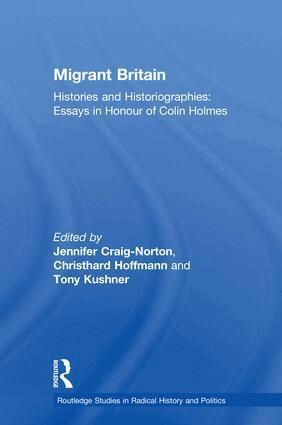
Britain has largely been in denial of its migrant past - it is often suggested that the arrivals after 1945 represent a new phenomenon and not the continuation of a much longer and deeper trend. There is also an assumption that Britain is a tolerant country towards minorities that distinguishes itself from the rest of Europe and beyond.
The historian who was the first and most important to challenge this dominant view is Colin Holmes, who, from the early 1970s onwards, provided a framework for a different interpretation based on extensive research. This challenge came not only through his own work but also that of a ''new school'' of students who studied under him and the creation of the journal Immigrants and Minorities in 1982.
This volume not only celebrates this remarkable achievement, but also explores the state of migrant historiography (including responses to migrants) in the twenty-first century.
702 kr
Läs direkt efter köp
Britain has largely been in denial of its migrant past - it is often suggested that the arrivals after 1945 represent a new phenomenon and not the continuation of a much longer and deeper trend. There is also an assumption that Britain is a tolerant country towards minorities that distinguishes itself from the rest of Europe and beyond.
The historian who was the first and most important to challenge this dominant view is Colin Holmes, who, from the early 1970s onwards, provided a framework for a different interpretation based on extensive research. This challenge came not only through his own work but also that of a ''new school'' of students who studied under him and the creation of the journal Immigrants and Minorities in 1982.
This volume not only celebrates this remarkable achievement, but also explores the state of migrant historiography (including responses to migrants) in the twenty-first century.