Jennifer M. Larson - Böcker
Visar alla böcker från författaren Jennifer M. Larson. Handla med fri frakt och snabb leverans.
4 produkter
4 produkter
929 kr
Skickas inom 7-10 vardagar
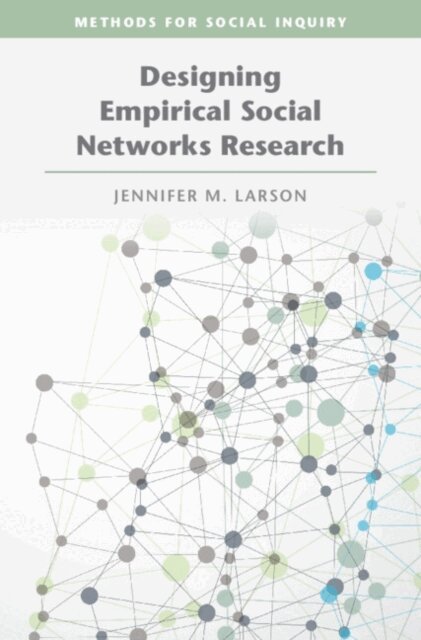
A user-friendly introductory guide to the empirical study of social networks. Jennifer M. Larson presents the fundamentals of social networks in an intuition-forward way which guides theory-driven research design. Substantial attention is devoted to a framework for developing a network theory that will steer data collection to be maximally informative and minimally frustrating. Other features include: Coverage of a range of practical topics including selecting operationalizations, cutting survey costs, and cleaning data; A tutorial for getting started in analyzing networks in R; Technical sections full of examples, points to hone intuition, and practice problems with solutions. Designing Empirical Social Networks Research will be a valuable tool for advanced undergraduates, Ph.D. students in the social sciences, especially political science, and researchers across the social sciences who are new to the study of networks.
297 kr
Skickas inom 7-10 vardagar
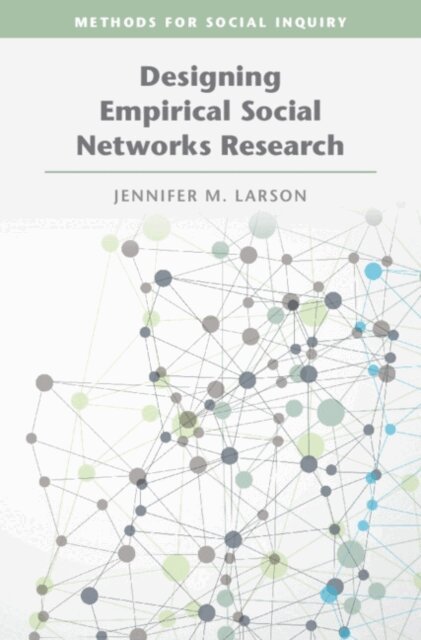
A user-friendly introductory guide to the empirical study of social networks. Jennifer M. Larson presents the fundamentals of social networks in an intuition-forward way which guides theory-driven research design. Substantial attention is devoted to a framework for developing a network theory that will steer data collection to be maximally informative and minimally frustrating. Other features include: Coverage of a range of practical topics including selecting operationalizations, cutting survey costs, and cleaning data; A tutorial for getting started in analyzing networks in R; Technical sections full of examples, points to hone intuition, and practice problems with solutions. Designing Empirical Social Networks Research will be a valuable tool for advanced undergraduates, Ph.D. students in the social sciences, especially political science, and researchers across the social sciences who are new to the study of networks.
Del 225 - Studies in Fuzziness and Soft Computing
Applying Fuzzy Mathematics to Formal Models in Comparative Politics
Inbunden, Engelska, 2008
1 069 kr
Skickas inom 10-15 vardagar
This book explores the intersection of fuzzy mathematics and the spatial modeling of preferences in political science. Beginning with a critique of conventional modeling approaches predicated on Cantor set theoretical assumptions, the authors outline the potential benefits of a fuzzy approach to the study of ambiguous or uncertain preference profiles. While crisp models assume that ambiguity is a form of confusion emerging from imperfect information about policy options, the authors argue instead that some level of ambiguity is innate in human preferences and social interaction. What fuzzy mathematics offers the researcher, then, is a precise tool with which he can model the inherently imprecise dimensions of nuanced empirical reality. Moving beyond the limited treatment fuzzy methodologies have received in extant political science literature, this book develops single- and multidimensional models of fuzzy preference landscapes and characterizes the surprisingly high levels of stability that emerge from interactions between players operating within these models. The material presented makes it a good text for a graduate seminar in formal modeling. It is also suitable as an introductory text in fuzzy mathematics for graduate and advanced undergraduate students.
Del 225 - Studies in Fuzziness and Soft Computing
Applying Fuzzy Mathematics to Formal Models in Comparative Politics
Häftad, Engelska, 2010
1 069 kr
Skickas inom 10-15 vardagar
This book explores the intersection of fuzzy mathematics and the spatial modeling of preferences in political science. Beginning with a critique of conventional modeling approaches predicated on Cantor set theoretical assumptions, the authors outline the potential benefits of a fuzzy approach to the study of ambiguous or uncertain preference profiles. While crisp models assume that ambiguity is a form of confusion emerging from imperfect information about policy options, the authors argue instead that some level of ambiguity is innate in human preferences and social interaction. What fuzzy mathematics offers the researcher, then, is a precise tool with which he can model the inherently imprecise dimensions of nuanced empirical reality. Moving beyond the limited treatment fuzzy methodologies have received in extant political science literature, this book develops single- and multidimensional models of fuzzy preference landscapes and characterizes the surprisingly high levels of stability that emerge from interactions between players operating within these models. The material presented makes it a good text for a graduate seminar in formal modeling. It is also suitable as an introductory text in fuzzy mathematics for graduate and advanced undergraduate students.