Jennifer Yablonski – författare
Visar alla böcker från författaren Jennifer Yablonski. Handla med fri frakt och snabb leverans.
2 produkter
2 produkter
E-bok
PDF, Engelska, 20161 327 kr
Läs direkt efter köp
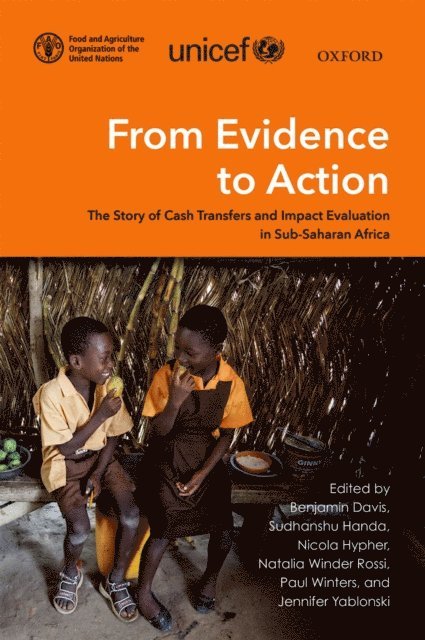
Impact evaluations must be embedded in the ongoing process of policy and programme design in order to be effective in influencing country policy. This is the primary lesson found in this book, which is based on the rigorous impact evaluations and country-case study analysis of government-run cash transfer programmes undertaken in eight Sub-Saharan African countries (Kenya, Ghana, Ethiopia, Zambia, Zimbabwe, Lesotho, Malawi, South Africa) evaluated as part of theTransfer Project and From Protection to Production Project. The impact evaluations employed mixed method approaches, including randomized controls trials (RCTs) and non-experimental designs, qualitative methods and village LEWIE-CGE modelling. Evidence presented in the book counteracts concerns aroundsocial protection creating dependency showing that unconditional cash transfers lead to a broad range of social and productive impacts, even though they are not tied to any specific behaviour.
Inbunden, Engelska, 2016
2 308 kr
Skickas inom 3-6 vardagar
Impact evaluations must be embedded in the ongoing process of policy and programme design in order to be effective in influencing country policy. This is the primary lesson found in this book, which is based on the rigorous impact evaluations and country-case study analysis of government-run cash transfer programmes undertaken in eight Sub-Saharan African countries (Kenya, Ghana, Ethiopia, Zambia, Zimbabwe, Lesotho, Malawi, South Africa) evaluated as part of the Transfer Project and From Protection to Production Project. The impact evaluations employed mixed method approaches, including randomized controls trials (RCTs) and non-experimental designs, qualitative methods and village LEWIE-CGE modelling. Evidence presented in the book counteracts concerns around social protection creating dependency showing that unconditional cash transfers lead to a broad range of social and productive impacts, even though they are not tied to any specific behaviour.