Jens Høyrup – författare
Visar alla böcker från författaren Jens Høyrup. Handla med fri frakt och snabb leverans.
16 produkter
16 produkter
Inbunden, Engelska, 2002
1 893 kr
Skickas inom 10-15 vardagar
In this examination of the Babylonian cuneiform "algebra" texts, based on a detailed investigation of the terminology and discursive organization of the texts, Jens Høyrup proposes that the traditional interpretation must be rejected. The texts turn out to speak not of pure numbers, but of the dimensions and areas of rectangles and other measurable geometrical magnitudes, often serving as representatives of other magnitudes (prices, workdays, etc...), much as pure numbers represent concrete magnitudes in modern applied algebra. Moreover, the geometrical procedures are seen to be reasoned to the same extent as the solutions of modern equation algebra, though not built on any explicit deductive structure.
Häftad, Engelska, 2010
1 838 kr
Skickas inom 10-15 vardagar
In this examination of the Babylonian cuneiform "algebra" texts, based on a detailed investigation of the terminology and discursive organization of the texts, Jens Høyrup proposes that the traditional interpretation must be rejected. The texts turn out to speak not of pure numbers, but of the dimensions and areas of rectangles and other measurable geometrical magnitudes, often serving as representatives of other magnitudes (prices, workdays, etc...), much as pure numbers represent concrete magnitudes in modern applied algebra. Moreover, the geometrical procedures are seen to be reasoned to the same extent as the solutions of modern equation algebra, though not built on any explicit deductive structure.
Inbunden, Engelska, 2019
869 kr
Skickas inom 10-15 vardagar
This book presents a broad selection of articles mainly published during the last two decades on a variety of topics within the history of mathematics, mostly focusing on particular aspects of mathematical practice. This book is of interest to, and provides methodological inspiration for, historians of science or mathematics and students of these disciplines.
Häftad, Engelska, 2020
653 kr
Skickas inom 10-15 vardagar
This book presents a broad selection of articles mainly published during the last two decades on a variety of topics within the history of mathematics, mostly focusing on particular aspects of mathematical practice. This book is of interest to, and provides methodological inspiration for, historians of science or mathematics and students of these disciplines.
Häftad, Engelska, 2024
599 kr
Skickas inom 10-15 vardagar
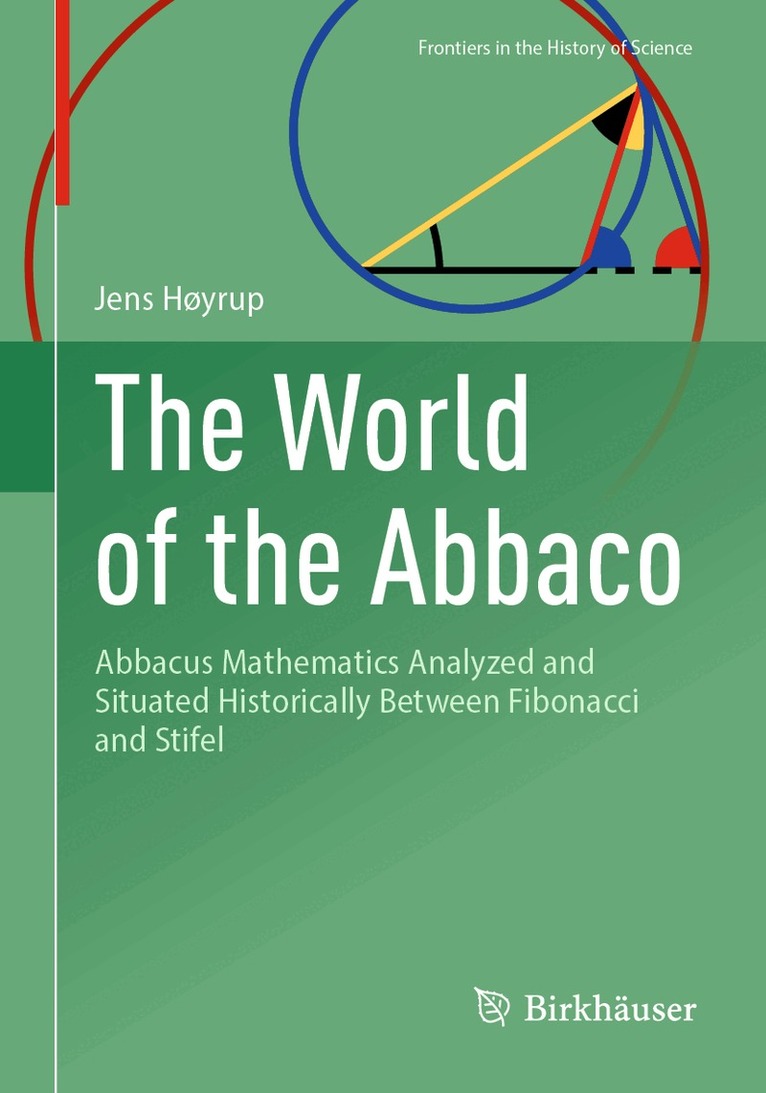
The abbacus was a thorough and complete system of arithmetical calculations, which saw its dawn in the Indian and Arabic tradition of the Middle Ages, but which was developed in its fully fledged aspects especially in Italy, between Genoa, Milan, Venice and the region of Umbria. In this monograph, Høyrup explores how the abbacus tradition has developed in Europe, with a focus on Italy and Germany between the 14th and the 17th Century. With the analysis of texts from Fibonacci, Pacioli, and Stifel to name but a few, this book offers a critical historical analysis of the development and diffusion of a tradition of calculus that has deeply influenced the way in which mathematics has developed in the West. The primary purpose of the book is to present a fairly detailed portrait of the abbacus tradition as it developed historically; as will be argued, Fibonacci was much less important for the emergence of this tradition than mostly assumed – but since his importance isbroadly taken for granted, that argument needs to be made, for which reason Fibonacci’s Liber Abbaci is also described and analyzed in some depth. A secondary purpose is to show how the adoption of abbacus mathematics in German lands gave rise to the creation of a different tradition. The end of the book investigates the interplay of abbacus algebra with other intellectual currents which turned the whole mathematical undertaking upside-down in the 17th Century.
Häftad, Engelska, 2024
546 kr
Skickas inom 10-15 vardagar
This book provides a unique perspective on the history of European algebra up to the advent of Viète and Descartes. The standard version of this history is written on the basis of a narrow and misleading source basis: the Latin translations of al-Khwārizmī, Fibonacci's Liber abbaci, Luca Pacioli's Summa, Cardano's Ars magna—with neither Fibonacci nor Pacioli being read in detail. The existence of the Italian abacus and German cossic algebra is at most taken note of but they are not read, leading to the idea that Viète's and Descartes' use of genuine symbolism (not only abbreviations), many unknowns, and abstract coefficients seem to be miraculous leaps. This book traces the meandering development of all these techniques along with the mostly ignored but very important parenthesis function, by means of detailed readings of all pertinent sources, including the abacus and cossic algebra and French algebra from Chuquet to Gosselin. It argues for a necessary distinction between abbreviating glyphs and genuine symbols serving within a symbolic syntax, which allows it to trace the emergence of symbolic calculation. Characterization of the mathematical practice of the environment within which Viète and Descartes moved allows for an explanation of how these two figures did not even need to invent abstract coefficients but rather received them as a gift.
Inbunden, Engelska, 2024
1 515 kr
Skickas inom 10-15 vardagar
This book is the first of a three-volume set introducing the history of scientific thought (including social and human science). The area covered in this volume is ancient Mesopotamia, classical Antiquity and the Islamic Middle Ages. Combining general descriptions with extensive excerpts from original sources in English translation, it concentrates on ways of thinking and actual argumentation and not just on results and mistakes; questions of validity are primarily dealt with in the perspective of the time of the writing, not on that of the 21st century. The work is of great interest to historians of science and culture, students as well as seasoned workers – but also for amateurs willing to invest the necessary serious efforts.
Häftad, Engelska, 2025
1 515 kr
Skickas inom 10-15 vardagar
This book is the first of a three-volume set introducing the history of scientific thought (including social and human science). The area covered in this volume is ancient Mesopotamia, classical Antiquity and the Islamic Middle Ages. Combining general descriptions with extensive excerpts from original sources in English translation, it concentrates on ways of thinking and actual argumentation and not just on results and mistakes; questions of validity are primarily dealt with in the perspective of the time of the writing, not on that of the 21st century. The work is of great interest to historians of science and culture, students as well as seasoned workers – but also for amateurs willing to invest the necessary serious efforts.
Inbunden, Engelska, 2024
1 515 kr
Skickas inom 10-15 vardagar
This book is the second of a three-volume set introducing the history of scientific thought (including social and human science) and covers the Latin Middle Ages, the Renaissance period, and the 17th century. Combining general descriptions with extensive excerpts from original sources in English translation, it concentrates on ways of thinking and actual argumentation and not just on results and mistakes; questions of validity are primarily dealt with in the perspective of the time of the writing, not on that of the 21st century. The work is of great interest to historians of science and culture, students as well as seasoned workers – but also for amateurs willing to invest the necessary serious efforts.
Häftad, Engelska, 2025
1 515 kr
Skickas inom 10-15 vardagar
This book is the second of a three-volume set introducing the history of scientific thought (including social and human science) and covers the Latin Middle Ages, the Renaissance period, and the 17th century. Combining general descriptions with extensive excerpts from original sources in English translation, it concentrates on ways of thinking and actual argumentation and not just on results and mistakes; questions of validity are primarily dealt with in the perspective of the time of the writing, not on that of the 21st century. The work is of great interest to historians of science and culture, students as well as seasoned workers – but also for amateurs willing to invest the necessary serious efforts.
Inbunden, Engelska, 2024
1 399 kr
Skickas inom 5-8 vardagar
This book is the third of a three-volume set introducing the history of scientific thought (including social and human science). The area covered in this volume is Western Europe during the 18th and 19th centuries. Combining general descriptions with extensive excerpts from original sources in English translation, it concentrates on ways of thinking and actual argumentation and not just on results and mistakes; questions of validity are primarily dealt with in the perspective of the time of the writing, not on that of the 21st century. The work is of great interest to historians of science and culture, students as well as seasoned workers – but also for amateurs willing to invest the necessary serious efforts.
Häftad, Engelska, 2025
1 407 kr
Skickas inom 10-15 vardagar
This book is the third of a three-volume set introducing the history of scientific thought (including social and human science). The area covered in this volume is Western Europe during the 18th and 19th centuries. Combining general descriptions with extensive excerpts from original sources in English translation, it concentrates on ways of thinking and actual argumentation and not just on results and mistakes; questions of validity are primarily dealt with in the perspective of the time of the writing, not on that of the 21st century. The work is of great interest to historians of science and culture, students as well as seasoned workers – but also for amateurs willing to invest the necessary serious efforts.
3 446 kr
Skickas inom 11-20 vardagar
Volume I introduces the history of scientific thought (including social and human science). The area covered in this volume is ancient Mesopotamia, classical Antiquity and the Islamic Middle Ages. Combining general descriptions with extensive excerpts from original sources in English translation, it concentrates on ways of thinking and actual argumentation and not just on results and mistakes; questions of validity are primarily dealt with in the perspective of the time of the writing, not on that of the 21st century. The work is of great interest to historians of science and culture, students as well as seasoned workers – but also for amateurs willing to invest the necessary serious efforts. Volume II introduces the history of scientific thought (including social and human science) and covers the Latin Middle Ages, the Renaissance period, and the 17th century. Combining general descriptions with extensive excerpts from original sources in English translation, it concentrates on ways of thinking and actual argumentation and not just on results and mistakes; questions of validity are primarily dealt with in the perspective of the time of the writing, not on that of the 21st century. The work is of great interest to historians of science and culture, students as well as seasoned workers – but also for amateurs willing to invest the necessary serious efforts. Volume III introduces the history of scientific thought (including social and human science). The area covered in this volume is Western Europe during the 18th and 19th centuries. Combining general descriptions with extensive excerpts from original sources in English translation, it concentrates on ways of thinking and actual argumentation and not just on results and mistakes; questions of validity are primarily dealt with in the perspective of the time of the writing, not on that of the 21st century. The work is of great interest to historians of science and culture, students as well as seasoned workers – but also for amateurs willing to invest the necessary serious efforts.
Häftad, Engelska, 2003
1 299 kr
Skickas inom 10-15 vardagar
Mathematics has for centuries been stimulated, financed and credited by military purposes. Some mathematical thoughts and mathematical technology have also been vital in war. During World War II mathematical work by the Anti-Hitler coalition was part of an aspiration to serve humanity and not help destroy it. At present, it is not an easy task to view the bellicose potentials of mathematics in a proper perspective.The book presents historical evidence and recent changes in the interaction between mathematics and the military. It discusses the new mathematically enhanced development of military technology which seems to have changed the very character of modern warfare.
Del 34 - Science Networks. Historical Studies
Jacopo da Firenze's Tractatus Algorismi and Early Italian Abbacus Culture
Inbunden, Engelska, 2007
1 084 kr
Skickas inom 10-15 vardagar
This book examines a Tractatus algorismi written in 1307 in Montpellier by Jacopo da Firenze. It is one of the earliest surviving "abbacus" treatises and the first to contain a presentation of algebra. This current book includes the text in late medieval Italian with an English translation. The author offers extensive discussions of the contents and its place within early abbacus culture. Historians, mathematicians, and students interested in the history of mathematics will find this text provides a fascinating glimpse into the field’s early development and evolution.
Del 16 - Wiener Offene Orientalistik
Varia Mesopotamica
Mathematical - but not only
Häftad, Engelska, 2025
429 kr
Skickas inom 5-8 vardagar