Jens Schippl - Böcker
Visar alla böcker från författaren Jens Schippl. Handla med fri frakt och snabb leverans.
3 produkter
3 produkter
Energy as a Sociotechnical Problem
An Interdisciplinary Perspective on Control, Change, and Action in Energy Transitions
Häftad, Engelska, 2020
643 kr
Skickas inom 10-15 vardagar
Energy as a Sociotechnical Problem offers an innovative approach to equip interdisciplinary research on sociotechnical transitions with coherence and focus. The book emphasizes sociotechnical problems in three analytical dimensions:- In the control dimension, contributing authors examine how control can be maintained despite increasing complexity and uncertainty, e.g., in power grid operations or on energy markets;- In the change dimension, the authors explore if and how change is possible despite the need for stable orientation, e.g., regarding discourses, real-world labs and learning;- Finally, in the action dimension, the authors analyze how the ability to act on a permanent basis is sustained despite opaqueness and ignorance, exemplified by the work on trust, capabilities or individual motives.Drawing on contributions from engineering, economics, philosophy, political science, psychology and sociology, the book assembles a range of classic and current themes including innovation, resilience, institutional economics, design or education. Energy as a Sociotechnical Problem presents the ongoing transformation of the energy complex as a multidimensional process, in which the analytical dimensions interact with each other in shaping the energy future. As such, this book will be of great interest to students and scholars of energy transitions, energy science and environmental social science more generally, as well as to practitioners working within the field of energy policy.
Energy as a Sociotechnical Problem
An Interdisciplinary Perspective on Control, Change, and Action in Energy Transitions
Inbunden, Engelska, 2018
2 104 kr
Skickas inom 10-15 vardagar
Energy as a Sociotechnical Problem offers an innovative approach to equip interdisciplinary research on sociotechnical transitions with coherence and focus. The book emphasizes sociotechnical problems in three analytical dimensions:- In the control dimension, contributing authors examine how control can be maintained despite increasing complexity and uncertainty, e.g., in power grid operations or on energy markets;- In the change dimension, the authors explore if and how change is possible despite the need for stable orientation, e.g., regarding discourses, real-world labs and learning;- Finally, in the action dimension, the authors analyze how the ability to act on a permanent basis is sustained despite opaqueness and ignorance, exemplified by the work on trust, capabilities or individual motives.Drawing on contributions from engineering, economics, philosophy, political science, psychology and sociology, the book assembles a range of classic and current themes including innovation, resilience, institutional economics, design or education. Energy as a Sociotechnical Problem presents the ongoing transformation of the energy complex as a multidimensional process, in which the analytical dimensions interact with each other in shaping the energy future. As such, this book will be of great interest to students and scholars of energy transitions, energy science and environmental social science more generally, as well as to practitioners working within the field of energy policy.
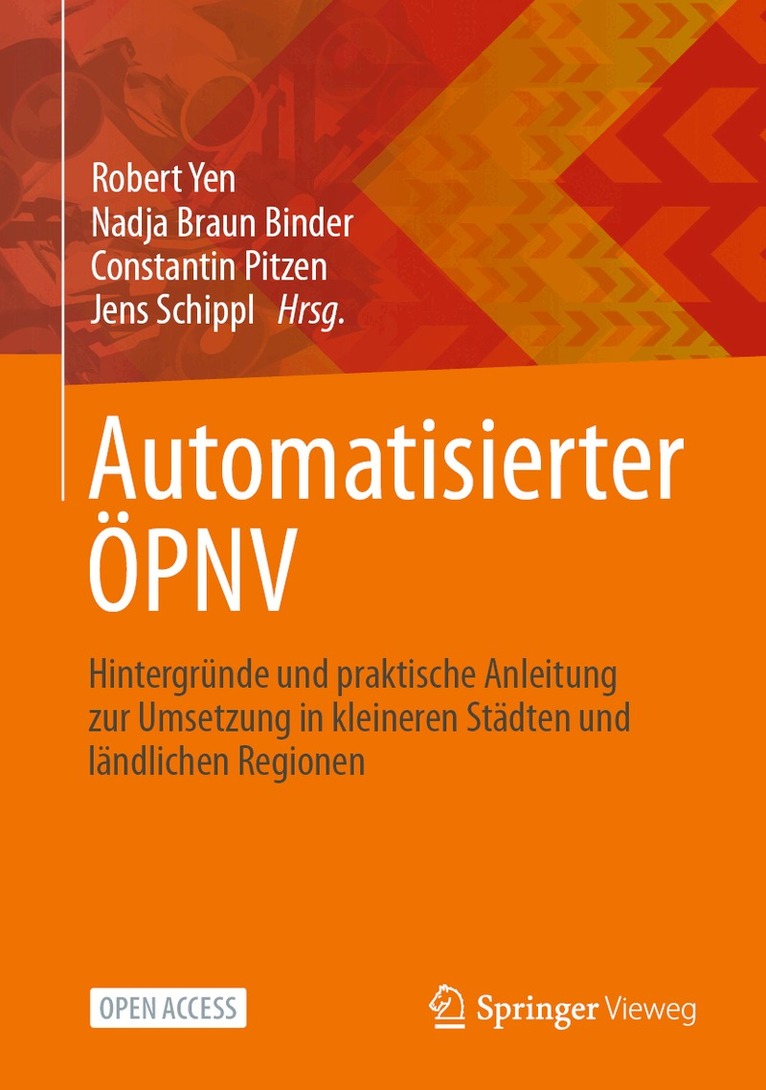
Automatisierter ÖPNV
Hintergründe und praktische Anleitung zur Umsetzung in kleineren Städten und ländlichen Regionen
Inbunden, Tyska, 2023
534 kr
Skickas inom 10-15 vardagar
Dieses Open-Access-Handbuch versteht sich als praktisches Hilfsmittel für den gezielten Einsatz eines automatisierten ÖPNV auf dem Weg zur Mobilitätswende. Es richtet sich in erster Linie an Entscheidungsträger, Verwaltungen kleinerer und größerer Kommunen sowie an Verkehrsbetriebe. Das Handbuch vermittelt der Leserin und dem Leser einen umfassenden Überblick über verschiedene Entwicklungslinien des automatisierten Fahrens sowie über die damit verbundenen Chancen und Risiken für Mobilität und Gesellschaft. Die Autorinnen und Autoren verdeutlichen sehr anschaulich, dass die Chancen des automatisierten Fahrens vor allem in der Ergänzung oder Erweiterung des ÖPNV liegen. Davon ausgehend adressiert das Buch sehr praxisnah und umsetzungsorientiert alle wesentlichen Fragestellungen, die vor dem Start eines Pilotprojekts zur Einführung eines automatisierten ÖPNV bedacht werden sollten. Der Fokus liegt auf den oft unberücksichtigten ländlichen Räumen bzw. jenen Räumen größerer Städte und Regionen, die heute von den Verkehrsbetrieben und -verbünden nicht oder nur sehr unzureichend versorgt werden.Den Herausgebern und der Herausgeberin ist das Anliegen, die Mobilitätswende so gut und rasch als möglich zu schaffen, sowie das Wissen um die herausragende Rolle des ÖPNV als kollektives Verkehrsmittel gemein. Die Autorinnen und Autoren stammen aus der Wissenschaft und aus der täglichen Planungs- und Beratungspraxis. Es ist ihnen in hervorragender Weise gelungen, eine sowohl systemische wie auch sehr lösungsorientierte Sicht auf die oft komplexe Aufgabe der Mobilitätswende zu eröffnen und die Rolle zu beschreiben, die ein automatisierter ÖPNV bei der Mobilitätswende spielen könnte.